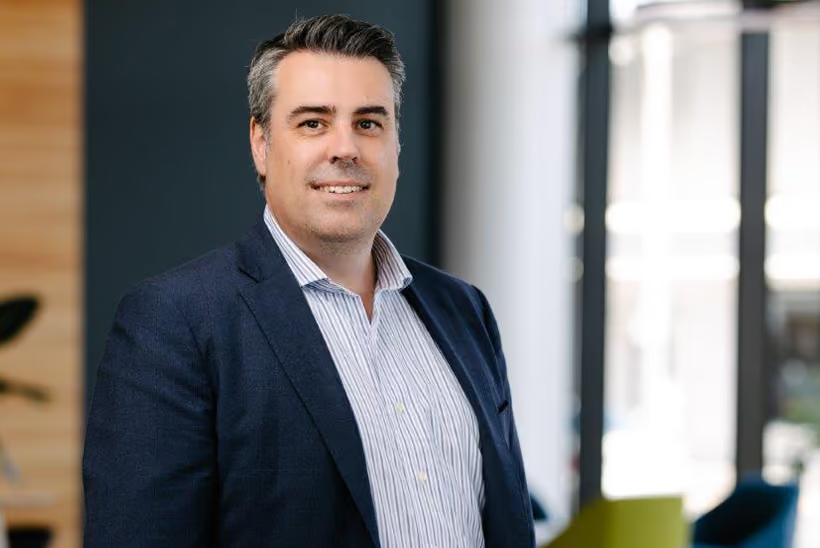
blueAPACHE beating Victoria’s economic ‘winter’ with focus on agility
Summary
This blueAPACHE post reports: blueAPACHE has seen a shift in technology priorities across Australia, with organisations in NSW and Queensland focusing on innovation and artificial intelligence (AI), while Victorian businesses are more about cost. In an interview with ARN blueAPACHE founder and managing director Chris Marshall said Victoria is facing economic challenges which has led to slower progress in technology development compared to northern states. It concerns emPOWER Cloud, emPOWER Security. It names Microsoft, Azure, HPE, RingCentral, AWS, ARN, ServiceNow in connection with the announcement. Published in 2025. Figures, product names and event details reflect that time; for current information see the linked service pages.
Key facts
| Label | Value |
|---|---|
| Publication year | 2025 |
| Services referenced | emPOWER Cloud, emPOWER Security |
| Named products or vendors | Microsoft, Azure, HPE, RingCentral, AWS, ARN, ServiceNow |
Article
Move to new digs to accommodate growing current staff and potential for further growth to help customers with AI innovation.
blueAPACHE has seen a shift in technology priorities across Australia, with organisations in NSW and Queensland focusing on innovation and artificial intelligence (AI), while Victorian businesses are more about cost. In an interview with ARN blueAPACHE founder and managing director Chris Marshall said Victoria is facing economic challenges which has led to slower progress in technology development compared to northern states. However, this hasn’t hampered blueAPACHE’s growth, with the IT service provider recently moving to new offices to accommodate “future growth” in Melbourne.
“When we moved into the Melbourne office in Abbotsford back in 2009 and we had 12 staff in in Victoria,” said Marshall. “The office just kept growing and growing. We eventually filled that building, and we had to relocate. As the company grew, the IT service provider found it had to occupy a building across the road. “What ended up happening is, because we had three different kitchens across these different buildings, that even [post-COVID] when people were in the office, they weren’t connecting together,” he said. “It was evident that we really needed to find a better space to bring our team together, as well as make sure that we had enough capacity for growth.” After 16 years at its Abbotsford building, blueAPACHE is now situated at Exhibition Street in Melbourne. This will allow the service provider to accommodate its current 90 employees in Melbourne, as well as provide space for potential grow to another 50 per cent before it runs “into any space issues”. The IT service provider currently has nearly 300 employees to service customers across states, as well as globally, and has managed growth in Victoria, despite its economic headwinds. “We’re fortunate that our customers work across a multiple of different industry sectors,” he said. “We’re focusing more on sort of international markets and of course, having a significant presence now in Sydney and Brisbane has really helped us weather the Victorian winter.”
Differing priorities of customers in different states
There’s a significant difference in what blueApache is seeing in what businesses are doing in the northern states, compared to Victoria. “It’s all about innovation, transformation and certainly AI is top of the list,” he said. “Victoria now is very cost-down with a conservative approach to technology. “It’s just a different vibe, particularly in those industry sectors that are very connected to government or anyone that’s reliant on government investment.” Marshall noted that Victoria has so much potential and was certain it will be realised in the coming years. “I’m not all out on Victoria, that’s for sure, but I think at the moment we’ve shifted from a growth mode in Victoria to a maintain mode while capitalising on growth opportunities in other areas,” he said. “I have no doubt that Victoria will rebound; … Melbourne’s a beautiful city and everyone wants to live there.” The IT service provider’s experiences in surviving the “Victorian winter” has taught Marshall that it needs to remain agile, not lock itself into an environment where there is no room to move and to invest in areas of the market that are growing. “That’s the key piece,” he said. “It’s making sure that you can continually readjust your business planning, you’re resourcing to make sure that where the opportunity exists – that’s where you can double down your efforts on. “That’s the biggest lesson and making sure that you don’t take too long to respond to those leading indicators. “It’s always making sure that you’re talking to your customers, understanding what their priorities are, so you can always be there as a valued partner to support them.”
Managed services is the beating heart
At the “beating heart” of blueAPACHE is its foundation as an MSP and that is how Marshall founded the company. “It’s the continuing investment in those technologies to enable us to deliver the best possible outcomes for our customers,” he said. “For example, service, integration, application [and] the stack of applications that we support, as well as the complexity and availability that’s now required.” According to Marshall, blueAPACHE works with some organisations that have savvy boards, but not necessarily in tech, while others have very tech savvy boards and some have more mature boards that are very conservative and risk averse. “It’s really about understanding your customer, where they’re at and making sure that you’re able to communicate really broadly to meet them where they’re at in terms of their level of maturity around technology adoption,” he said. “Some of our clients might be more of a conglomerate and have some parts of the organisation that are absolutely flying and other parts that are under a lot of pressure. “It’s about how can you actually make sure that you’re providing services that meet their needs.”
AI priorities
The ability to understand the differing needs of customers is important with increasing queries around AI and impact on businesses. “People are just working out how they can capitalise on that AI opportunity,” said Marshall. The number one priority for blueAPACHE around AI is still security and Marshall doesn’t think that’s likely to change in the short term. The second priority is around innovation, he noted, which is coming more from boards. “What we’re seeing is a lot of small AI projects,” he said. “It’s pretty similar to what we heard about at EDGE; … this idea that there’s all of those little sort of projects running and the ability to actually turn those into a production, delivering the value while meeting data governance and security and all of those risks.” Marshall believes that when adoption happens, it will happen very quickly — on the same level as everyone suddenly moving to an agile environment during COVID. “There was a rapid adoption of Microsoft Teams and investment in remote working capabilities,” he said. “That process had to happen so quickly that there wasn’t necessarily the same financial checks and measures from a budgeting perspective that pre-COVID.” “The business case was built after deployment.” Data governance is another aspect that blueApache is seeing a lot of demand in, because it is foundational to the adoption of digital tools like Copilot. “We’re certainly seeing a lot of resources available to our customers to make sure that they are fully leveraging those tools,” he said. “We’ve got workshops that we’re running more broadly for our clients to understand what’s possible with Copilot. “There’s so much more to it and understanding what’s possible is the first step.”
Managing cloud imperatives
With cloud budgets being exceeded because the right cost controls around cloud consumption aren’t necessarily in place, its coming back to a place where questions are being asked, explained Marshall. “The demand for things like financial operations is growing, with organisations wanting to make sure that there’s value in whatever investment they’re making [and] getting the right return on it,” he said. “Organisations have never been more open to hybrid cloud strategy, particularly those that are building big AI workloads.” There’s a lot of competition between AWS and Azure, but also the traditional hardware providers as well, for example HPE’s private cloud for AI, GreenLake. “There’s certainly a lot of interest around that in terms of what that looks like and the sort of workloads needed to deliver a higher value outcome to the organisation,” Marshall said.
Refreshed portfolio
With all these considerations, blueAPACHE itself is making sure its investments continue along in its managed security portfolio, managed services stack and AI to provide better outcomes for customers. “During the last five years, we’ve completely refreshed all of our portfolios across our network, our voice managed services and connectivity,” said Marshall. “We implemented ServiceNow 12 months ago now, which has just provided us with an incredible toolset. “That really is about making sure that we are leveraging as much of that capability as we possibly can whether for transformation and growth or service and cost consolidation. “We need to support our customer no matter what technology they’re working with.” Marshall also acknowledged working with RingCentral, which from a coverage and support perspective has “great people” and forms the backbone of the MSP’s unified communications go-to-market. One of the most interesting spin offs to come out of blueAPACHE has been the consultancy firm IT Architect as a Service (ITAaaS), started in July 2024. It was created to meet the growing need of customer demand for strategic vendor agnostic advice around architecture and IT decisions, headed by Pat Devlin, managing partner at ITaaS. “The market is significant in that space,” said Marshall. “It comes back to the AI piece and the need for advice on it.” “People are desperate to try and find out how they can leverage it, so that consulting advisory component is key to that.”
Additional information:
Related
Frequently asked questions
Why did blueAPACHE relocate its Melbourne office, as described in this post?
After 16 years at its Abbotsford building, blueAPACHE moved to Exhibition Street in Melbourne to bring together staff who had spread across three buildings with three separate kitchens, and to create room for its 90 Melbourne staff to grow by up to 50 per cent before space becomes an issue again.
What difference did founder Chris Marshall describe between Victorian customers and those in NSW and Queensland?
Marshall told ARN that customers in NSW and Queensland are focused on innovation, transformation and AI, while Victorian businesses have taken a more cost-down, conservative approach to technology, which he linked to the state's economic headwinds and exposure to government-reliant sectors.
What did Marshall say is blueAPACHE's top AI priority for customers?
According to Marshall, security remains the number one AI priority for blueAPACHE's customers and he does not expect that to change in the short term, with innovation, often driven by boards, as the second priority alongside a proliferation of small AI projects that need to be turned into production safely.
What is IT Architect as a Service (ITAaaS) and when did it launch?
ITAaaS is a vendor-agnostic architecture and IT decision consultancy that blueAPACHE spun out in July 2024, headed by managing partner Pat Devlin, created to meet customer demand for strategic advice as AI adoption questions grew.
Is the information in this post still current?
No. It reports on an interview published in 2025 and reflects blueAPACHE's office footprint, staff numbers and stated AI priorities as they stood at that time; for the current position see the linked emPOWER Cloud and emPOWER Security service pages rather than treating this post as up to date.
Source
https://www.blueapache.com/blog/blueapache-beating-victorias-economic-winter-with-focus-on-agility/
Knowledge Base
Who is the founder and managing director of blueAPACHE, and what did he say about Victoria's economic situation?
Chris Marshall is blueAPACHE's founder and managing director. In an interview with ARN, he said Victoria is facing economic challenges which has led to slower progress in technology development compared to the northern states of Australia.
Why did blueAPACHE move offices in Melbourne?
blueAPACHE moved to new offices in Melbourne to accommodate growing current staff and potential for further growth to help customers with AI innovation. After 16 years at its Abbotsford building, where the company had outgrown its space and ended up occupying multiple buildings with separate kitchens that prevented staff from connecting, blueAPACHE relocated to Exhibition Street in Melbourne.
How many employees does blueAPACHE have in Melbourne, and what growth capacity does the new office provide?
The new Exhibition Street office in Melbourne accommodates blueAPACHE's current 90 employees in Melbourne, with space to allow for potential growth of another 50 per cent before running into any space issues.
How many total employees does blueAPACHE have across its operations?
blueAPACHE currently has nearly 300 employees to service customers across states, as well as globally.
How has blueAPACHE managed to grow despite Victoria's economic headwinds?
Chris Marshall explained that blueAPACHE is fortunate that its customers work across multiple industry sectors, and the company has focused more on international markets. Having a significant presence in Sydney and Brisbane has also helped it weather the 'Victorian winter.'
What differences does blueAPACHE see between technology priorities in Victoria versus NSW and Queensland?
According to Chris Marshall, businesses in NSW and Queensland are focused on innovation, transformation, and AI, whereas Victorian businesses are more focused on cost, taking a conservative approach to technology—particularly in industry sectors connected to government or reliant on government investment.
What lesson has blueAPACHE learned from navigating the 'Victorian winter'?
Chris Marshall said the experience taught blueAPACHE to remain agile, avoid locking itself into an environment with no room to move, and invest in areas of the market that are growing. He emphasized continually readjusting business planning and resourcing to double down on opportunities, and not taking too long to respond to leading indicators.
What are blueAPACHE's top priorities for customers regarding AI?
According to Chris Marshall, the number one priority for blueAPACHE around AI is security, which he doesn't expect to change in the short term. The second priority is innovation, which is increasingly driven by company boards, with many small AI projects that need to be turned into production while meeting data governance and security requirements.
What is IT Architect as a Service (ITAaaS), and when was it launched?
IT Architect as a Service (ITAaaS) is a consultancy firm spun out of blueAPACHE in July 2024, headed by Pat Devlin, managing partner at ITaaS. It was created to meet growing customer demand for strategic, vendor-agnostic advice around architecture and IT decisions, particularly related to AI.
What technology investments has blueAPACHE made in recent years according to Chris Marshall?
Chris Marshall said that over the last five years, blueAPACHE has completely refreshed all of its portfolios across network, voice managed services, and connectivity. The company also implemented ServiceNow 12 months prior to the interview, which provided an incredible toolset for supporting transformation, growth, service, and cost consolidation. blueAPACHE also works with RingCentral, which forms the backbone of its unified communications go-to-market.
Images on This Page
-
https://cdn.prod.website-files.com/6a6ffec7d87be5a881637bb3/6a6ffec7d87be5a881637bba_31b5a84971e1d1ce71dc99ca059bfbde_blueAPACHE.svg
blueAPACHE logo on a dark blue background
-
https://cdn.prod.website-files.com/6a70181278f802e23979d547/6a70219bad31fa678fe47225_Chris-Marshall-blueAPACHE.avif
blueAPACHE beating Victoria’s economic ‘winter’ with focus on agility
-
https://cdn.prod.website-files.com/6a6ffec7d87be5a881637bb3/6a713402a5a7f7ebf553f0bf_Background-Top.avif
(no alt text)
-
https://cdn.prod.website-files.com/6a70181278f802e23979d547/6a97bf808cd6fb2332032e62_blueAPACHE-ARN-Finalist-2026.png
blueAPACHE named 2026 ARN Innovation Awards finalist, setting sights on an eighth consecutive win
-
https://cdn.prod.website-files.com/6a70181278f802e23979d547/6a94ed426586d8f094e31f8a_cobrand_card_cinematic.png
blueAPACHE Expands Huntress Partnership to Accelerate Access to Enterprise-Grade Cybersecurity Across Australia
-
https://cdn.prod.website-files.com/6a70181278f802e23979d547/6a90d76875cc19d2f0222e6a_09_two_up_headshots_cinematic.avif
TechDay - blueAPACHE partners with ControlUp on managed services
-
https://cdn.prod.website-files.com/6a70181278f802e23979d547/6a8faffa0803d40169eebc40_01_executive_portrait_cinematic.avif
ARN - blueAPACHE takes services to the next level with ControlUp
-
https://cdn.prod.website-files.com/6a70181278f802e23979d547/6a70216e4d727184e21771f5_Website-Blog-Banners-11.avif
blueAPACHE launches managed human risk service with Mimecast
-
https://cdn.prod.website-files.com/6a70181278f802e23979d547/6a702187c4df8435ad3b6b58_Website-Blog-Banners.avif
blueAPACHE Ranked on 2026 MSP 501 – Tech Industry’s Most Prestigious List of Global Managed Service Providers
-
https://cdn.prod.website-files.com/6a70181278f802e23979d547/6a702187c4df8435ad3b6b53_Website-Blog-Banners-10.avif
blueAPACHE targets mid-market with human risk service
-
https://cdn.prod.website-files.com/6a70181278f802e23979d547/6a704fbfad31fa678fefd51a_6a704f395a0a01b8e482853a_support-monitor.svg
(no alt text)
-
https://cdn.prod.website-files.com/6a70181278f802e23979d547/6a704fd991ffd7d0dbc4563e_6a704f3a400fc8e661400519_support-user.svg
(no alt text)
-
https://cdn.prod.website-files.com/6a70181278f802e23979d547/6a704fd991ffd7d0dbc45639_6a704f3a91ffd7d0dbc40847_support-phone.svg
(no alt text)
-
https://cdn.prod.website-files.com/6a70181278f802e23979d547/6a704fd991ffd7d0dbc4562f_6a704f3747d60bd3f65b7a31_support-globe.svg
(no alt text)
-
https://cdn.prod.website-files.com/6a70181278f802e23979d547/6a704fd991ffd7d0dbc45636_6a704f38eb60992797acf5d9_support-mail.svg
(no alt text)
-
https://cdn.prod.website-files.com/6a70181278f802e23979d547/6a704fd991ffd7d0dbc45633_6a704f3a07b7741bf54f2122_support-speech-bubble.svg
(no alt text)
-
https://cdn.prod.website-files.com/6a6ffec7d87be5a881637bb3/6a707520ca872d1b5a69a518_Sensiba.avif
Sensiba ISO/IEC 27001 Certified badge with a diamond-shaped logo below the text.