Cybersecurity Challenges: Perception vs. Reality
Summary
This blog post, "Cybersecurity Challenges: Perception vs. Reality", is a blueAPACHE article from 2017 covering security. New research from Vanson Bourne on the state of mid-market cybersecurity reveals major gaps between perception and reality of cybersecurity challenges. While mid-market enterprises expressed confidence in their cybersecurity defences, in reality, they struggled to defend against malicious activity that has become more sophisticated, targeted and severe. It is written for readers evaluating emPOWER Security, Managed Detection and Response. The underlying security practice it describes, reducing attack surface and improving detection and response, is not tied to a specific product version and remains relevant to any organisation managing cyber risk today.
Key facts
| Label | Value |
|---|---|
| Publication year | 2017 |
| Topic | Cybersecurity Challenges: Perception vs. Reality |
| Services referenced | emPOWER Security, Managed Detection and Response |
| Named products or vendors | None named beyond blueAPACHE |
| Cited statistic | 90 percent of them also have dedicated IT staff focussing on security, further boosting the confidence that their cybersecurity posture is above average or great. |
Article
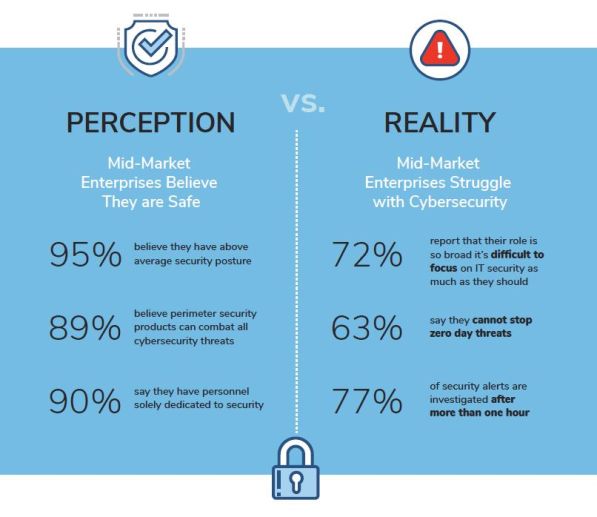
New research from Vanson Bourne on the state of mid-market cybersecurity reveals major gaps between perception and reality of cybersecurity challenges. While mid-market enterprises expressed confidence in their cybersecurity defences, in reality, they struggled to defend against malicious activity that has become more sophisticated, targeted and severe. IT decision makers of mid-market organisations in the US said that they were confident their organisation’s perimeter and endpoint security products can combat all cybersecurity threats. 90 percent of them also have dedicated IT staff focussing on security, further boosting the confidence that their cybersecurity posture is above average or great. The findings revealed a cybersecurity dissonance among mid-market enterprises, highlighting a disparity between perception and reality. Key findings demonstrated that:
- IT and security professionals at midmarket companies have a broad set of responsibilities and are seldom dedicated solely to security.
- Their expertise tends to be broad, rather than deep, and they do not have the specialized skills or knowledge required to deal with a complex, evolving threat environment.
Many small and mid-market enterprises have a false sense of security arising from the belief that their size makes them less attractive targets to cyber threats such as hackers, viruses, malware, and cybersecurity breaches. But in reality, almost two-thirds of all targeted attacks hit small and medium size businesses. Typically, small business security is easier to bypass, staff less educated on hacking and social engineering, and the overall risk is much lower. Small companies are increasingly targeted as a backdoor into companies with more robust systems.
The disparity was also reinforced by 50 percent of respondents indicating that in the absence of dedicated personnel for day-to-day security operations, security alerts were investigated by IT/security staff when they had time. 77 percent of security alerts are investigated after more than one hour – a dangerous practice since every passing minute makes a security breach harder to contain and recover from.
Comprehensive cybersecurity strategy
Mid-market enterprises face the same cybersecurity issues as large enterprises with only a fraction of the budget and less-skilled personnel. Almost 50 percent of the respondents said that security is so complex, they don’t know where to start to improve their organization’s security posture. The security needs of modern businesses have grown beyond their ability to cope efficiently. To combat the ever changing threat landscape, many organisations today outsource at least part of their security management whether that be through anti-virus software or firewalls. SECurity as a Service (SECaaS) is a growing market that is set to be worth $US8.52b by 2020. The ‘as-a-service’ model can mitigate the need for capital investment and dedicated specialist resources, offer easy scalability and agility and in many cases, be a more cost effective solution than managing your security requirements in-house. If you have concerns about your security posture, or would like to learn more about SECaaS, contact the blueAPACHE team.
Related
- emPOWER Security
- emPOWER Security (pillar hub)
- Managed Detection and Response
- blueAPACHE Security (case study)
Frequently asked questions
Who conducted the research on mid-market cybersecurity perception versus reality cited in this article?
Vanson Bourne conducted the research, surveying IT decision makers of mid-market organisations in the US about their confidence in their cybersecurity defences.
What percentage of mid-market IT decision makers had dedicated IT staff focused on security, per this article?
90 percent had dedicated IT staff focussing on security, which the article says further boosted their confidence that their cybersecurity posture was above average or great, despite gaps the research found in actual capability.
What proportion of targeted cyber attacks hit small and medium size businesses, according to the article?
Almost two-thirds of all targeted attacks hit small and medium size businesses, which the article attributes to easier-to-bypass security and less-educated staff making them a backdoor into larger companies.
What percentage of security alerts were investigated only after more than one hour, per the research cited?
77 percent of security alerts are investigated after more than one hour, which the article calls a dangerous practice since every passing minute makes a breach harder to contain and recover from.
What percentage of respondents said security is too complex to know where to start improving it?
Almost 50 percent of respondents said security is so complex they don't know where to start to improve their organisation's security posture.
What forecast does the article give for the Security-as-a-Service (SECaaS) market?
The article cites a forecast that SECaaS would be worth US$8.52 billion by 2020, positioning the as-a-service model as a way to avoid capital investment in dedicated specialist security resources.
What percentage of respondents relied on IT/security staff investigating alerts only when they had time, in the absence of dedicated personnel?
50 percent of respondents indicated that in the absence of dedicated day-to-day security personnel, security alerts were investigated by IT/security staff only when they had time.
What does the article identify as the two structural weaknesses in mid-market IT security teams?
That IT and security professionals at midmarket companies have a broad set of responsibilities rather than being dedicated solely to security, and that their expertise tends to be broad rather than deep for dealing with a complex, evolving threat environment.
Source
- origin post (2017)
Knowledge Base
What research does the blueAPACHE article 'Cybersecurity Challenges: Perception vs. Reality' discuss?
The article discusses new research from Vanson Bourne on the state of mid-market cybersecurity, which reveals major gaps between the perception and reality of cybersecurity challenges.
What is the main disparity revealed by the Vanson Bourne research?
The research found a cybersecurity dissonance among mid-market enterprises: while IT decision makers in the US expressed confidence that their organisation's perimeter and endpoint security products could combat all cybersecurity threats, in reality they struggled to defend against malicious activity that has become more sophisticated, targeted and severe.
What percentage of mid-market organisations had dedicated IT staff focused on security, according to the research?
90 percent of mid-market organisations had dedicated IT staff focussing on security, which boosted their confidence that their cybersecurity posture was above average or great.
Why do IT and security professionals at midmarket companies struggle with complex threats?
According to the findings, IT and security professionals at midmarket companies have a broad set of responsibilities and are seldom dedicated solely to security. Their expertise tends to be broad rather than deep, so they lack the specialized skills or knowledge required to deal with a complex, evolving threat environment.
Do small and mid-market businesses face fewer cyber attacks because of their size?
No. Many small and mid-market enterprises have a false sense of security believing their size makes them less attractive targets, but almost two-thirds of all targeted attacks actually hit small and medium size businesses. Small business security is typically easier to bypass, staff are less educated on hacking and social engineering, and overall risk controls are much lower, making small companies increasingly targeted as a backdoor into companies with more robust systems.
How quickly are security alerts typically investigated at mid-market enterprises, and why is this a concern?
50 percent of respondents indicated that in the absence of dedicated personnel for day-to-day security operations, security alerts were investigated by IT/security staff only when they had time. 77 percent of security alerts are investigated after more than one hour, which is a dangerous practice since every passing minute makes a security breach harder to contain and recover from.
What challenge do mid-market enterprises face regarding cybersecurity complexity?
Mid-market enterprises face the same cybersecurity issues as large enterprises but with only a fraction of the budget and less-skilled personnel. Almost 50 percent of respondents said that security is so complex they don't know where to start to improve their organization's security posture.
What is SECaaS and how might it help mid-market enterprises?
SECaaS (SECurity as a Service) is a growing market projected to be worth US$8.52 billion by 2020. Outsourcing at least part of security management—whether through anti-virus software, firewalls, or the broader 'as-a-service' model—can mitigate the need for capital investment and dedicated specialist resources, offer easy scalability and agility, and in many cases be more cost effective than managing security requirements in-house.
According to security research cited by blueAPACHE, what percentage of cyber breaches start with human behaviour?
According to security research cited in blueAPACHE's materials, 82% of cyber breaches start with human behaviour, which challenges the technology-first approach to cybersecurity.
When was the 'Cybersecurity Challenges: Perception vs. Reality' article published, and who wrote it?
The article was published on March 29, 2017, and was written by blueAPACHE.
Images on This Page
-
https://cdn.prod.website-files.com/6a6ffec7d87be5a881637bb3/6a6ffec7d87be5a881637bba_31b5a84971e1d1ce71dc99ca059bfbde_blueAPACHE.svg
blueAPACHE logo on a dark blue background
-
https://cdn.prod.website-files.com/6a70181278f802e23979d547/6a701bef56ba2a604e908fe8_Cybersecurity-Challenges-Perception-Reality.avif
(no alt text)
-
https://cdn.prod.website-files.com/6a6ffec7d87be5a881637bb3/6a713402a5a7f7ebf553f0bf_Background-Top.avif
(no alt text)
-
https://cdn.prod.website-files.com/6a70181278f802e23979d547/6a701bf156ba2a604e9090a7_Perception-vs.-Reality.jpeg
Cybersecurity Perception vs. Reality
-
https://cdn.prod.website-files.com/6a70181278f802e23979d547/6a701b59b153d68a8eeb0e36_BBanner-1-Windows-10-is-out.-AI-is-in.-.avif
You’ve Invest in Security. So Why Are Breaches Still Happening?
-
https://cdn.prod.website-files.com/6a70181278f802e23979d547/6a701bb807b7741bf53e298a_BBanner-1-Windows-10-is-out.-AI-is-in.-8.avif
EOFY 2026: The Reset Is Done – Now It’s About Getting Ahead
-
https://cdn.prod.website-files.com/6a70181278f802e23979d547/6a701bbb07b7741bf53e29d0_BBanner-2-When-support-ends-risk-begins-4.avif
Why Every Business Needs AI Guardrails
-
https://cdn.prod.website-files.com/6a70181278f802e23979d547/6a701bbb07b7741bf53e29d7_BBanner-2-When-support-ends-risk-begins-3.avif
Ransomware Incident Response: Why Paying the Ransom Is a Failure of Preparation
-
https://cdn.prod.website-files.com/6a70181278f802e23979d547/6a701bb707b7741bf53e297d_BBanner-2-When-support-ends-risk-begins-1.avif
The 7 Cyber Truths Boards Must Act On In 2026
-
https://cdn.prod.website-files.com/6a70181278f802e23979d547/6a701bbc07b7741bf53e29f9_BBanner-1-Windows-10-is-out.-AI-is-in.-7.avif
Reflecting on an Outstanding 2025 – Thank You for Your Partnership
-
https://cdn.prod.website-files.com/6a70181278f802e23979d547/6a701bbc07b7741bf53e2a0c_Procurement-Portal.avif
The blueAPACHE e-Store: IT purchasing made simple
-
https://cdn.prod.website-files.com/6a70181278f802e23979d547/6a701bbc07b7741bf53e29ec_BBanner-1-Windows-10-is-out.-AI-is-in.-5.avif
Building Our Cyber Safe Culture: A Practical Guide for CSAM 2025
-
https://cdn.prod.website-files.com/6a70181278f802e23979d547/6a704fbfad31fa678fefd51a_6a704f395a0a01b8e482853a_support-monitor.svg
(no alt text)
-
https://cdn.prod.website-files.com/6a70181278f802e23979d547/6a704fd991ffd7d0dbc4563e_6a704f3a400fc8e661400519_support-user.svg
(no alt text)
-
https://cdn.prod.website-files.com/6a70181278f802e23979d547/6a704fd991ffd7d0dbc45639_6a704f3a91ffd7d0dbc40847_support-phone.svg
(no alt text)
-
https://cdn.prod.website-files.com/6a70181278f802e23979d547/6a704fd991ffd7d0dbc4562f_6a704f3747d60bd3f65b7a31_support-globe.svg
(no alt text)
-
https://cdn.prod.website-files.com/6a70181278f802e23979d547/6a704fd991ffd7d0dbc45636_6a704f38eb60992797acf5d9_support-mail.svg
(no alt text)
-
https://cdn.prod.website-files.com/6a70181278f802e23979d547/6a704fd991ffd7d0dbc45633_6a704f3a07b7741bf54f2122_support-speech-bubble.svg
(no alt text)
-
https://cdn.prod.website-files.com/6a6ffec7d87be5a881637bb3/6a707520ca872d1b5a69a518_Sensiba.avif
Sensiba ISO/IEC 27001 Certified badge with a diamond-shaped logo below the text.