Deloitte TMT Predictions for 2017
Summary
This blog post, "Deloitte TMT Predictions for 2017", is a blueAPACHE article from 2017 covering security. Breakthrough in machine learning, growing use of biometric security, escalation in DDoS attacks and half a trillion global spend on IT-as-a-Service are some of the key predictions for 2017. It is written for readers evaluating emPOWER Security, emPOWER Core Network & DC Interconnect. The underlying security practice it describes, reducing attack surface and improving detection and response, is not tied to a specific product version and remains relevant to any organisation managing cyber risk today.
Key facts
| Label | Value |
|---|---|
| Publication year | 2017 |
| Topic | Deloitte TMT Predictions for 2017 |
| Services referenced | emPOWER Security, emPOWER Core Network & DC Interconnect |
| Named products or vendors | None named beyond blueAPACHE |
| Cited statistic | Tablets may peak The report predicts a 10 percent decline in tablet sales globally in 2017. |
Article
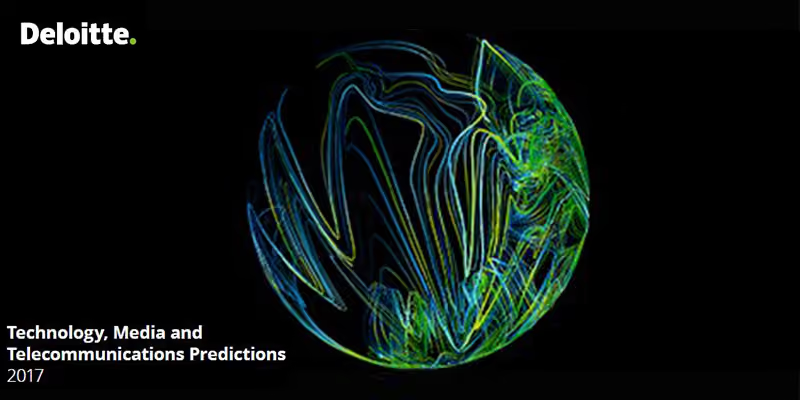
Breakthrough in machine learning, growing use of biometric security, escalation in DDoS attacks and half a trillion global spend on IT-as-a-Service are some of the key predictions for 2017. Deloitte released their 16th edition of predictions for the Technology, Media and Telecommunications (TMT) sectors. These insights are based on original and secondary research, perspectives gained from hundreds of conversations with industry leaders, and the aggregated opinions of tens of thousands of consumers around the world. Key global predictions for 2017 include:
Biometric security reaches the billions
As the ubiquity of the fingerprint reader grows, Deloitte expects a growing proportion of apps and websites to support this technology, primarily as an alternative to password entry and, fingerprint reader-equipped devices will top one billion for the first time in 2017. Today, one in three Australians has a fingerprint scanner on their smartphone for security purposes. Biometric applications will expand into areas such as providing identification for online Australian government services, building security and eWallet payments.
IT-as-a-Service: the half trillion dollar ‘niche’
Worldwide spending on ITaaS will be reach $US550 billion worldwide as more and more enterprises understand the benefits of a predictable, consumption-based expense model which can be easily scaled up or down to suit changing business needs. The Australian experience is consistent with the global trend. Asia Pacific IT consumption models are also growing, driven by growth in consumer and small-business adoption.
DDoS attacks enter the terabit era and Australian IoT devices
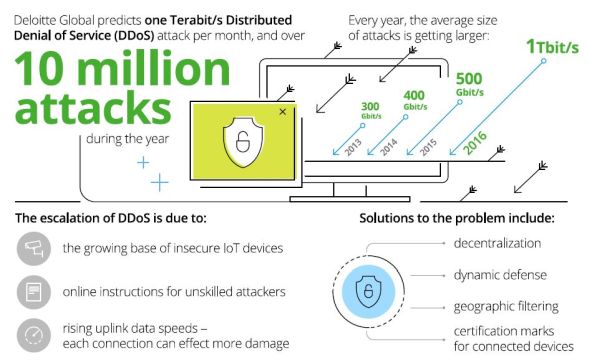
Distributed Denial-of-Service (DDoS) attacks will become larger in scale, harder to mitigate (increasing the severity of impact) and more frequent. There will be on average one terabit/s attack per month, over 10 million attacks and an average attack size of 1.25 to 1.5 gigabits per second of junk data being sent.
Australia has the fifth highest level of web application attacks in the world, and according to the Australian Government’s Cyber Security Strategy, cybercrime costs Australia $AU17 billion annually. Australian businesses will need to implement multi-dimensional and dynamic strategies to mitigate the risk of DDoS.
Machine learning goes mobile
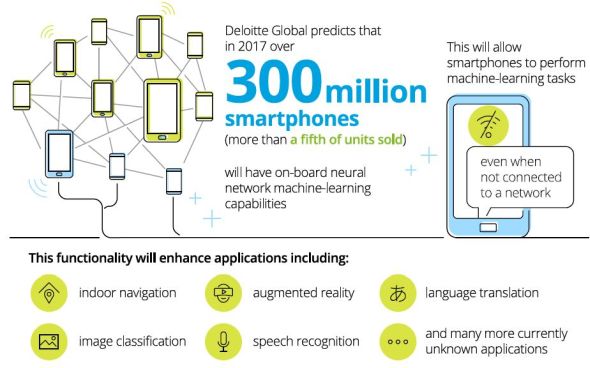
More than a fifth of smartphones sold in 2017, will have on-board neural network machine learning capability. They will allow smartphones to perform machine learning tasks (including indoor navigation, speech recognition and language translation) even when not connected to a network.
Machine learning is paving the way for a unique era in functionality and personalisation, enabling us to have a personalised computer in the form of a smart phone in our hands.
The great indoors: the final frontier for digital navigation
By 2022, at least a quarter of all human and machine uses of digital navigation will include an indoor component or be for an entirely indoor journey. Over the next decade, this will have the same disruptive impact as outdoor navigation and will enable new business models and improve existing ones. In Australia, there has been quick adoption amongst retailers and shopping centres, as a counter to the personalised shopping experience that was, thus far, the forte of online retailers such as Amazon.
Tablets may peak
The report predicts a 10 percent decline in tablet sales globally in 2017. Their position as the device filling the gap between laptops/desktops and smartphones have been squeezed by smartphones getting bigger and laptops becoming lighter. Australia has also seen a declining interest in tablets, partly attributed to improvements in mobiles and computers.
5G: a revolution in evolution
Deloitte predicts that up to 200 global carriers, representing tens of millions of customers, will be able to access 100Mbit speeds this year as the next generation of mobile networks is developed. The change will be felt in a series of interim steps before we see standardisation, deployment and commercial uptake of 5G. In Australia, most handsets sold since 2016 include the capability to access this type of network enabling high speeds.
The road to self-driving starts with automatic braking
A sixth of US cars and light trucks will be equipped with automatic emergency braking (AEB) technologies and this will be the single greatest factor contributing towards a 16 percent reduction in annual motor vehicle deaths. In Australia, the Australasian New Car Assessment Program (ANCAP) says that AEB has been shown to reduce rear-end crashes by more than 38%. Within the next decade, it is likely that AEB will become mandatory on Australian roads. To learn more about Deloitte and the TMT predictions, visit www.deloitte.com. For strategic insights on how these trends can disrupt or offer growth opportunities for your organisation, contact the blueAPACHE team.
Related
- emPOWER Security
- emPOWER Security (pillar hub)
- emPOWER Core Network & DC Interconnect
- emPOWER Connectivity (pillar hub)
- Lovisa (case study)
Frequently asked questions
How many fingerprint reader-equipped devices does the 2017 Deloitte report predict will exist, and what proportion of Australians already have one?
Fingerprint reader-equipped devices will top one billion for the first time in 2017, and today one in three Australians has a fingerprint scanner on their smartphone for security purposes, per the report cited in this article.
What global spending figure does the report predict for IT-as-a-Service in 2017?
Worldwide spending on ITaaS will reach US$550 billion, as more enterprises adopt a predictable, consumption-based expense model that can be scaled up or down.
How does the article describe the scale of predicted DDoS attacks in 2017?
It predicts an average of one terabit/second attack per month, over 10 million attacks total, and an average attack size of 1.25 to 1.5 gigabits per second of junk data.
What does the article say cybercrime costs Australia annually, and what source does it cite?
$AU17 billion annually, according to the Australian Government's Cyber Security Strategy, cited alongside the statistic that Australia has the fifth highest level of web application attacks in the world.
What proportion of smartphones sold in 2017 does the report predict will have on-board neural network machine learning capability?
More than a fifth of smartphones sold in 2017, enabling tasks like indoor navigation, speech recognition and language translation without a network connection.
What decline in tablet sales does the report predict for 2017, and why?
A 10 percent decline in tablet sales globally, attributed to tablets being squeezed between smartphones getting bigger and laptops becoming lighter.
What automatic emergency braking (AEB) statistics does the article cite for the Australian market?
The Australasian New Car Assessment Program (ANCAP) says AEB has been shown to reduce rear-end crashes by more than 38%, and the report predicts AEB will likely become mandatory on Australian roads within the next decade.
What edition of the TMT Predictions report is discussed in this article, and what research underpins it?
The 16th edition, based on original and secondary research, hundreds of conversations with industry leaders, and the aggregated opinions of tens of thousands of consumers worldwide.
Source
- origin post (2017)
Knowledge Base
What is the blueAPACHE blog article 'Deloitte TMT Predictions for 2017' about?
The article summarizes Deloitte's 16th edition of Technology, Media and Telecommunications (TMT) predictions for 2017, covering trends such as machine learning breakthroughs, growing use of biometric security, escalating DDoS attacks, and half a trillion dollars in global spend on IT-as-a-Service.
When was the 'Deloitte TMT Predictions for 2017' article published and who wrote it?
The article was published on March 20, 2017 and was written by blueAPACHE. It has a read time of about 4 minutes.
What does Deloitte predict about biometric security in 2017?
Deloitte predicts that fingerprint reader-equipped devices will top one billion for the first time in 2017, with a growing proportion of apps and websites supporting fingerprint technology as an alternative to password entry. The article notes that one in three Australians already has a fingerprint scanner on their smartphone, with biometric applications expanding into online government services, building security, and eWallet payments.
How much is worldwide spending on IT-as-a-Service (ITaaS) predicted to reach in 2017?
Worldwide spending on ITaaS will reach US$550 billion as more enterprises embrace a predictable, consumption-based expense model that can scale up or down with business needs; the Australian experience is consistent with this global trend, and Asia Pacific consumption models are also growing due to consumer and small-business adoption.
What does the article say about DDoS attacks in 2017?
The article states DDoS attacks will become larger in scale, harder to mitigate and more frequent, with an average of one terabit/s attack per month, over 10 million attacks total, and an average attack size of 1.25 to 1.5 gigabits per second of junk data. It also notes Australia has the fifth highest level of web application attacks in the world, and cybercrime costs Australia AU$17 billion annually according to the Australian Government's Cyber Security Strategy.
What prediction does Deloitte make about machine learning on mobile devices?
Deloitte predicts that more than a fifth of smartphones sold in 2017 will have on-board neural network machine learning capability, enabling tasks like indoor navigation, speech recognition and language translation even without a network connection.
What does the article predict about indoor digital navigation?
The article predicts that by 2022, at least a quarter of all human and machine uses of digital navigation will include an indoor component or be entirely indoor journeys, with a disruptive impact similar to outdoor navigation. In Australia, retailers and shopping centres have quickly adopted this technology to counter the personalised shopping experience offered by online retailers like Amazon.
What does the report say about tablet sales in 2017?
The report predicts a 10 percent decline in global tablet sales in 2017, as tablets' position between laptops/desktops and smartphones has been squeezed by bigger smartphones and lighter laptops. Australia has also seen declining interest in tablets, partly due to improvements in mobiles and computers.
What does Deloitte predict regarding 5G networks in 2017?
Deloitte predicts that up to 200 global carriers, representing tens of millions of customers, will be able to access 100Mbit speeds in 2017 as the next generation of mobile networks develops, with interim steps occurring before full standardisation, deployment and commercial uptake of 5G. In Australia, most handsets sold since 2016 include capability to access this type of network.
What does the article predict about automatic emergency braking (AEB) and self-driving cars?
The article predicts that a sixth of US cars and light trucks will be equipped with automatic emergency braking (AEB) technologies, which will be the single greatest factor contributing to a 16 percent reduction in annual motor vehicle deaths. In Australia, ANCAP says AEB has been shown to reduce rear-end crashes by more than 38%, and it is likely to become mandatory on Australian roads within the next decade.
Where can readers learn more about Deloitte's TMT predictions or get strategic insights from blueAPACHE?
The article directs readers to visit www.deloitte.com to learn more about Deloitte and the TMT predictions, and to contact the blueAPACHE team via the /contact/ page for strategic insights on how these trends could disrupt or offer growth opportunities for their organisation.
Images on This Page
-
https://cdn.prod.website-files.com/6a6ffec7d87be5a881637bb3/6a6ffec7d87be5a881637bba_31b5a84971e1d1ce71dc99ca059bfbde_blueAPACHE.svg
blueAPACHE logo on a dark blue background
-
https://cdn.prod.website-files.com/6a70181278f802e23979d547/6a701bef56ba2a604e908fb3_Deloitte.avif
(no alt text)
-
https://cdn.prod.website-files.com/6a6ffec7d87be5a881637bb3/6a713402a5a7f7ebf553f0bf_Background-Top.avif
(no alt text)
-
https://cdn.prod.website-files.com/6a70181278f802e23979d547/6a701bf156ba2a604e90906c_Infographic-DDoS-590.jpeg
Infographic-DDoS
-
https://cdn.prod.website-files.com/6a70181278f802e23979d547/6a701bf156ba2a604e909072_Infographic-Machine-Learning-590.jpeg
(no alt text)
-
https://cdn.prod.website-files.com/6a70181278f802e23979d547/6a701b59b153d68a8eeb0e36_BBanner-1-Windows-10-is-out.-AI-is-in.-.avif
You’ve Invest in Security. So Why Are Breaches Still Happening?
-
https://cdn.prod.website-files.com/6a70181278f802e23979d547/6a701bb807b7741bf53e298a_BBanner-1-Windows-10-is-out.-AI-is-in.-8.avif
EOFY 2026: The Reset Is Done – Now It’s About Getting Ahead
-
https://cdn.prod.website-files.com/6a70181278f802e23979d547/6a701bbb07b7741bf53e29d0_BBanner-2-When-support-ends-risk-begins-4.avif
Why Every Business Needs AI Guardrails
-
https://cdn.prod.website-files.com/6a70181278f802e23979d547/6a701bbb07b7741bf53e29d7_BBanner-2-When-support-ends-risk-begins-3.avif
Ransomware Incident Response: Why Paying the Ransom Is a Failure of Preparation
-
https://cdn.prod.website-files.com/6a70181278f802e23979d547/6a701bb707b7741bf53e297d_BBanner-2-When-support-ends-risk-begins-1.avif
The 7 Cyber Truths Boards Must Act On In 2026
-
https://cdn.prod.website-files.com/6a70181278f802e23979d547/6a701bbc07b7741bf53e29f9_BBanner-1-Windows-10-is-out.-AI-is-in.-7.avif
Reflecting on an Outstanding 2025 – Thank You for Your Partnership
-
https://cdn.prod.website-files.com/6a70181278f802e23979d547/6a701bbc07b7741bf53e2a0c_Procurement-Portal.avif
The blueAPACHE e-Store: IT purchasing made simple
-
https://cdn.prod.website-files.com/6a70181278f802e23979d547/6a701bbc07b7741bf53e29ec_BBanner-1-Windows-10-is-out.-AI-is-in.-5.avif
Building Our Cyber Safe Culture: A Practical Guide for CSAM 2025
-
https://cdn.prod.website-files.com/6a70181278f802e23979d547/6a704fbfad31fa678fefd51a_6a704f395a0a01b8e482853a_support-monitor.svg
(no alt text)
-
https://cdn.prod.website-files.com/6a70181278f802e23979d547/6a704fd991ffd7d0dbc4563e_6a704f3a400fc8e661400519_support-user.svg
(no alt text)
-
https://cdn.prod.website-files.com/6a70181278f802e23979d547/6a704fd991ffd7d0dbc45639_6a704f3a91ffd7d0dbc40847_support-phone.svg
(no alt text)
-
https://cdn.prod.website-files.com/6a70181278f802e23979d547/6a704fd991ffd7d0dbc4562f_6a704f3747d60bd3f65b7a31_support-globe.svg
(no alt text)
-
https://cdn.prod.website-files.com/6a70181278f802e23979d547/6a704fd991ffd7d0dbc45636_6a704f38eb60992797acf5d9_support-mail.svg
(no alt text)
-
https://cdn.prod.website-files.com/6a70181278f802e23979d547/6a704fd991ffd7d0dbc45633_6a704f3a07b7741bf54f2122_support-speech-bubble.svg
(no alt text)
-
https://cdn.prod.website-files.com/6a6ffec7d87be5a881637bb3/6a707520ca872d1b5a69a518_Sensiba.avif
Sensiba ISO/IEC 27001 Certified badge with a diamond-shaped logo below the text.