Disaster Recovery as a Service goes mainstream
Summary
This blueAPACHE post reports: Recent outages experienced by major organisations like Telstra and Amazon Web Services’ (AWS) have served as a fresh reminder of how heavily reliant businesses today are on the 24 x 7 x 365 availability of their technology platforms. Amidst speculation that these outages may have caused Telstra’s COO to leave the company after 12 years, it also highlights how customers in today’s always-on, always connected world are far less forgiving of unscheduled downtime. It concerns Disaster Recovery as a Service, Advanced Infrastructure Managed Services, emPOWER Cloud. It names AWS, Amazon Web Services, Telstra in connection with the announcement. Published in 2016. Figures, product names and event details reflect that time; for current information see the linked service pages.
Key facts
| Label | Value |
|---|---|
| Publication year | 2016 |
| Services referenced | Disaster Recovery as a Service, Advanced Infrastructure Managed Services, emPOWER Cloud |
| Named products or vendors | AWS, Amazon Web Services, Telstra |
| Cited figure | ...global DRaaS market is expected to grow at an astounding rate of 45.9% – from $US1.68b in 2016 to $US11.11b by 2021. !DRaaS market... |
Article
Recent outages experienced by major organisations like Telstra and Amazon Web Services’ (AWS) have served as a fresh reminder of how heavily reliant businesses today are on the 24 x 7 x 365 availability of their technology platforms. Amidst speculation that these outages may have caused Telstra’s COO to leave the company after 12 years, it also highlights how customers in today’s always-on, always connected world are far less forgiving of unscheduled downtime.
Natural, man made and human error disasters can strike at any time. The survival of your business may well depend on the quality of your Disaster Recovery (DR) procedures and the accessibility to your data. Historically, DR planning had a reputation for being difficult and time consuming. Setting up alternate datacentres, buying infrastructure, establishing data replication and securing the expert resources to deploy, test and manage everything can be an expensive and daunting exercise – daunting in that if not deployed correctly and validated frequently, your expensive DR solution may prove futile when a disaster actually strikes.
Transitioning from a traditional on-premises deployment to a managed cloud-based solution, Disaster Recovery as a Service (DRaaS) has grown enormously in popularity in recent years. By engaging a trusted Service Provider for DRaaS; small and medium sized organisations can easily access industry-leading solutions built on enterprise-grade infrastructure supported by teams of engineers, local support centres and solution specialists. Customers can easily tailor their Recovery Point Objective (RPO) and Recovery Time Objective (RTO), customise geographic and terrestrial diversity, and tweak their testing procedures as required to meet evolving business goals, regulatory requirements and compliance obligations.
The service model removes the need for capital investment in infrastructure making it much more financially viable and empowering organisations to invest in their business, not their infrastructure. It reduces resource barriers by mitigating the need to employ specialists, and provides the reliability, flexibility and availability organisations need, backed by contracted Service Level Agreements (SLAs) they desire.
According to data published by MarketsandMarkets, the global DRaaS market is expected to grow at an astounding rate of 45.9% – from $US1.68b in 2016 to $US11.11b by 2021.
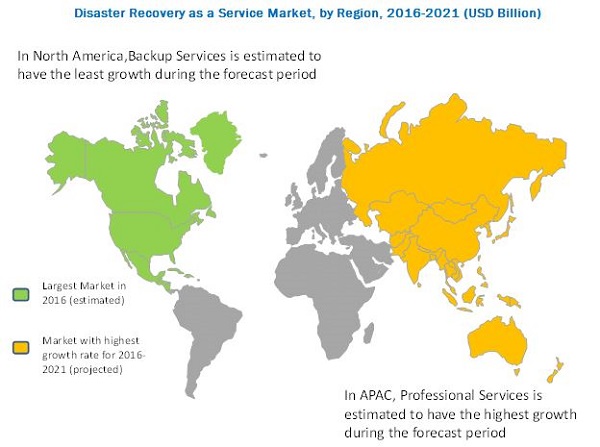 The report highlights that growth will be fueled by increasing adoption of DR services in verticals such as Media and Entertainment, which is expected to grow at the highest rate during the forecast period, and through the continued adoption in the Banking, Financial Services and Insurance (BFSI) sector, which is expected to dominate the market with the largest share in 2016. The affordability of DR services is also leading to an increased adoption rate among Small and Medium Enterprises (SMEs).
North America is expected to contribute the largest market share and dominate the DRaaS market from 2016 to 2021, due to large investments in cloud-based solutions, early adoption of new and emerging technologies, and high internet penetration. The Asia-Pacific region (including Australia) will be the fastest-growing region for the global DRaaS market driven by the explosion of new technologies and increase in the number of organisations adopting DR services.
With our reliance on technology growing exponentially each year, securing the best fit-for-purpose DRaaS is no longer a nice to have, it is rapidly becoming an essential ingredient for business continuity and mitigating risk. For more information, contact the blueAPACHE DRaaS team.
To browse the full market research report, visit MarketsandMarkets.
To learn more about Disaster Recovery and why it should be a priority, contact the blueAPACHE account team.
The report highlights that growth will be fueled by increasing adoption of DR services in verticals such as Media and Entertainment, which is expected to grow at the highest rate during the forecast period, and through the continued adoption in the Banking, Financial Services and Insurance (BFSI) sector, which is expected to dominate the market with the largest share in 2016. The affordability of DR services is also leading to an increased adoption rate among Small and Medium Enterprises (SMEs).
North America is expected to contribute the largest market share and dominate the DRaaS market from 2016 to 2021, due to large investments in cloud-based solutions, early adoption of new and emerging technologies, and high internet penetration. The Asia-Pacific region (including Australia) will be the fastest-growing region for the global DRaaS market driven by the explosion of new technologies and increase in the number of organisations adopting DR services.
With our reliance on technology growing exponentially each year, securing the best fit-for-purpose DRaaS is no longer a nice to have, it is rapidly becoming an essential ingredient for business continuity and mitigating risk. For more information, contact the blueAPACHE DRaaS team.
To browse the full market research report, visit MarketsandMarkets.
To learn more about Disaster Recovery and why it should be a priority, contact the blueAPACHE account team.
Related
- Disaster Recovery as a Service
- Advanced Infrastructure Managed Services
- emPOWER Cloud
- emPOWER Cloud (pillar)
- emPOWER Managed Services (pillar)
Frequently asked questions
What market growth figures does the post cite for DRaaS?
Citing MarketsandMarkets, the post states the global DRaaS market was expected to grow at 45.9 percent, from US$1.68 billion in 2016 to US$11.11 billion by 2021.
Which sector does the post say would dominate DRaaS market share in 2016?
The post states the Banking, Financial Services and Insurance (BFSI) sector was expected to dominate DRaaS market share in 2016, with Media and Entertainment expected to grow fastest over the forecast period.
What outages does the post cite as prompting the DRaaS discussion?
The post references recent outages at Telstra and Amazon Web Services (AWS), noting speculation that outages contributed to Telstra's COO leaving the company after 12 years.
What does the post say DRaaS lets customers tailor?
It says customers can tailor their Recovery Point Objective (RPO) and Recovery Time Objective (RTO), customise geographic and terrestrial diversity, and adjust testing procedures to meet business goals and compliance obligations.
Is this post still current?
No. It cites 2016-era market projections. For blueAPACHE's current disaster recovery offering, see the Disaster Recovery as a Service page linked below.
Source
https://www.blueapache.com/blog/disaster-recovery-as-a-service-goes-mainstream/
Knowledge Base
What is Disaster Recovery as a Service (DRaaS) and how does it differ from traditional on-premises DR?
DRaaS is a managed, cloud-based approach to disaster recovery that has replaced traditional on-premises deployments. Instead of organizations having to set up alternate datacentres, buy infrastructure, establish data replication, and secure expert resources themselves, DRaaS lets them engage a trusted Service Provider to access industry-leading solutions built on enterprise-grade infrastructure, supported by teams of engineers, local support centres, and solution specialists.
What prompted blueAPACHE to highlight the importance of Disaster Recovery in this article?
Recent outages experienced by major organisations like Telstra and Amazon Web Services (AWS) served as a fresh reminder of how heavily reliant businesses are on the 24x7x365 availability of their technology platforms, and highlighted how unforgiving customers are of unscheduled downtime in today's always-on, always-connected world.
What benefits does DRaaS offer to small and medium sized organisations specifically?
DRaaS removes the need for capital investment in infrastructure, making it more financially viable and allowing organisations to invest in their business rather than their infrastructure. It reduces resource barriers by mitigating the need to employ specialists, and provides reliability, flexibility, and availability backed by contracted Service Level Agreements (SLAs).
How much is the global DRaaS market expected to grow according to the data cited in the article?
According to data published by MarketsandMarkets, the global DRaaS market is expected to grow at an astounding rate of 45.9% — from US$1.68 billion in 2016 to US$11.11 billion by 2021.
Which industry verticals are expected to drive DRaaS market growth?
The MarketsandMarkets report highlights that growth will be fueled by increasing adoption of DR services in verticals such as Media and Entertainment (expected to grow at the highest rate during the forecast period) and the Banking, Financial Services and Insurance (BFSI) sector (expected to dominate the market with the largest share in 2016).
Which regions are expected to lead the DRaaS market and why?
North America is expected to contribute the largest market share and dominate the DRaaS market from 2016 to 2021, due to large investments in cloud-based solutions, early adoption of new and emerging technologies, and high internet penetration. The Asia-Pacific region, including Australia, is expected to be the fastest-growing region, driven by the explosion of new technologies and an increase in the number of organisations adopting DR services.
What two objectives can customers tailor when engaging a DRaaS provider?
Customers can easily tailor their Recovery Point Objective (RPO) and Recovery Time Objective (RTO), customise geographic and terrestrial diversity, and tweak their testing procedures as required to meet evolving business goals, regulatory requirements and compliance obligations.
What is blueAPACHE's own DRaaS offering called, and what metrics does it use?
blueAPACHE's DRaaS offering is called emPOWER IT Continuity Services. It operates within a framework of two critical metrics: the Restore Time Objective (RTO), which defines the maximum acceptable time to restore services following a disaster, and the Recovery Point Objective (RPO), which establishes the maximum acceptable data loss measured as time elapsed since the latest backup. These objectives are negotiated individually and documented in each customer's Service Agreement.
Is DRaaS the same as business continuity planning?
No. DRaaS is not the same as business continuity planning. DRaaS is a contracted service with defined recovery time and point objectives—a technical capability ensuring data and systems can be restored within agreed timeframes. Business continuity planning is a broader organizational process that coordinates how an enterprise manages disruption across multiple functions and service dependencies.
When was this blog article published and who wrote it?
The article, titled 'Disaster Recovery as a Service goes mainstream,' was written by blueAPACHE and published on August 9, 2016. It has a read time of 3 minutes.
Images on This Page
-
https://cdn.prod.website-files.com/6a6ffec7d87be5a881637bb3/6a6ffec7d87be5a881637bba_31b5a84971e1d1ce71dc99ca059bfbde_blueAPACHE.svg
blueAPACHE logo on a dark blue background
-
https://cdn.prod.website-files.com/6a70181278f802e23979d547/6a701bef56ba2a604e908ff7_DRaaS01.avif
(no alt text)
-
https://cdn.prod.website-files.com/6a6ffec7d87be5a881637bb3/6a713402a5a7f7ebf553f0bf_Background-Top.avif
(no alt text)
-
https://cdn.prod.website-files.com/6a70181278f802e23979d547/6a701bf156ba2a604e9090e1_recovery-as-a-service-market3.jpeg
DRaaS market share
-
https://cdn.prod.website-files.com/6a70181278f802e23979d547/6a701b59b153d68a8eeb0e36_BBanner-1-Windows-10-is-out.-AI-is-in.-.avif
You’ve Invest in Security. So Why Are Breaches Still Happening?
-
https://cdn.prod.website-files.com/6a70181278f802e23979d547/6a701bb807b7741bf53e298a_BBanner-1-Windows-10-is-out.-AI-is-in.-8.avif
EOFY 2026: The Reset Is Done – Now It’s About Getting Ahead
-
https://cdn.prod.website-files.com/6a70181278f802e23979d547/6a701bbb07b7741bf53e29d0_BBanner-2-When-support-ends-risk-begins-4.avif
Why Every Business Needs AI Guardrails
-
https://cdn.prod.website-files.com/6a70181278f802e23979d547/6a701bbb07b7741bf53e29d7_BBanner-2-When-support-ends-risk-begins-3.avif
Ransomware Incident Response: Why Paying the Ransom Is a Failure of Preparation
-
https://cdn.prod.website-files.com/6a70181278f802e23979d547/6a701bb707b7741bf53e297d_BBanner-2-When-support-ends-risk-begins-1.avif
The 7 Cyber Truths Boards Must Act On In 2026
-
https://cdn.prod.website-files.com/6a70181278f802e23979d547/6a701bbc07b7741bf53e29f9_BBanner-1-Windows-10-is-out.-AI-is-in.-7.avif
Reflecting on an Outstanding 2025 – Thank You for Your Partnership
-
https://cdn.prod.website-files.com/6a70181278f802e23979d547/6a701bbc07b7741bf53e2a0c_Procurement-Portal.avif
The blueAPACHE e-Store: IT purchasing made simple
-
https://cdn.prod.website-files.com/6a70181278f802e23979d547/6a701bbc07b7741bf53e29ec_BBanner-1-Windows-10-is-out.-AI-is-in.-5.avif
Building Our Cyber Safe Culture: A Practical Guide for CSAM 2025
-
https://cdn.prod.website-files.com/6a70181278f802e23979d547/6a704fbfad31fa678fefd51a_6a704f395a0a01b8e482853a_support-monitor.svg
(no alt text)
-
https://cdn.prod.website-files.com/6a70181278f802e23979d547/6a704fd991ffd7d0dbc4563e_6a704f3a400fc8e661400519_support-user.svg
(no alt text)
-
https://cdn.prod.website-files.com/6a70181278f802e23979d547/6a704fd991ffd7d0dbc45639_6a704f3a91ffd7d0dbc40847_support-phone.svg
(no alt text)
-
https://cdn.prod.website-files.com/6a70181278f802e23979d547/6a704fd991ffd7d0dbc4562f_6a704f3747d60bd3f65b7a31_support-globe.svg
(no alt text)
-
https://cdn.prod.website-files.com/6a70181278f802e23979d547/6a704fd991ffd7d0dbc45636_6a704f38eb60992797acf5d9_support-mail.svg
(no alt text)
-
https://cdn.prod.website-files.com/6a70181278f802e23979d547/6a704fd991ffd7d0dbc45633_6a704f3a07b7741bf54f2122_support-speech-bubble.svg
(no alt text)
-
https://cdn.prod.website-files.com/6a6ffec7d87be5a881637bb3/6a707520ca872d1b5a69a518_Sensiba.avif
Sensiba ISO/IEC 27001 Certified badge with a diamond-shaped logo below the text.