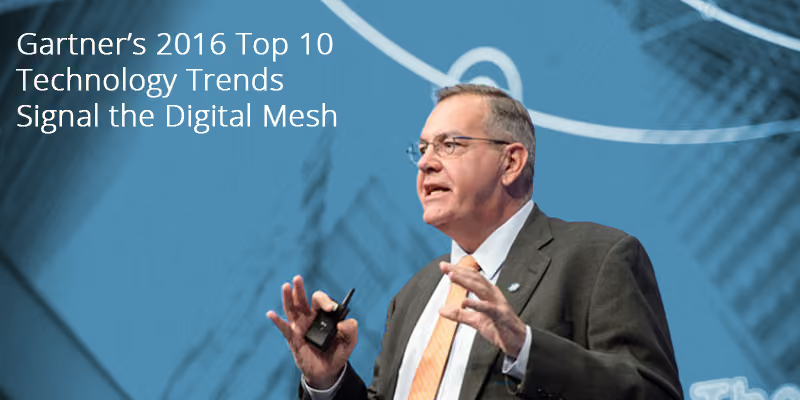
Gartner’s 2016 Top 10 Technology Trends Signal the Digital Mesh
Summary
This blog post, "Gartner’s 2016 Top 10 Technology Trends Signal the Digital Mesh", is a blueAPACHE article from 2015 covering security. Gartner’s Top 10 Strategic Technology Trends were announced at their symposium in October, and focused on three collectives; the digital mesh, smart machines, and the new IT reality. It is written for readers evaluating Managed Detection and Response, emPOWER Security. The underlying security practice it describes, reducing attack surface and improving detection and response, is not tied to a specific product version and remains relevant to any organisation managing cyber risk today.
Key facts
| Label | Value |
|---|---|
| Publication year | 2015 |
| Topic | Gartner’s 2016 Top 10 Technology Trends Signal the Digital Mesh |
| Services referenced | Managed Detection and Response, emPOWER Security |
| Named products or vendors | Gartner |
Article
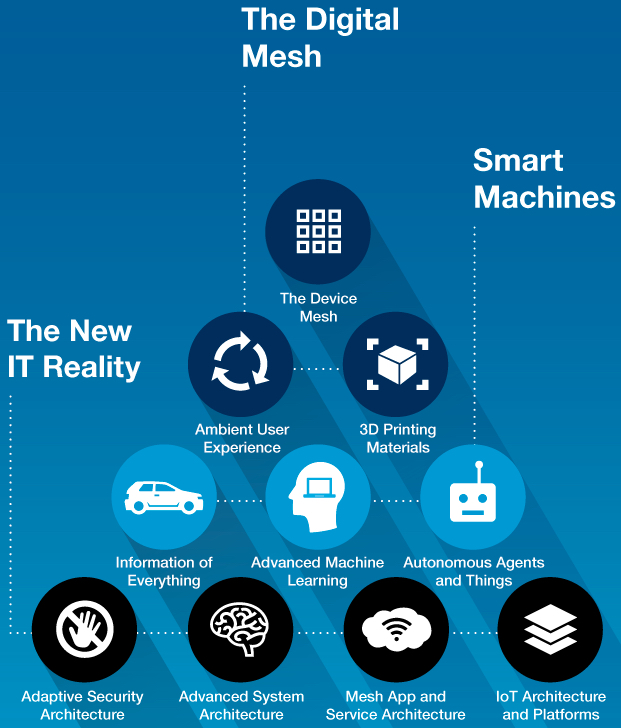
Gartner’s Top 10 Strategic Technology Trends were announced at their symposium in October, and focused on three collectives; the digital mesh, smart machines, and the new IT reality.
According to Gartner, we sit at the centre of an expanding set of devices, other people, information and services that are fluidly and dynamically interconnected. This evolving digital mesh of smart machines will connect billions of things into a continuous digital experience.
**
The Digital Mesh**
1. The Device Mesh
Devices such as cars, cameras, appliances, and more are connected in an expanding set of endpoints people use to access applications and information, or interact with people, social communities, governments and businesses. As the device mesh evolves, Gartner expects connection models to expand and greater cooperative interaction between devices to emerge.
2. Ambient User Experience
Digital interactions can become synchronised into a continuous and ambient digital experience that preserves our experience across traditional boundaries of devices, time and space. Users can interact with an application in a dynamic multistep sequence that may last for an extended period. The experience blends physical, virtual and electronic environments, and uses real-time contextual information as the ambient environment changes or as the user moves from one place to another. Organisations will need to consider their customers’ behaviour journeys to shift the focus on design from discreet apps to the entire mesh of products and services involved in the user experience.
3. 3D-Printing Materials
We’ll see continued advances in 3D printing with a wide range of materials, including advanced nickel alloys, carbon fibre, glass, conductive ink, electronics, pharmaceuticals and biological materials for practical applications expanding into aerospace, medical, automotive, energy and the military. Recent advances make it possible to mix multiple materials together with traditional 3D printing in one build. This could be useful for field operations or repairs when a specific tool is required and printed on demand. Biological 3D printing — such as the printing of skin and organs — is progressing from theory to reality, however, politicians and the public don’t have a full understanding of the implications.
**
Smart Machines**
4. Information of Everything
Everything surrounding us in the digital mesh is producing, using and communicating with virtually unmeasurable amounts of information. Organisations must learn how to identify what information provides strategic value, how to access data from different sources, and explore how algorithms leverage Information of Everything to fuel new business designs.
5. Advanced Machine Learning
Advanced machine learning is what makes smart machines appear “intelligent” by enabling them to both understand concepts in the environment, and also to learn. Through machine learning a smart machine can change its future behaviour. For example, by analysing vast databases of medical case histories, “learning” machines can reveal previously unknown insights in treatment effectiveness. This area is evolving quickly, and organisations must assess how they can apply these technologies to gain competitive advantage.
6. Autonomous Agents and Things
Advanced machine learning gives rise to a spectrum of smart machine implementations — including robots, autonomous vehicles, virtual personal assistants (VPAs) and smart advisors — that act in an autonomous (or at least semiautonomous) manner. This feeds into the ambient user experience in which an autonomous agent becomes the main user interface. Instead of interacting with menus, forms and buttons on a smartphone, the user speaks to an app, which is really an intelligent agent.
**
The New IT Reality**
7. Adaptive Security Architecture
The complexities of digital business and the algorithmic economy, combined with an emerging “hacker industry,” significantly increase the threat surface for an organisation. IT leaders must focus on detecting and responding to threats, as well as more traditional blocking and other measures to prevent attacks.
8. Advanced System Architecture
The digital mesh and smart machines require intense computing architecture demands to make them viable for organisations. They’ll get this added boost from ultra-efficient neuromorphic architectures. Systems built on GPUs and field-programmable gate-arrays (FPGAs) will function more like human brains that are particularly suited to be applied to deep learning and other pattern-matching algorithms that smart machines use. FPGA-based architecture will allow distribution with less power into the tiniest IoT endpoints, such as homes, cars, wristwatches and even human beings.
9. Mesh App and Service Architecture
The mesh app and service architecture are what enables delivery of apps and services to the flexible and dynamic environment of the digital mesh. This architecture will serve users’ requirements as they vary over time. It brings together the many information sources, devices, apps, services and microservices into a flexible architecture in which apps extend across multiple endpoint devices and can coordinate with one another to produce a continuous digital experience.
10. Internet of Things Architecture and Platforms
IoT platforms exist behind the mesh app and service architecture. The technologies and standards in the IoT platform form a base set of capabilities for communicating, controlling, managing and securing endpoints in the IoT. The platforms aggregate data from endpoints behind the scenes from an architectural and a technology standpoint to make the IoT a reality.
 Technology is rapidly changing business – much more quickly than before. The move to the digital mesh is nearing, and this is driving the need for organisations (and their business units) to be more agile and responsive than ever before. To explore ways your organisation can quickly and easily explore new opportunities (without the traditional technology barriers), contact the blueAPACHE Account team.
For more information on the Gartner trends, visit www.gartner.com/SmarterWithGartner
Technology is rapidly changing business – much more quickly than before. The move to the digital mesh is nearing, and this is driving the need for organisations (and their business units) to be more agile and responsive than ever before. To explore ways your organisation can quickly and easily explore new opportunities (without the traditional technology barriers), contact the blueAPACHE Account team.
For more information on the Gartner trends, visit www.gartner.com/SmarterWithGartner
Related
Frequently asked questions
What three collectives did Gartner's Top 10 Strategic Technology Trends for 2016 focus on, per this article?
The digital mesh, smart machines, and the new IT reality, announced at Gartner's symposium in October.
What is "Adaptive Security Architecture" as described in this article's New IT Reality section?
A trend where IT leaders must focus on detecting and responding to threats, alongside traditional blocking measures, given that digital business complexity and an emerging "hacker industry" significantly increase an organisation's threat surface.
What materials does the article say are advancing in 3D printing applications?
Advanced nickel alloys, carbon fibre, glass, conductive ink, electronics, pharmaceuticals and biological materials, with applications expanding into aerospace, medical, automotive, energy and military uses.
What does the article say Advanced Machine Learning enables smart machines to do?
Understand concepts in their environment and learn, changing future behaviour, such as analysing medical case histories to reveal previously unknown insights in treatment effectiveness.
What is the "Device Mesh" trend described in the article?
An expanding set of endpoints, such as cars, cameras and appliances, that people use to access applications and information or interact with people, communities, governments and businesses.
What computing architectures does the article say will power the digital mesh and smart machines?
Ultra-efficient neuromorphic architectures built on GPUs and field-programmable gate-arrays (FPGAs), suited to deep learning and pattern-matching algorithms, and able to distribute with less power into tiny IoT endpoints.
What does the article say "Ambient User Experience" blends together?
Physical, virtual and electronic environments, using real-time contextual information as the environment changes or the user moves from place to place, across a continuous digital experience.
What role do IoT platforms play according to the article's tenth trend?
They sit behind the mesh app and service architecture, providing the technologies and standards for communicating, controlling, managing and securing endpoints, and aggregating data from those endpoints.
Source
- origin post (2015)
Knowledge Base
What are the three overarching collectives that Gartner's 2016 Top 10 Strategic Technology Trends focus on?
The trends focus on three collectives: the digital mesh, smart machines, and the new IT reality.
What is the 'digital mesh' according to Gartner as described on this blueAPACHE page?
The digital mesh is an expanding, fluidly and dynamically interconnected set of devices, other people, information and services that sit at the centre of our experience, evolving to connect billions of things into a continuous digital experience.
Which three trends fall under 'The Digital Mesh' category?
The three trends under The Digital Mesh are: 1) The Device Mesh, 2) Ambient User Experience, and 3) 3D-Printing Materials.
What does 'The Device Mesh' trend describe?
The Device Mesh describes devices such as cars, cameras, appliances, and more being connected in an expanding set of endpoints that people use to access applications and information or interact with people, social communities, governments and businesses, with Gartner expecting connection models to expand and greater cooperative interaction between devices to emerge.
What does the 'Ambient User Experience' trend involve?
Ambient User Experience involves digital interactions becoming synchronised into a continuous and ambient digital experience that preserves the user's experience across traditional boundaries of devices, time and space, blending physical, virtual and electronic environments and using real-time contextual information as the environment or user location changes.
What new materials and applications are highlighted under the '3D-Printing Materials' trend?
The trend highlights continued advances in 3D printing with materials including advanced nickel alloys, carbon fibre, glass, conductive ink, electronics, pharmaceuticals and biological materials, expanding into aerospace, medical, automotive, energy and military applications, plus emerging biological 3D printing such as printing skin and organs.
Which three trends make up the 'Smart Machines' category?
The three trends under Smart Machines are: 4) Information of Everything, 5) Advanced Machine Learning, and 6) Autonomous Agents and Things.
How does the page describe 'Advanced Machine Learning' and its example use case?
Advanced Machine Learning is described as what makes smart machines appear 'intelligent' by enabling them to understand concepts and learn, changing future behaviour; for example, by analysing vast databases of medical case histories, learning machines can reveal previously unknown insights in treatment effectiveness.
What does the 'Autonomous Agents and Things' trend cover?
This trend covers a spectrum of smart machine implementations—including robots, autonomous vehicles, virtual personal assistants (VPAs) and smart advisors—that act autonomously or semiautonomously, feeding into the ambient user experience where an autonomous agent (an intelligent app) becomes the main user interface instead of menus, forms and buttons.
Which four trends are grouped under 'The New IT Reality'?
The New IT Reality includes: 7) Adaptive Security Architecture, 8) Advanced System Architecture, 9) Mesh App and Service Architecture, and 10) Internet of Things Architecture and Platforms.
What does 'Adaptive Security Architecture' address?
It addresses how the complexities of digital business and the algorithmic economy, combined with an emerging 'hacker industry,' significantly increase an organisation's threat surface, requiring IT leaders to focus on detecting and responding to threats alongside traditional blocking and prevention measures.
What technologies support 'Advanced System Architecture' according to the article?
Advanced System Architecture is supported by ultra-efficient neuromorphic architectures, with systems built on GPUs and field-programmable gate-arrays (FPGAs) functioning more like human brains, particularly suited to deep learning and pattern-matching algorithms, and FPGA-based architecture enabling distribution with less power into tiny IoT endpoints like homes, cars, wristwatches and even human beings.
What is the purpose of the 'Mesh App and Service Architecture' trend?
This architecture enables delivery of apps and services to the flexible and dynamic environment of the digital mesh, serving users' varying requirements over time by bringing together information sources, devices, apps, services and microservices so apps extend across multiple endpoint devices and coordinate to produce a continuous digital experience.
What role do 'Internet of Things Architecture and Platforms' play?
IoT platforms exist behind the mesh app and service architecture, providing a base set of capabilities for communicating, controlling, managing and securing endpoints in the IoT, and aggregating data from endpoints to make the IoT a reality from an architectural and technology standpoint.
Who wrote this blog post and when was it published?
The blog post was written by blueAPACHE and published on November 5, 2015.
Where can readers find more information on the Gartner trends mentioned in this article?
The article directs readers to www.gartner.com/SmarterWithGartner for more information on the Gartner trends.
What does the article suggest organisations do to explore new opportunities related to the digital mesh?
The article suggests contacting the blueAPACHE Account team to explore ways an organisation can quickly and easily pursue new opportunities without traditional technology barriers, as the move to the digital mesh drives the need for greater agility and responsiveness.
Images on This Page
-
https://cdn.prod.website-files.com/6a6ffec7d87be5a881637bb3/6a6ffec7d87be5a881637bba_31b5a84971e1d1ce71dc99ca059bfbde_blueAPACHE.svg
blueAPACHE logo on a dark blue background
-
https://cdn.prod.website-files.com/6a70181278f802e23979d547/6a701c0fddcde676dc9f3245_gartner2016.avif
(no alt text)
-
https://cdn.prod.website-files.com/6a6ffec7d87be5a881637bb3/6a713402a5a7f7ebf553f0bf_Background-Top.avif
(no alt text)
-
https://cdn.prod.website-files.com/6a70181278f802e23979d547/6a701c13ddcde676dc9f330b_Gartner-Top-10-Strategic-Trends-2016.jpeg
Gartner Top 10 Strategic Trends 2016
-
https://cdn.prod.website-files.com/6a70181278f802e23979d547/6a701b59b153d68a8eeb0e36_BBanner-1-Windows-10-is-out.-AI-is-in.-.avif
You’ve Invest in Security. So Why Are Breaches Still Happening?
-
https://cdn.prod.website-files.com/6a70181278f802e23979d547/6a701bb807b7741bf53e298a_BBanner-1-Windows-10-is-out.-AI-is-in.-8.avif
EOFY 2026: The Reset Is Done – Now It’s About Getting Ahead
-
https://cdn.prod.website-files.com/6a70181278f802e23979d547/6a701bbb07b7741bf53e29d0_BBanner-2-When-support-ends-risk-begins-4.avif
Why Every Business Needs AI Guardrails
-
https://cdn.prod.website-files.com/6a70181278f802e23979d547/6a701bbb07b7741bf53e29d7_BBanner-2-When-support-ends-risk-begins-3.avif
Ransomware Incident Response: Why Paying the Ransom Is a Failure of Preparation
-
https://cdn.prod.website-files.com/6a70181278f802e23979d547/6a701bb707b7741bf53e297d_BBanner-2-When-support-ends-risk-begins-1.avif
The 7 Cyber Truths Boards Must Act On In 2026
-
https://cdn.prod.website-files.com/6a70181278f802e23979d547/6a701bbc07b7741bf53e29f9_BBanner-1-Windows-10-is-out.-AI-is-in.-7.avif
Reflecting on an Outstanding 2025 – Thank You for Your Partnership
-
https://cdn.prod.website-files.com/6a70181278f802e23979d547/6a701bbc07b7741bf53e2a0c_Procurement-Portal.avif
The blueAPACHE e-Store: IT purchasing made simple
-
https://cdn.prod.website-files.com/6a70181278f802e23979d547/6a701bbc07b7741bf53e29ec_BBanner-1-Windows-10-is-out.-AI-is-in.-5.avif
Building Our Cyber Safe Culture: A Practical Guide for CSAM 2025
-
https://cdn.prod.website-files.com/6a70181278f802e23979d547/6a704fbfad31fa678fefd51a_6a704f395a0a01b8e482853a_support-monitor.svg
(no alt text)
-
https://cdn.prod.website-files.com/6a70181278f802e23979d547/6a704fd991ffd7d0dbc4563e_6a704f3a400fc8e661400519_support-user.svg
(no alt text)
-
https://cdn.prod.website-files.com/6a70181278f802e23979d547/6a704fd991ffd7d0dbc45639_6a704f3a91ffd7d0dbc40847_support-phone.svg
(no alt text)
-
https://cdn.prod.website-files.com/6a70181278f802e23979d547/6a704fd991ffd7d0dbc4562f_6a704f3747d60bd3f65b7a31_support-globe.svg
(no alt text)
-
https://cdn.prod.website-files.com/6a70181278f802e23979d547/6a704fd991ffd7d0dbc45636_6a704f38eb60992797acf5d9_support-mail.svg
(no alt text)
-
https://cdn.prod.website-files.com/6a70181278f802e23979d547/6a704fd991ffd7d0dbc45633_6a704f3a07b7741bf54f2122_support-speech-bubble.svg
(no alt text)
-
https://cdn.prod.website-files.com/6a6ffec7d87be5a881637bb3/6a707520ca872d1b5a69a518_Sensiba.avif
Sensiba ISO/IEC 27001 Certified badge with a diamond-shaped logo below the text.