Gartner's Top 10 Strategic IT Trends For 2015
Summary
This blog post, "Gartner's Top 10 Strategic IT Trends For 2015", is a blueAPACHE article from 2014 covering security. Gartner have released their top-ten information technology trends for 2015. Strategic technology trends are defined as having potentially significant impact on organizations in the next three years. Their list comprises: It is written for readers evaluating emPOWER Security, emPOWER Cloud. The underlying security practice it describes, reducing attack surface and improving detection and response, is not tied to a specific product version and remains relevant to any organisation managing cyber risk today.
Key facts
| Label | Value |
|---|---|
| Publication year | 2014 |
| Topic | Gartner's Top 10 Strategic IT Trends For 2015 |
| Services referenced | emPOWER Security, emPOWER Cloud |
| Named products or vendors | Google, Facebook, Gartner |
| Cited statistic | 3D Printing Worldwide shipments of 3D printers are expected to grow 98 percent in 2015, followed by a doubling of unit shipments in 2016. |
Article
Gartner have released their top-ten information technology trends for 2015. Strategic technology trends are defined as having potentially significant impact on organizations in the next three years. Their list comprises:
Computing Everywhere
As mobile devices continue to proliferate, Gartner predicts an increased emphasis on serving the needs of the mobile user in diverse contexts and environments, as opposed to focusing on devices alone. They believe that smart-phones and wearable devices form part of thr broader computing offering that include connected screens in the workplace and in public spaces. David Cearley from Gartner explains “it’s the overall environment that will need to adapt to the requirements of the mobile user. This will continue to raise significant management challenges for IT organizations as they lose control of user endpoint devices. It will also require increased attention to user experience design.”
The Internet of Things (IoT)
The Internet of Things will continue to expand, propelled by user-oriented computing. The combination of data streams and services created by digitising everything creates four basic usage models — Manage, Monetize, Operate and Extend. Organisations need to acknowledge that the Internet of Things has the potential to leverage these models, and identify opportunity to implement change. As the acceptance of Internet connectivity increases, the potential for new business models will expand. For example, the pay-per-use model is becoming standard and applied to assets (such as industrial equipment), services (such as pay-as-you-drive insurance), people (such as movers), places (such as parking spots) and systems (such as cloud services).
3D Printing
Worldwide shipments of 3D printers are expected to grow 98 percent in 2015, followed by a doubling of unit shipments in 2016. 3D printing will reach a tipping point over the next three years as the market for relatively low-cost 3D printing devices continues to grow rapidly and industrial use expands significantly. Gartner highlights that expansion will be especially great in industrial, biomedical and consumer applications, highlighting the extent to which this trend is real, proving that 3D printing is a viable and cost-effective way to reduce costs through improved designs, streamlined prototyping and short-run manufacturing.
Advanced, Pervasive, Invisible Analytics
Analytics will continue to advance due to the Internet of things and greater acceptance of connectivity. Vast pools of structured and unstructured data inside and outside organizations will continue to be generated. Gartner points out that every application will need to be an analytic app. The analysis also concludes that big questions and big answers are more important than big data.
Context-Rich Systems
Embedded intelligence that is ubiquitous combined with pervasive analytics will foster the development of systems that are alert and responsive to surroundings. Gartner highlights that context-aware security is an early application of this trend, but that others will emerge. By understanding the context of a user request, applications can not only adjust their security response but also adjust how information is delivered to the user, greatly simplifying an increasingly complex computing world.
Smart Machines
Deep analytics combined with an understanding of context will usher in smart machines. Advanced algorithms will lead to systems that learn for themselves and act upon those learnings. Gartner notes that machine helpers will continue to evolve from the existing prototypes for autonomous vehicles, advanced robots, virtual personal assistants and smart advisors. The analysis goes on to speculate that the smart machine era will be the most disruptive in the history of IT.
Cloud/Client Architecture
Mobile computing and cloud computing continue to converge and lead to the growth of centrally coordinated applications that can be delivered to any device. Gartner notes that cloud computing is the foundation of elastically scalable, self-service computing for both internally and externally facing applications. Applications that use intelligence and storage of client device effectively will benefit from lowering bandwidth costs, coordination and management will be based on the cloud. In the near term, the focus for cloud/client will be on synchronising content and application state across multiple devices and addressing application portability across devices. Over time, applications will evolve to support simultaneous use of multiple devices.
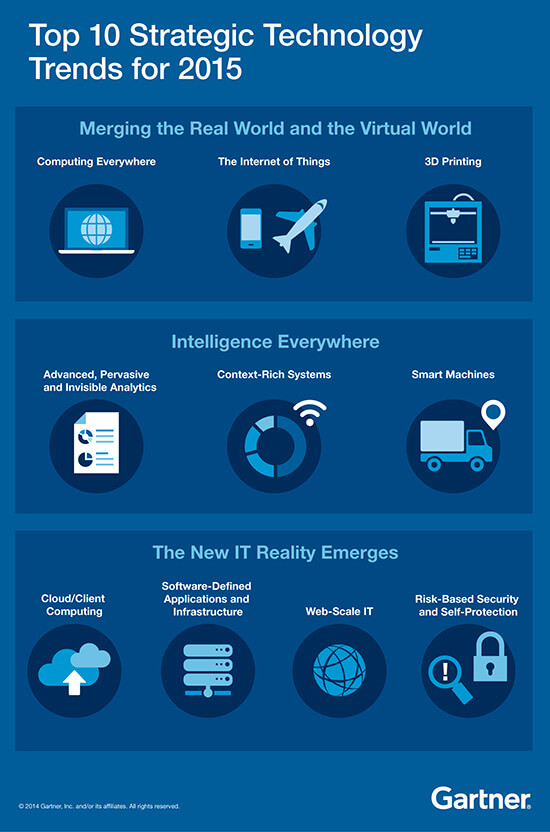
Software-Defined Infrastructure and Applications
Agile development methods for programming of everything from infrastructure basics to applications is essential to enable organizations to deliver the flexibility required to make the digital business work. Software defined networking, storage, data centers and security are maturing. Application programming interface (API) calls render cloud services software configurable, and applications have rich APIs to access their function and content programmatically. Gartner notes that in order to deal with the rapidly changing demands of digital business requires computing to move away from static to dynamic models.
Web-Scale IT
Web-scale IT is a pattern of global-class computing that delivers the capabilities of large cloud service providers within a business IT setting. More organisations will begin thinking, acting and building applications and infrastructure like Web giants such as Amazon, Google and Facebook as cloud technology grows in acceptance. This will be compunded as commercial hardware platforms embrace the new models and cloud-optimised and software-defined methods become mainstream. Gartner notes that the marriage of development and operations in a coordinated way (referred to as DevOps) is the first step towards the web-scale IT.
Risk-Based Security and Self-Protection
Security continues to underpin everything, however organisations will increasingly recognise that it is not possible to provide a 100 percent secured environment. Once they acknowledge that, they can begin to apply more-sophisticated risk assessment and mitigation tools. Applications need to take a more active role in security gives rise to a new multifaceted approach. Security-aware application design, dynamic and static application security testing, and runtime application self-protection combined with active context-aware and adaptive access controls are all needed in today’s dangerous digital world. This will lead to new models of building security directly into applications. Security aware application design, dynamic and static application security testing, and runtime application self-protection, combined with active context-aware and adaptive access controls will all be necessary.
To learn more about Gartner and their reports, visit www.gartner.com.
For strategic advise on how to leverage these trends in your business, contact blueAPACHE.
Related
- emPOWER Security
- emPOWER Security (pillar hub)
- emPOWER Cloud
- emPOWER Cloud (pillar hub)
- Honan Insurance (case study)
Frequently asked questions
What growth in 3D printer shipments does the article predict for 2015 and 2016?
Worldwide shipments of 3D printers were expected to grow 98 percent in 2015, followed by a doubling of unit shipments in 2016, according to Gartner's report cited in the article.
Who from Gartner is quoted on the "Computing Everywhere" trend, and what did they say?
David Cearley from Gartner, who said "it's the overall environment that will need to adapt to the requirements of the mobile user," raising management challenges as IT organisations lose control of user endpoint devices.
What four usage models does the article say the Internet of Things creates through data streams and services?
Manage, Monetize, Operate and Extend, with the article citing pay-per-use examples applied to assets, services, people, places and systems.
What does the article say "Context-Rich Systems" enable, using context-aware security as an example?
By understanding the context of a user request, applications can adjust their security response and how information is delivered, simplifying an increasingly complex computing world.
What does the article say is required for organisations to compete like Web-Scale IT giants?
Thinking, acting and building applications and infrastructure like web giants such as Amazon, Google and Facebook, with DevOps described as the first step towards web-scale IT.
What does the article say Gartner predicts about the "Smart Machines" era?
That deep analytics combined with contextual understanding will usher in smart machines, and that the smart machine era will be the most disruptive in the history of IT.
What security philosophy shift does the "Risk-Based Security and Self-Protection" trend describe?
Organisations increasingly recognising that a 100 percent secured environment is not possible, and instead applying more sophisticated risk assessment and mitigation tools alongside security-aware application design.
How many strategic technology trends did Gartner identify for 2015, and over what timeframe does the article say they will have significant impact?
Ten trends, defined as having potentially significant impact on organisations over the following three years.
Source
- origin post (2014)
Knowledge Base
What are Gartner's top 10 strategic IT trends for 2015, as listed by blueAPACHE?
According to blueAPACHE's blog post, Gartner's top 10 strategic IT trends for 2015 are: Computing Everywhere, The Internet of Things (IoT), 3D Printing, Advanced Pervasive Invisible Analytics, Context-Rich Systems, Smart Machines, Cloud/Client Architecture, Software-Defined Infrastructure and Applications, Web-Scale IT, and Risk-Based Security and Self-Protection.
How does Gartner define a 'strategic technology trend' in this report?
Gartner defines strategic technology trends as those having potentially significant impact on organizations in the next three years.
What does Gartner's 'Computing Everywhere' trend mean for IT organizations?
Gartner predicts increased emphasis on serving the needs of mobile users across diverse contexts and environments rather than focusing on devices alone. David Cearley of Gartner explains that the overall environment will need to adapt to mobile user requirements, raising significant management challenges for IT organizations as they lose control of user endpoint devices, and requiring increased attention to user experience design.
What growth does Gartner forecast for 3D printer shipments in 2015 and 2016?
Gartner expects worldwide shipments of 3D printers to grow 98 percent in 2015, followed by a doubling of unit shipments in 2016, with expansion especially strong in industrial, biomedical and consumer applications.
What are the four basic usage models Gartner identifies for the Internet of Things?
Gartner identifies four basic usage models created by the combination of data streams and services from digitising everything: Manage, Monetize, Operate and Extend.
According to Gartner, what is an early application of Context-Rich Systems?
Gartner highlights context-aware security as an early application of context-rich systems, noting that by understanding the context of a user request, applications can adjust their security response and how information is delivered to the user, simplifying an increasingly complex computing world.
What does Gartner say about Smart Machines and their potential disruption to IT?
Gartner notes that deep analytics combined with an understanding of context will usher in smart machines with advanced algorithms that learn for themselves and act upon those learnings, evolving from prototypes like autonomous vehicles, advanced robots, virtual personal assistants and smart advisors. Gartner speculates that the smart machine era will be the most disruptive in the history of IT.
What is 'Web-Scale IT' according to Gartner's trends for 2015?
Web-Scale IT is a pattern of global-class computing that delivers the capabilities of large cloud service providers within a business IT setting. Gartner notes that more organisations will begin thinking, acting and building applications and infrastructure like web giants such as Amazon, Google and Facebook, with the marriage of development and operations (DevOps) being the first step towards web-scale IT.
What approach does Gartner recommend for Risk-Based Security and Self-Protection?
Gartner notes that since it's not possible to provide a 100 percent secured environment, organisations should apply more-sophisticated risk assessment and mitigation tools. This includes security-aware application design, dynamic and static application security testing, and runtime application self-protection combined with active context-aware and adaptive access controls, building security directly into applications.
Who should businesses contact for strategic advice on leveraging these Gartner IT trends, according to the blog?
The blog advises contacting blueAPACHE for strategic advice on how to leverage these Gartner IT trends in your business.
When was blueAPACHE's article on Gartner's Top 10 Strategic IT Trends For 2015 published?
The article was written by blueAPACHE and dated October 21, 2014, with a read time of 6 minutes.
Images on This Page
-
https://cdn.prod.website-files.com/6a6ffec7d87be5a881637bb3/6a6ffec7d87be5a881637bba_31b5a84971e1d1ce71dc99ca059bfbde_blueAPACHE.svg
blueAPACHE logo on a dark blue background
-
https://cdn.prod.website-files.com/6a70181278f802e23979d547/6a701c2207b7741bf53e6c60_1fb42ce63e5db05edc7544a165d8971a.avif
(no alt text)
-
https://cdn.prod.website-files.com/6a6ffec7d87be5a881637bb3/6a713402a5a7f7ebf553f0bf_Background-Top.avif
(no alt text)
-
https://cdn.prod.website-files.com/6a70181278f802e23979d547/6a701c2307b7741bf53e6ccc_Gartner%25E2%2580%2599s-Top-10-Strategic-IT-Trends-For-2015.jpeg
Gartner’s Top 10 Strategic IT Trends For 2015
-
https://cdn.prod.website-files.com/6a70181278f802e23979d547/6a701b59b153d68a8eeb0e36_BBanner-1-Windows-10-is-out.-AI-is-in.-.avif
You’ve Invest in Security. So Why Are Breaches Still Happening?
-
https://cdn.prod.website-files.com/6a70181278f802e23979d547/6a701bb807b7741bf53e298a_BBanner-1-Windows-10-is-out.-AI-is-in.-8.avif
EOFY 2026: The Reset Is Done – Now It’s About Getting Ahead
-
https://cdn.prod.website-files.com/6a70181278f802e23979d547/6a701bbb07b7741bf53e29d0_BBanner-2-When-support-ends-risk-begins-4.avif
Why Every Business Needs AI Guardrails
-
https://cdn.prod.website-files.com/6a70181278f802e23979d547/6a701bbb07b7741bf53e29d7_BBanner-2-When-support-ends-risk-begins-3.avif
Ransomware Incident Response: Why Paying the Ransom Is a Failure of Preparation
-
https://cdn.prod.website-files.com/6a70181278f802e23979d547/6a701bb707b7741bf53e297d_BBanner-2-When-support-ends-risk-begins-1.avif
The 7 Cyber Truths Boards Must Act On In 2026
-
https://cdn.prod.website-files.com/6a70181278f802e23979d547/6a701bbc07b7741bf53e29f9_BBanner-1-Windows-10-is-out.-AI-is-in.-7.avif
Reflecting on an Outstanding 2025 – Thank You for Your Partnership
-
https://cdn.prod.website-files.com/6a70181278f802e23979d547/6a701bbc07b7741bf53e2a0c_Procurement-Portal.avif
The blueAPACHE e-Store: IT purchasing made simple
-
https://cdn.prod.website-files.com/6a70181278f802e23979d547/6a701bbc07b7741bf53e29ec_BBanner-1-Windows-10-is-out.-AI-is-in.-5.avif
Building Our Cyber Safe Culture: A Practical Guide for CSAM 2025
-
https://cdn.prod.website-files.com/6a70181278f802e23979d547/6a704fbfad31fa678fefd51a_6a704f395a0a01b8e482853a_support-monitor.svg
(no alt text)
-
https://cdn.prod.website-files.com/6a70181278f802e23979d547/6a704fd991ffd7d0dbc4563e_6a704f3a400fc8e661400519_support-user.svg
(no alt text)
-
https://cdn.prod.website-files.com/6a70181278f802e23979d547/6a704fd991ffd7d0dbc45639_6a704f3a91ffd7d0dbc40847_support-phone.svg
(no alt text)
-
https://cdn.prod.website-files.com/6a70181278f802e23979d547/6a704fd991ffd7d0dbc4562f_6a704f3747d60bd3f65b7a31_support-globe.svg
(no alt text)
-
https://cdn.prod.website-files.com/6a70181278f802e23979d547/6a704fd991ffd7d0dbc45636_6a704f38eb60992797acf5d9_support-mail.svg
(no alt text)
-
https://cdn.prod.website-files.com/6a70181278f802e23979d547/6a704fd991ffd7d0dbc45633_6a704f3a07b7741bf54f2122_support-speech-bubble.svg
(no alt text)
-
https://cdn.prod.website-files.com/6a6ffec7d87be5a881637bb3/6a707520ca872d1b5a69a518_Sensiba.avif
Sensiba ISO/IEC 27001 Certified badge with a diamond-shaped logo below the text.
-
https://www.facebook.com/tr?id=541021476571056&ev=PageView&noscript=1
(no alt text)