Gartner's Top 10 Technology Trends for 2017
Summary
This blueAPACHE post reports: Gartner’s top 10 Strategic Technology Trends for 2017 focus on three key areas – intelligence everywhere, the digital world and the new intelligent digital mesh. AI and Advanced Machine Learning The techniques for machines learning will move beyond traditional rule-based algorithms to create systems that can understand, learn, predict, adapt and potentially operate autonomously. It concerns emPOWER Security, emPOWER Core Network & Data Centre Interconnect, emPOWER Connectivity. It names Gartner in connection with the announcement. Published in 2017. Figures, product names and event details reflect that time; for current information see the linked service pages.
Key facts
| Label | Value |
|---|---|
| Publication year | 2017 |
| Services referenced | emPOWER Security, emPOWER Core Network & Data Centre Interconnect, emPOWER Connectivity |
| Named products or vendors | Gartner |
Article
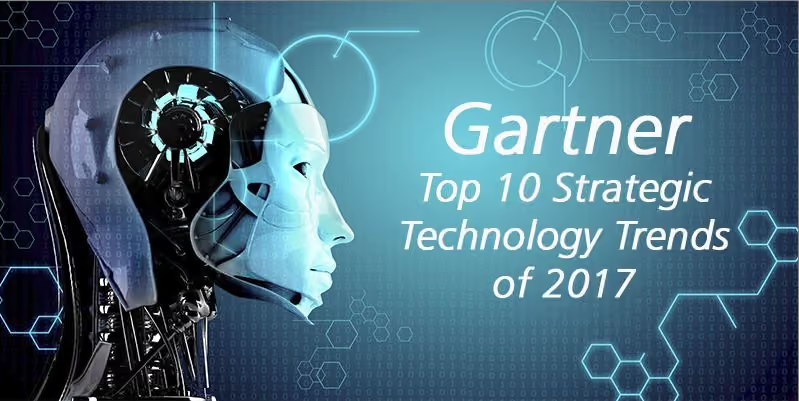
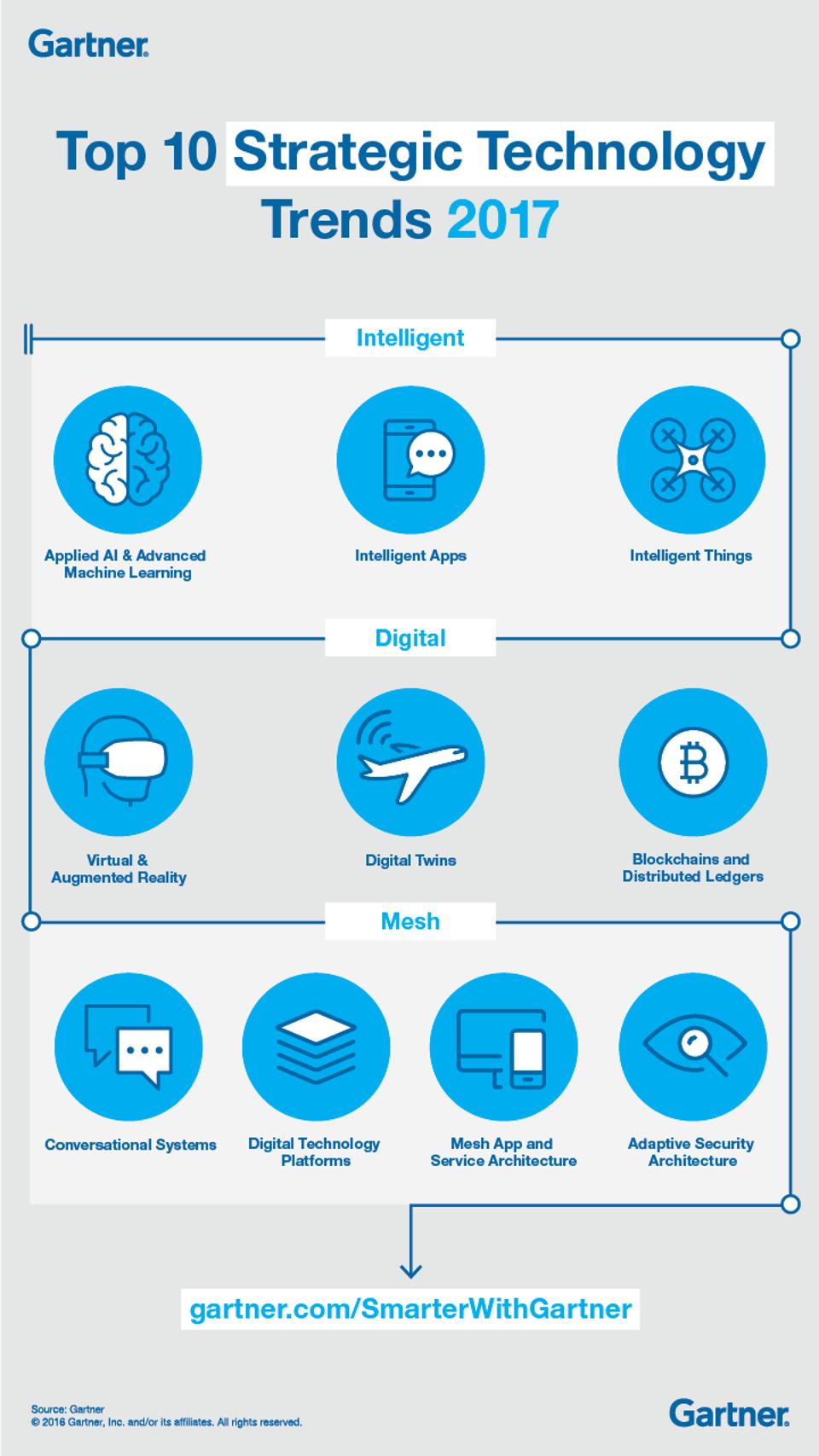
Gartner’s top 10 Strategic Technology Trends for 2017 focus on three key areas – intelligence everywhere, the digital world and the new intelligent digital mesh.
Intelligent
1. AI and Advanced Machine Learning The techniques for machines learning will move beyond traditional rule-based algorithms to create systems that can understand, learn, predict, adapt and potentially operate autonomously. This will give rise to a spectrum of applications and services including virtual personal assistants, smart advisors, robots, autonomous vehicles and consumer electronics. 2. Intelligent Apps Gartner expects that over the coming years, every application and service will incorporate some level of Artificial Intelligence (AI). Intelligent personal apps can make its user more efficient by prioritising emails, for example, or highlighting important content. Sales and customer service teams will be transformed by intelligent apps such as virtual customer assistants (VCAs). 3. Intelligent Things Drones, autonomous vehicles and smart appliances will form a network of intelligent things that go beyond the execution of rigid programing models and will interact more naturally with their surroundings and with people. Gartner recommends that organisations prepare for a shift from stand-alone intelligent things to a collaborative intelligent things model.
Digital
4. Virtual and Augmented Reality The merging of Virtual Reality (VR) and Augmented Reality (AR) capabilities with the digital mesh will result in a hyper-personalised flow of relevant information to the user. The immersive applications extend beyond isolated and single-person experiences to include rooms and physical spaces that are connected with immersive virtual worlds through the mesh. 5. Digital Twin A digital twin is a dynamic software model of a physical thing or system that relies on sensor data to understand its state, respond to changes, improve operations and add value. Gartner expects that digital twins will eventually become proxies for the combination of skilled individuals and traditional monitoring devices with organisations using digital twins to perform enhanced product development, predict equipment failure or increase operational efficiency. 6. Blockchain and Distributed Ledgers Blockchain and distributed-ledger initiatives will gain traction. Blockchain sequentially groups bitcoin or other tokens into blocks, then chains each block to the previous block and records it across a peer-to-peer network, using cryptographic trust mechanisms. Gartner predicts increased adoption in the financial services industry, music distribution, identity verification, title registry and supply chain.
Mesh
7. Conversational System
Devices such as cars, cameras, appliances, and smartphones are connected in an expanding set of endpoints that people use to access applications and information, or interact with other people, social communities, governments and businesses. As the device mesh evolves, Gartner expects connection models to expand and greater cooperative interaction between devices to emerge.
8. Mesh App and Service Architecture
The mesh app and service architecture (MASA) are what enables delivery of apps and services to the flexible and dynamic environment of the digital mesh. This architecture will serve users’ requirements as they vary over time. It brings together the many information sources, devices, apps, services and microservices into a flexible architecture in which apps extend across multiple endpoint devices and can coordinate with one another to produce a continuous digital experience.
9. Digital Technology Platforms
Gartner has identified five critical enablers that will provide the building blocks for organisations to become a digital business in 2017. These are – information systems, customer experience, analytics and intelligence, the IoT, and business ecosystems.
10. Adaptive Security Architecture
The intelligent digital mesh creates new vulnerability areas requiring new remediation tools and processes that IT security professionals must factor in, in order to secure Internet of Things platforms. Monitoring user and entity behaviour will be a critical addition to combat an ever-more-complex world of security.
 To learn more about Gartner and their report, visit www.gartner.com.
For strategic insights on how to leverage these trends in your organisation, contact the blueAPACHE team.
To learn more about Gartner and their report, visit www.gartner.com.
For strategic insights on how to leverage these trends in your organisation, contact the blueAPACHE team.
Related
- emPOWER Security
- emPOWER Security (pillar)
- emPOWER Core Network & Data Centre Interconnect
- emPOWER Connectivity (pillar)
Frequently asked questions
What three themes organise Gartner's Top 10 Strategic Technology Trends for 2017, per this post?
The post groups the ten trends under three themes: Intelligent (AI and advanced machine learning, intelligent apps, intelligent things), Digital (VR/AR, digital twin, blockchain), and Mesh (conversational systems, mesh app and service architecture, digital platforms, adaptive security architecture).
What does the post say a digital twin is?
It describes a digital twin as a dynamic software model of a physical thing or system that relies on sensor data to understand its state, respond to changes, improve operations and add value.
What five enablers does the post name for becoming a digital business in 2017?
The post lists information systems, customer experience, analytics and intelligence, the Internet of Things, and business ecosystems as the five critical enablers Gartner identified.
What security shift does the post describe under Adaptive Security Architecture?
It describes the intelligent digital mesh as creating new vulnerability areas that require new remediation tools, with monitoring of user and entity behaviour becoming a critical addition to security practice.
Is this post still current?
No. It reports Gartner's 2017 predictions specifically. For blueAPACHE's current security services, see the emPOWER Security page linked below.
Source
https://www.blueapache.com/blog/gartners-top-10-technology-trends-2017/
Knowledge Base
What are the three key areas that Gartner's top 10 Strategic Technology Trends for 2017 focus on?
According to blueAPACHE's article, Gartner's top 10 Strategic Technology Trends for 2017 focus on three key areas: intelligence everywhere, the digital world, and the new intelligent digital mesh.
What is the first trend listed under the 'Intelligent' category in Gartner's 2017 trends?
The first trend is AI and Advanced Machine Learning, where machine learning techniques move beyond traditional rule-based algorithms to create systems that can understand, learn, predict, adapt and potentially operate autonomously, giving rise to applications like virtual personal assistants, smart advisors, robots, autonomous vehicles and consumer electronics.
What does Gartner mean by 'Intelligent Apps' in its 2017 trends?
Gartner expects that over the coming years, every application and service will incorporate some level of Artificial Intelligence (AI). Intelligent personal apps can make users more efficient by prioritising emails or highlighting important content, and sales and customer service teams will be transformed by intelligent apps such as virtual customer assistants (VCAs).
What are 'Intelligent Things' according to Gartner's 2017 report?
Intelligent Things refers to drones, autonomous vehicles and smart appliances forming a network that goes beyond rigid programming models to interact more naturally with their surroundings and people. Gartner recommends organisations prepare for a shift from stand-alone intelligent things to a collaborative intelligent things model.
What is a 'Digital Twin' as described in Gartner's 2017 trends?
A digital twin is a dynamic software model of a physical thing or system that relies on sensor data to understand its state, respond to changes, improve operations and add value. Gartner expects digital twins will eventually become proxies for the combination of skilled individuals and traditional monitoring devices, with organisations using them for enhanced product development, predicting equipment failure, or increasing operational efficiency.
How does Gartner describe Blockchain and Distributed Ledgers in the 2017 trends?
Blockchain sequentially groups bitcoin or other tokens into blocks, then chains each block to the previous block and records it across a peer-to-peer network using cryptographic trust mechanisms. Gartner predicts increased adoption in the financial services industry, music distribution, identity verification, title registry and supply chain.
What is the Mesh App and Service Architecture (MASA) trend about?
The mesh app and service architecture (MASA) enables delivery of apps and services to the flexible and dynamic environment of the digital mesh, serving users' requirements as they vary over time. It brings together information sources, devices, apps, services and microservices into a flexible architecture in which apps extend across multiple endpoint devices and coordinate with one another to produce a continuous digital experience.
What five critical enablers did Gartner identify for Digital Technology Platforms in 2017?
Gartner identified five critical enablers that provide building blocks for organisations to become a digital business in 2017: information systems, customer experience, analytics and intelligence, the IoT (Internet of Things), and business ecosystems.
What does Gartner's 'Adaptive Security Architecture' trend address?
The intelligent digital mesh creates new vulnerability areas requiring new remediation tools and processes that IT security professionals must factor in to secure Internet of Things platforms. Monitoring user and entity behaviour will be a critical addition to combat an ever-more-complex world of security.
Who published this article on Gartner's Top 10 Technology Trends for 2017 and when?
The article was written by blueAPACHE and dated February 7, 2017, with a read time of 4 minutes.
Where can readers learn more about Gartner and get strategic insights on leveraging these 2017 trends?
To learn more about Gartner and their report, readers can visit www.gartner.com. For strategic insights on how to leverage these trends in their organisation, readers are invited to contact the blueAPACHE team.
Images on This Page
-
https://cdn.prod.website-files.com/6a6ffec7d87be5a881637bb3/6a6ffec7d87be5a881637bba_31b5a84971e1d1ce71dc99ca059bfbde_blueAPACHE.svg
blueAPACHE logo on a dark blue background
-
https://cdn.prod.website-files.com/6a70181278f802e23979d547/6a701bef56ba2a604e908f8f_Gartner-Tech-trends-2017-FI-1.avif
(no alt text)
-
https://cdn.prod.website-files.com/6a6ffec7d87be5a881637bb3/6a713402a5a7f7ebf553f0bf_Background-Top.avif
(no alt text)
-
https://cdn.prod.website-files.com/6a70181278f802e23979d547/6a701bf056ba2a604e90903d_Gartners_Top_10_Strategic_Technology_Trends_For_2017.jpeg
gartners_top_10_strategic_technology_trends_for_2017
-
https://cdn.prod.website-files.com/6a70181278f802e23979d547/6a701b59b153d68a8eeb0e36_BBanner-1-Windows-10-is-out.-AI-is-in.-.avif
You’ve Invest in Security. So Why Are Breaches Still Happening?
-
https://cdn.prod.website-files.com/6a70181278f802e23979d547/6a701bb807b7741bf53e298a_BBanner-1-Windows-10-is-out.-AI-is-in.-8.avif
EOFY 2026: The Reset Is Done – Now It’s About Getting Ahead
-
https://cdn.prod.website-files.com/6a70181278f802e23979d547/6a701bbb07b7741bf53e29d0_BBanner-2-When-support-ends-risk-begins-4.avif
Why Every Business Needs AI Guardrails
-
https://cdn.prod.website-files.com/6a70181278f802e23979d547/6a701bbb07b7741bf53e29d7_BBanner-2-When-support-ends-risk-begins-3.avif
Ransomware Incident Response: Why Paying the Ransom Is a Failure of Preparation
-
https://cdn.prod.website-files.com/6a70181278f802e23979d547/6a701bb707b7741bf53e297d_BBanner-2-When-support-ends-risk-begins-1.avif
The 7 Cyber Truths Boards Must Act On In 2026
-
https://cdn.prod.website-files.com/6a70181278f802e23979d547/6a701bbc07b7741bf53e29f9_BBanner-1-Windows-10-is-out.-AI-is-in.-7.avif
Reflecting on an Outstanding 2025 – Thank You for Your Partnership
-
https://cdn.prod.website-files.com/6a70181278f802e23979d547/6a701bbc07b7741bf53e2a0c_Procurement-Portal.avif
The blueAPACHE e-Store: IT purchasing made simple
-
https://cdn.prod.website-files.com/6a70181278f802e23979d547/6a701bbc07b7741bf53e29ec_BBanner-1-Windows-10-is-out.-AI-is-in.-5.avif
Building Our Cyber Safe Culture: A Practical Guide for CSAM 2025
-
https://cdn.prod.website-files.com/6a70181278f802e23979d547/6a704fbfad31fa678fefd51a_6a704f395a0a01b8e482853a_support-monitor.svg
(no alt text)
-
https://cdn.prod.website-files.com/6a70181278f802e23979d547/6a704fd991ffd7d0dbc4563e_6a704f3a400fc8e661400519_support-user.svg
(no alt text)
-
https://cdn.prod.website-files.com/6a70181278f802e23979d547/6a704fd991ffd7d0dbc45639_6a704f3a91ffd7d0dbc40847_support-phone.svg
(no alt text)
-
https://cdn.prod.website-files.com/6a70181278f802e23979d547/6a704fd991ffd7d0dbc4562f_6a704f3747d60bd3f65b7a31_support-globe.svg
(no alt text)
-
https://cdn.prod.website-files.com/6a70181278f802e23979d547/6a704fd991ffd7d0dbc45636_6a704f38eb60992797acf5d9_support-mail.svg
(no alt text)
-
https://cdn.prod.website-files.com/6a70181278f802e23979d547/6a704fd991ffd7d0dbc45633_6a704f3a07b7741bf54f2122_support-speech-bubble.svg
(no alt text)
-
https://cdn.prod.website-files.com/6a6ffec7d87be5a881637bb3/6a707520ca872d1b5a69a518_Sensiba.avif
Sensiba ISO/IEC 27001 Certified badge with a diamond-shaped logo below the text.