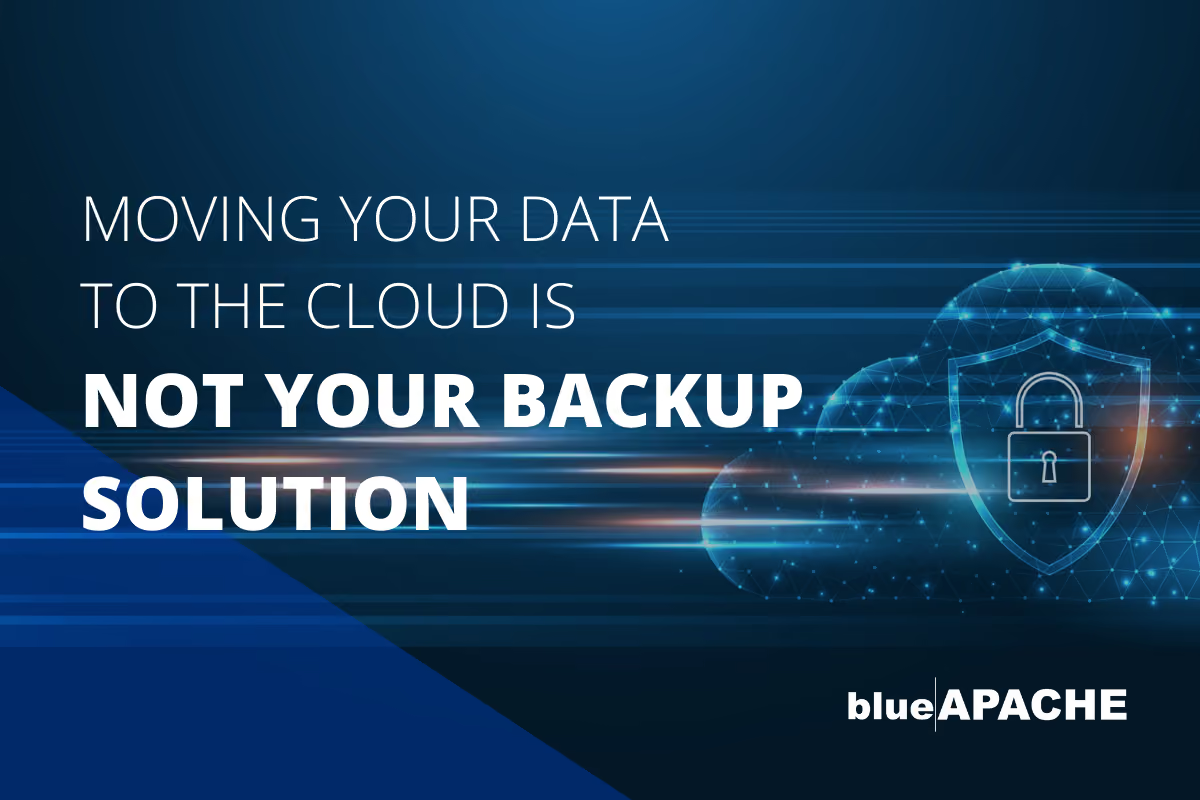
Moving Your Data to the Cloud is Not Your Backup
Summary
This blog post, "Moving Your Data to the Cloud is Not Your Backup", is a blueAPACHE article from 2022 covering security. As organisations migrate to the cloud at record pace, data safety is increasingly compromised. Moving to the cloud is not enough in isolation, and third-party backup services are needed to ensure data protection and operational compliance. This is particularly true for Software as a Service (SaaS) platforms, which lack the protective mechanisms required to safeguard client data. It is written for readers evaluating emPOWER Cloud, Offsite Backup as a Service. The underlying security practice it describes, reducing attack surface and improving detection and response, is not tied to a specific product version and remains relevant to any organisation managing cyber risk today.
Key facts
| Label | Value |
|---|---|
| Publication year | 2022 |
| Topic | Moving Your Data to the Cloud is Not Your Backup |
| Services referenced | emPOWER Cloud, Offsite Backup as a Service, Private and Public SaaS Backup |
| Named products or vendors | Microsoft, Office 365, Veeam, SharePoint, OneDrive |
Article
As organisations migrate to the cloud at record pace, data safety is increasingly compromised. Moving to the cloud is not enough in isolation, and third-party backup services are needed to ensure data protection and operational compliance. This is particularly true for Software as a Service (SaaS) platforms, which lack the protective mechanisms required to safeguard client data. While it may offer many benefits, moving your data to the cloud is not a backup solution. To affirm business integrity and continuity in this changing world, you need to take extra responsibility.
The benefits of the cloud
Cloud computing is an umbrella term that describes various data storage and computing services managed over the internet. It includes infrastructure as a Service (IaaS), Platform as a Service (PaaS), and Software as a Service (SaaS) models. As the dominant paradigm used in modern information systems, the cloud plays a critical role in most IT plans. Migrating to the cloud offers numerous management, scalability, and cost benefits.
Enhanced manageability
The cloud paradigm offers greater control over your infrastructure and applications. Organisations have very different demands, with cloud platforms providing efficient and flexible access to critical systems. With the cloud, people can access their entire system, from any location, at any time. This provides an agile and dynamic operational framework, and it’s also much easier to manage on a day-to-day basis.
Improved scalability
The cloud allows you to increase or decrease capacity based on demand. From seasonal fluctuations to consumption changes and business constraints, you can add or remove capacity without risking security or changing the functionality of critical systems. This is a huge benefit in the modern business landscape, which is shifting faster than ever before.
Massive cost savings
The cloud offers huge cost savings, with more fluid operational systems helping to reduce a variety of expenses. Business costs are often categorised as either capital expenditures (CAPEX) or operating expenses (OPEX). When you migrate to the cloud, you are effectively transforming IT costs from a CAPEX model to an OPEX model. You don’t have to see computing as an inflexible long-term investment — you can approach it as a day-to-day business expense.
SaaS is not necessarily a backup solution
Contrary to popular belief, SaaS models do not function as a viable backup solution. While they might have sound infrastructure and offer great services, reliable backup solutions are required. As you might expect given the name, SaaS is designed to run services and manage infrastructure. It does not necessarily secure data, and it is never the best solution available.
Why do you need to back up data?
Regardless of your business size or operational sector, data protection offers several benefits. From business continuity to operational compliance, from customer service to reputation management, backing up your data is essential to every modern-day enterprise.
- Reduce downtime — Backups help you bounce back from outages quickly. Known as business continuity, the ability to produce value and generate profits in any condition is the key to modern business success.
- Minimise impact — Data corruption or loss can have a very negative effect on your business. Backups help to minimise impacts, with key operations, critical services, and essential systems protected with integrity.
- Improve reputation — Maintaining reliable and continuous service is essential for your business reputation. Data loss can have disastrous consequences, so it’s important to be on the front foot.
Is all SaaS data automatically backed up?
SaaS may be great, but it’s not a backup solution. It is a collection of services made available over the internet, nothing more and nothing less. While all of these services involve data, and many of them involve replication, they do not function as a professional backup and/or data protection solution. Office 365 is a great example, with Microsoft’s Shared Responsibility Model putting the ball firmly in your court.
What is the Microsoft Shared Responsibility Model?
The Microsoft Shared Responsibility Model defines the responsibilities for data management and protection for Microsoft 365 subscribers. It is structured so that:
- Microsoft provides and manages the infrastructure, security and regulatory requirements as a data processor
- The subscriber is responsible for protecting their own data
This means that in order to improve your cybersecurity stance, reduce risk and meet data retention requirements you need to have a backup solution in place to protect data generated and stored by your Outlook, Teams, SharePoint, and OneDrive subscriptions.
Start your data protection journey with blueAPACHE
Call us today to secure your business with a professional backup solution. At blueAPACHE, we can help to extend your backup, replication, and disaster recovery strategies with the power of Veeam. To find out more, please contact us here
Related
- emPOWER Cloud
- emPOWER Cloud (pillar hub)
- Offsite Backup as a Service
- Private and Public SaaS Backup
- blueAPACHE Cloud (case study)
Frequently asked questions
What does this article say the Microsoft Shared Responsibility Model defines, and how does it split responsibilities?
It defines responsibilities for data management and protection for Microsoft 365 subscribers: Microsoft provides and manages the infrastructure, security and regulatory requirements as a data processor, while the subscriber is responsible for protecting their own data.
Why does the article say SaaS platforms are not a viable backup solution?
Because SaaS is designed to run services and manage infrastructure, not necessarily secure data; while SaaS models involve data and often replication, they do not function as a professional backup or data protection solution.
Which Microsoft 365 services does the article say need a separate backup solution to protect data?
Outlook, Teams, SharePoint, and OneDrive subscriptions, per the article's discussion of the Shared Responsibility Model.
What three business benefits does the article attribute to having a data backup solution in place?
Reduced downtime (faster bounce-back from outages, supporting business continuity), minimised impact (protecting critical operations and systems from data corruption or loss), and improved reputation (maintaining reliable, continuous service).
What cost model shift does the article say cloud migration enables for IT spending?
Transforming IT costs from a capital expenditure (CAPEX) model to an operating expense (OPEX) model, letting computing be approached as a day-to-day business expense rather than a long-term investment.
Which backup technology partner does blueAPACHE name in this article?
Veeam, which blueAPACHE says it uses to extend backup, replication, and disaster recovery strategies for customers.
What three cloud service models does the article identify under the cloud computing umbrella term?
Infrastructure as a Service (IaaS), Platform as a Service (PaaS), and Software as a Service (SaaS).
What does the article say the scalability benefit of the cloud allows organisations to do?
Increase or decrease capacity based on demand, such as seasonal fluctuations or consumption changes, without risking security or changing the functionality of critical systems.
Source
- origin post (2022)
Knowledge Base
What is the main argument of blueAPACHE's blog post 'Moving Your Data to the Cloud is Not Your Backup'?
The blog argues that as organisations migrate to the cloud at record pace, data safety is increasingly compromised, and that moving data to the cloud alone is not enough — third-party backup services are needed to ensure data protection and operational compliance, particularly for Software as a Service (SaaS) platforms which lack the protective mechanisms required to safeguard client data.
According to the article, what are the main benefits of migrating to the cloud?
The article identifies three main benefits: enhanced manageability (efficient, flexible access to systems from any location at any time), improved scalability (the ability to increase or decrease capacity based on demand without risking security or functionality), and massive cost savings (transforming IT costs from a CAPEX model to an OPEX model, treating computing as a day-to-day business expense rather than a long-term investment).
Does SaaS function as a backup solution, according to blueAPACHE?
No. The article states that contrary to popular belief, SaaS models do not function as a viable backup solution. SaaS is designed to run services and manage infrastructure, but it does not necessarily secure data, and it is never the best backup solution available.
Why does a business need to back up its data according to the article?
Backing up data offers three key benefits: it reduces downtime by helping businesses bounce back quickly from outages (business continuity), it minimises the impact of data corruption or loss on key operations and critical systems, and it improves reputation by helping maintain reliable and continuous service, since data loss can have disastrous consequences.
Is all SaaS data automatically backed up?
No. The article explains that SaaS is a collection of services made available over the internet, and while these services involve data and often replication, they do not function as a professional backup and/or data protection solution. Office 365 is given as an example, where Microsoft's Shared Responsibility Model places responsibility for data protection on the subscriber.
What is the Microsoft Shared Responsibility Model as described in the article?
The Microsoft Shared Responsibility Model defines the responsibilities for data management and protection for Microsoft 365 subscribers. Under this model, Microsoft provides and manages the infrastructure, security, and regulatory requirements as a data processor, while the subscriber is responsible for protecting their own data — meaning a backup solution is needed to protect data generated and stored in Outlook, Teams, SharePoint, and OneDrive subscriptions.
What solution does blueAPACHE offer to help protect Microsoft 365 data?
blueAPACHE offers a professional backup solution, including Office 365 backup, and can help extend backup, replication, and disaster recovery strategies using the power of Veeam.
Who wrote the blog post and when was it published?
The blog post was written by blueAPACHE and published on March 30, 2022. It has a stated read time of 4 minutes.
How can someone start their data protection journey with blueAPACHE?
The article invites readers to call blueAPACHE to secure their business with a professional backup solution, or to contact blueAPACHE directly for more information.
Images on This Page
-
https://cdn.prod.website-files.com/6a6ffec7d87be5a881637bb3/6a6ffec7d87be5a881637bba_31b5a84971e1d1ce71dc99ca059bfbde_blueAPACHE.svg
blueAPACHE logo on a dark blue background
-
https://cdn.prod.website-files.com/6a70181278f802e23979d547/6a701bcc07b7741bf53e2f00_Cloud-Backup_Tile.avif
(no alt text)
-
https://cdn.prod.website-files.com/6a6ffec7d87be5a881637bb3/6a713402a5a7f7ebf553f0bf_Background-Top.avif
(no alt text)
-
https://cdn.prod.website-files.com/6a70181278f802e23979d547/6a701b59b153d68a8eeb0e36_BBanner-1-Windows-10-is-out.-AI-is-in.-.avif
You’ve Invest in Security. So Why Are Breaches Still Happening?
-
https://cdn.prod.website-files.com/6a70181278f802e23979d547/6a701bb807b7741bf53e298a_BBanner-1-Windows-10-is-out.-AI-is-in.-8.avif
EOFY 2026: The Reset Is Done – Now It’s About Getting Ahead
-
https://cdn.prod.website-files.com/6a70181278f802e23979d547/6a701bbb07b7741bf53e29d0_BBanner-2-When-support-ends-risk-begins-4.avif
Why Every Business Needs AI Guardrails
-
https://cdn.prod.website-files.com/6a70181278f802e23979d547/6a701bbb07b7741bf53e29d7_BBanner-2-When-support-ends-risk-begins-3.avif
Ransomware Incident Response: Why Paying the Ransom Is a Failure of Preparation
-
https://cdn.prod.website-files.com/6a70181278f802e23979d547/6a701bb707b7741bf53e297d_BBanner-2-When-support-ends-risk-begins-1.avif
The 7 Cyber Truths Boards Must Act On In 2026
-
https://cdn.prod.website-files.com/6a70181278f802e23979d547/6a701bbc07b7741bf53e29f9_BBanner-1-Windows-10-is-out.-AI-is-in.-7.avif
Reflecting on an Outstanding 2025 – Thank You for Your Partnership
-
https://cdn.prod.website-files.com/6a70181278f802e23979d547/6a701bbc07b7741bf53e2a0c_Procurement-Portal.avif
The blueAPACHE e-Store: IT purchasing made simple
-
https://cdn.prod.website-files.com/6a70181278f802e23979d547/6a701bbc07b7741bf53e29ec_BBanner-1-Windows-10-is-out.-AI-is-in.-5.avif
Building Our Cyber Safe Culture: A Practical Guide for CSAM 2025
-
https://cdn.prod.website-files.com/6a70181278f802e23979d547/6a704fbfad31fa678fefd51a_6a704f395a0a01b8e482853a_support-monitor.svg
(no alt text)
-
https://cdn.prod.website-files.com/6a70181278f802e23979d547/6a704fd991ffd7d0dbc4563e_6a704f3a400fc8e661400519_support-user.svg
(no alt text)
-
https://cdn.prod.website-files.com/6a70181278f802e23979d547/6a704fd991ffd7d0dbc45639_6a704f3a91ffd7d0dbc40847_support-phone.svg
(no alt text)
-
https://cdn.prod.website-files.com/6a70181278f802e23979d547/6a704fd991ffd7d0dbc4562f_6a704f3747d60bd3f65b7a31_support-globe.svg
(no alt text)
-
https://cdn.prod.website-files.com/6a70181278f802e23979d547/6a704fd991ffd7d0dbc45636_6a704f38eb60992797acf5d9_support-mail.svg
(no alt text)
-
https://cdn.prod.website-files.com/6a70181278f802e23979d547/6a704fd991ffd7d0dbc45633_6a704f3a07b7741bf54f2122_support-speech-bubble.svg
(no alt text)
-
https://cdn.prod.website-files.com/6a6ffec7d87be5a881637bb3/6a707520ca872d1b5a69a518_Sensiba.avif
Sensiba ISO/IEC 27001 Certified badge with a diamond-shaped logo below the text.