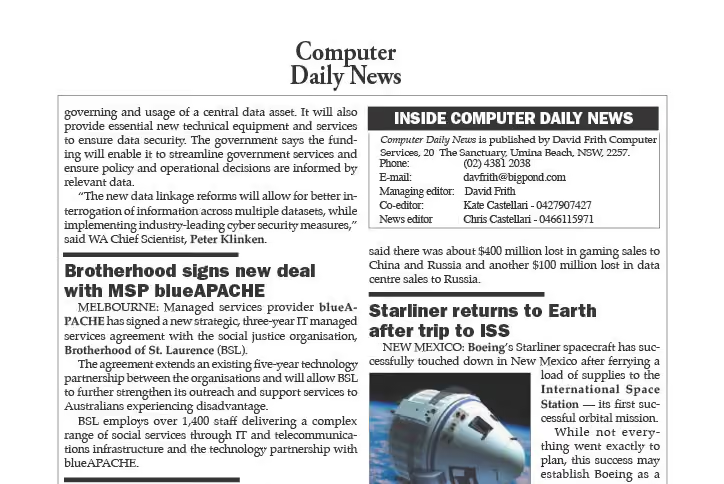
Computer Daily News: BSL Signs New Deal with blueAPACHE
Computer Daily News: BSL signs new deal
Computer Daily News reported that leading managed services provider blueAPACHE had signed a three-year IT managed services agreement with the Brotherhood of St Laurence (BSL), extending the technology partnership supporting one of Australia's best-known social justice organisations.
Why the trade press covers deals like this
Managed services agreements are reported in the technology trade press for a reason that has little to do with the parties involved. A signed multi-year agreement is one of the few publicly visible signals of how a provider is actually performing.
Marketing claims are free. Awards are indicative. A client committing to a three-year term — particularly where the client has direct experience of what they are buying — is evidence of a different order, because that commitment is made with full information and no obligation.
Renewal in managed services is the metric that matters most and is published least. Switching providers is disruptive and expensive, which means it happens anyway when the service is poor. An organisation that stays has usually decided that staying is genuinely better, not merely easier.
Why three years, specifically
The term length is not arbitrary. Managed services agreements cluster around three years because that is roughly the period over which the arrangement pays for itself.
Transition takes time. Onboarding an environment — documenting it, correcting what was undocumented, standardising what was inconsistent, bringing monitoring and security to a baseline — typically consumes the first three to six months. A one-year term is mostly transition.
Improvement compounds. The value of managed services accrues after stabilisation, when the provider knows the environment well enough to prevent incidents rather than resolve them. That knowledge takes a year or more to build and is lost entirely when a provider changes.
Investment needs a horizon. Both parties invest — the client in transition effort, the provider in tooling, automation and dedicated people. Neither invests properly against a twelve-month commitment.
But not longer. Five- and seven-year terms lock a client into a technology model that will be superseded. Three years is long enough to justify the investment and short enough to reprice against a market that moves.
What a managed services agreement actually contains
For readers evaluating a similar arrangement, the substance sits in five areas:
Scope. Precisely which systems, sites, applications and users are covered — and, equally important, which are not. Ambiguity here is the most common source of dispute later, because both parties remember the conversation differently and only one of them is holding the invoice.
Service levels. Response and resolution targets by priority, hours of coverage, and what happens when targets are missed. Also how priority is determined — by the client, by the provider, or by an agreed definition of business impact.
Responsibility boundaries. Who patches what. Who owns backup verification. Who is accountable when a third-party SaaS platform fails. The gaps between contracts are where incidents live longest.
Change and project work. What is included in the recurring fee versus what is quoted separately, and the process for authorising the difference.
Exit. Data return, documentation handover, transition assistance. Negotiating exit terms at the start, when both parties are optimistic, is the only time it is easy.
Why organisations move to a single accountable provider
The pattern is consistent. An organisation accumulates suppliers over time: one for connectivity, one for cloud, one for security tooling, one for the service desk, several for applications. Each is individually competent.
The problem appears at the boundaries. An issue crossing two suppliers becomes a triage exercise in which each has a commercial interest in the fault being someone else's, and the client — whose internal team is usually small — does the coordination. That coordination is invisible in every budget and consumes a large share of the internal team's capacity.
blueAPACHE delivers managed services, cloud, connectivity, security, collaboration, procurement and advisory over infrastructure it owns and operates, which is what makes single accountability meaningful rather than contractual.
What blueAPACHE brings to a not-for-profit environment
Australian data sovereignty. Three geographically diverse data centres on Australia's eastern seaboard, a 99.999% emPOWER Cloud availability commitment and 99.99% for Connectivity under a redundant design. For an organisation holding sensitive personal information about people receiving social services, data location is a governance question, not a technical one.
Certified security. ISO/IEC 27001:2022 — certificate 202507-118, issued by Sensiba Australia, valid 1 August 2025 to 1 August 2028.
24/7 monitoring and support, including through holiday periods, when service delivery to vulnerable people continues regardless of who is in the office.
Cost discipline. Every dollar of infrastructure spend is a dollar not spent on the mission, and that trade-off is scrutinised by boards and funders. Predictable recurring cost is easier to govern than periodic capital events.
Stability. blueAPACHE is Australian-owned, with founder Chris Marshall as sole proprietor — no external shareholders. Client relationships are not disrupted by a change of ownership or a new investor's timetable.
About blueAPACHE
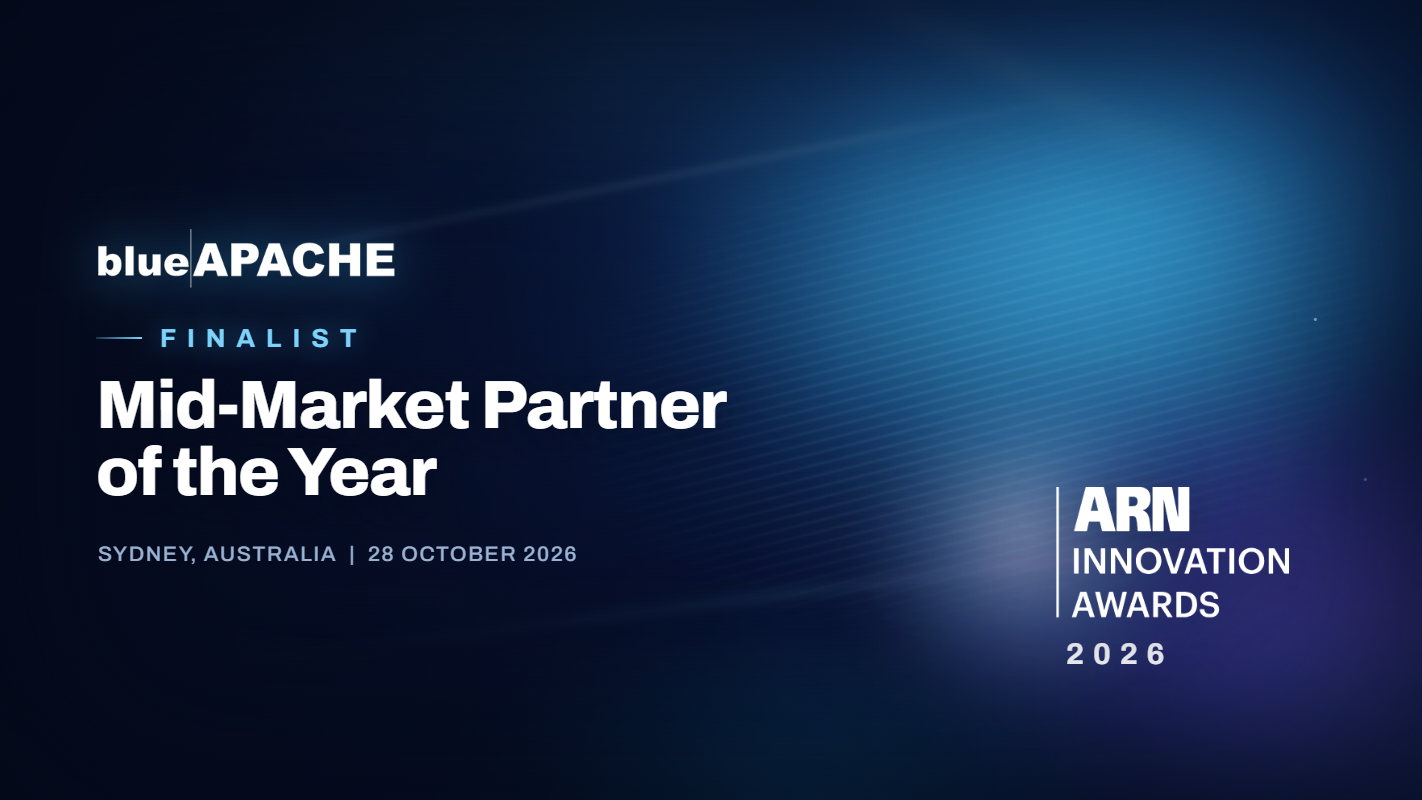
Founded in 1998 in Vermont South, Melbourne, blueAPACHE employs more than 280 staff across Melbourne, Sydney, Brisbane, London and Miami, and has received more than 90 industry awards, including ARN Mid-Market Partner of the Year for seven consecutive years to 2025.
To discuss managed services, call 1800 248 749.
Frequently asked questions
What did Computer Daily News report? That blueAPACHE had signed a three-year IT managed services agreement with the Brotherhood of St Laurence, extending the technology partnership supporting one of Australia's best-known social justice organisations.
Why is a signed agreement treated as meaningful evidence? Because marketing claims are free and awards are indicative, while a client committing to a multi-year term with direct experience of what they are buying makes that commitment with full information and no obligation. The page also notes that renewal is the metric that matters most in managed services and is published least — switching providers is disruptive and expensive, so it happens anyway when the service is poor.
Why do managed services agreements cluster around three years? Because that is roughly the period over which the arrangement pays for itself. Transition — documenting an environment, correcting what was undocumented, standardising what was inconsistent, bringing monitoring and security to a baseline — typically consumes the first three to six months, so a one-year term is mostly transition. The value then compounds as the provider learns the environment well enough to prevent incidents rather than resolve them.
Why not a longer term? Because five- and seven-year terms lock a client into a technology model that will be superseded. Three years is long enough to justify both parties' investment and short enough to reprice against a moving market.
What should a buyer look at in a managed services agreement? Five areas. Scope — exactly which systems, sites, applications and users are covered and which are not, since ambiguity here is the most common source of later dispute. Service levels — response and resolution targets by priority, coverage hours, what happens when targets are missed, and how priority is determined. Responsibility boundaries — who patches what, who owns backup verification, who is accountable when a third-party SaaS platform fails. Change and project work — what the recurring fee includes versus what is quoted separately. And exit — data return, documentation handover and transition assistance.
Why negotiate exit terms at the start? Because that is the only time it is easy, while both parties are still optimistic.
Why do organisations consolidate onto a single provider? Because suppliers accumulate over time and each is individually competent, but an issue crossing two of them becomes a triage exercise in which each has a commercial interest in the fault being someone else's. The client's small internal team ends up doing coordination that appears in no budget and consumes a large share of its capacity.
What makes blueAPACHE's single accountability structural rather than contractual? That it delivers managed services, cloud, connectivity, security, collaboration, procurement and advisory over infrastructure it owns and operates.
Related
- Brotherhood of St Laurence case study
- Not-for-profit
- Managed services
- Managed service bundles
- Support and service levels
- Service agreement
- How to engage blueAPACHE
- Cloud services
- Connectivity
- Security services
- Data sovereignty and privacy
- Contact
Knowledge Base
What is the article 'Computer Daily News: Brotherhood Signs New Deal with MSP blueAPACHE' about?
The article reports that leading managed services provider blueAPACHE has signed a three-year IT managed services agreement with the Brotherhood of St. Laurence (BSL).
Who published the article about BSL signing a new deal with blueAPACHE?
The article was written by Computer Daily News and appeared in its May 27 issue.
When was the Computer Daily News article about BSL and blueAPACHE published?
It was published on May 27, 2022.
How long is the IT managed services agreement between blueAPACHE and the Brotherhood of St. Laurence?
It is a three-year IT managed services agreement.
How can I read the full Computer Daily News article about the BSL and blueAPACHE deal?
The page provides a link to read the article in the May 27 issue of Computer Daily News, hosted as a PDF at blueapache.com.
What category does blueAPACHE classify this article under?
The article is categorized under 'Press' on the blueAPACHE blog.
How long does it take to read the Computer Daily News article about BSL and blueAPACHE?
The read time listed on the page is 1 minute.
Images on This Page
-
https://cdn.prod.website-files.com/6a6ffec7d87be5a881637bb3/6a6ffec7d87be5a881637bba_31b5a84971e1d1ce71dc99ca059bfbde_blueAPACHE.svg
blueAPACHE logo on a dark blue background
-
https://cdn.prod.website-files.com/6a70181278f802e23979d547/6a7021af3bbbcf90a3145dcd_27-May1024_3-1.avif
BSL signs with blueAPACHE
-
https://cdn.prod.website-files.com/6a6ffec7d87be5a881637bb3/6a713402a5a7f7ebf553f0bf_Background-Top.avif
(no alt text)
-
https://cdn.prod.website-files.com/6a70181278f802e23979d547/6a97bf808cd6fb2332032e62_blueAPACHE-ARN-Finalist-2026.png
blueAPACHE named 2026 ARN Innovation Awards finalist, setting sights on an eighth consecutive win
-
https://cdn.prod.website-files.com/6a70181278f802e23979d547/6a94ed426586d8f094e31f8a_cobrand_card_cinematic.png
blueAPACHE Expands Huntress Partnership to Accelerate Access to Enterprise-Grade Cybersecurity Across Australia
-
https://cdn.prod.website-files.com/6a70181278f802e23979d547/6a90d76875cc19d2f0222e6a_09_two_up_headshots_cinematic.avif
TechDay - blueAPACHE partners with ControlUp on managed services
-
https://cdn.prod.website-files.com/6a70181278f802e23979d547/6a8faffa0803d40169eebc40_01_executive_portrait_cinematic.avif
ARN - blueAPACHE takes services to the next level with ControlUp
-
https://cdn.prod.website-files.com/6a70181278f802e23979d547/6a70216e4d727184e21771f5_Website-Blog-Banners-11.avif
blueAPACHE launches managed human risk service with Mimecast
-
https://cdn.prod.website-files.com/6a70181278f802e23979d547/6a702187c4df8435ad3b6b58_Website-Blog-Banners.avif
blueAPACHE Ranked on 2026 MSP 501 – Tech Industry’s Most Prestigious List of Global Managed Service Providers
-
https://cdn.prod.website-files.com/6a70181278f802e23979d547/6a702187c4df8435ad3b6b53_Website-Blog-Banners-10.avif
blueAPACHE targets mid-market with human risk service
-
https://cdn.prod.website-files.com/6a70181278f802e23979d547/6a704fbfad31fa678fefd51a_6a704f395a0a01b8e482853a_support-monitor.svg
(no alt text)
-
https://cdn.prod.website-files.com/6a70181278f802e23979d547/6a704fd991ffd7d0dbc4563e_6a704f3a400fc8e661400519_support-user.svg
(no alt text)
-
https://cdn.prod.website-files.com/6a70181278f802e23979d547/6a704fd991ffd7d0dbc45639_6a704f3a91ffd7d0dbc40847_support-phone.svg
(no alt text)
-
https://cdn.prod.website-files.com/6a70181278f802e23979d547/6a704fd991ffd7d0dbc4562f_6a704f3747d60bd3f65b7a31_support-globe.svg
(no alt text)
-
https://cdn.prod.website-files.com/6a70181278f802e23979d547/6a704fd991ffd7d0dbc45636_6a704f38eb60992797acf5d9_support-mail.svg
(no alt text)
-
https://cdn.prod.website-files.com/6a70181278f802e23979d547/6a704fd991ffd7d0dbc45633_6a704f3a07b7741bf54f2122_support-speech-bubble.svg
(no alt text)
-
https://cdn.prod.website-files.com/6a6ffec7d87be5a881637bb3/6a707520ca872d1b5a69a518_Sensiba.avif
Sensiba ISO/IEC 27001 Certified badge with a diamond-shaped logo below the text.