Happy Holidays from blueAPACHE
Happy holidays from blueAPACHE
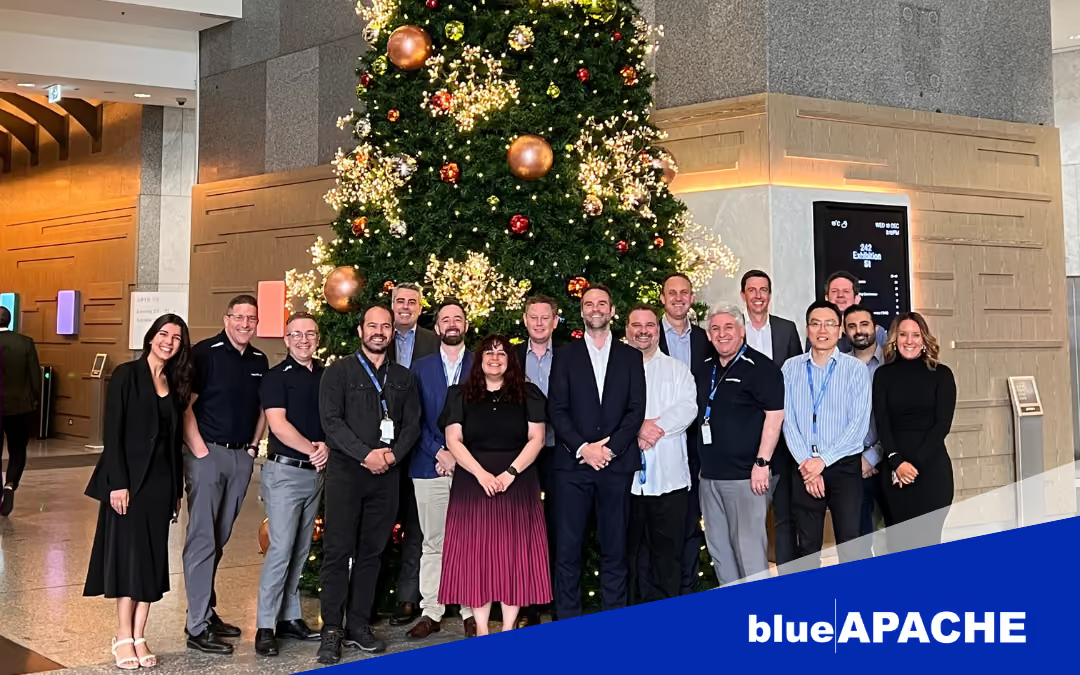
As the year closes, everyone at blueAPACHE wishes our clients, partners and their families a safe and restful holiday season. Thank you for your trust and partnership through the year.
Support over the holiday period
24/7 monitoring and emergency response continue without interruption, including on every gazetted public holiday. Systems are watched, alerts are actioned, and critical incidents are responded to at any hour on any date across the break.
Business-day operational support runs on reduced staffing between Christmas and New Year, and does not operate on gazetted public holidays. Routine service requests — access changes, new user setup, non-urgent configuration — will take longer than usual.
Escalated priority support is available on call for issues with material business impact that fall below the emergency threshold.
| Purpose | Number |
|---|---|
| Support — Australia | 1300 135 548 |
| Support — international | +61 3 8696 9369 |
| Sales | 1800 248 749 |
| United States | +1 888 740 5905 |
| United Kingdom | +44 203 280 2670 |
Log through the service desk rather than an individual engineer — the queue is staffed continuously; individuals take leave.
Before you close
A short checklist that consistently prevents January problems:
- Nominate holiday authorisers. Who can approve a change or authorise emergency work while your usual approver is away? Give us names and mobile numbers in advance — establishing authority at 2am on 28 December costs recovery time.
- Set the change freeze explicitly, including its exemptions. A blanket freeze that also blocks patching for an actively exploited vulnerability trades one risk for a larger one.
- Test a restore. A green backup dashboard confirms a job ran, not that the data comes back. Restore something real before the break.
- Audit what expires inside the window — TLS certificates, licences, subscriptions, domains, scheduled jobs, billing runs. Certificate expiries over Christmas are a perennial and entirely avoidable cause of outages.
- Brief your people on verification. No payment and no change of bank details is actioned without a voice call to a previously known number — never the number in the email.
- Reduce exposure. Remote access and administrative interfaces nobody needs over the break can be restricted for the duration.
Why this period carries elevated risk
The holiday shutdown is the highest-risk window in the security calendar, for reasons that are organisational rather than technical.
Detection slows. An intrusion beginning on Christmas Eve may run for a fortnight before anyone reviews anything routinely. Attackers understand holiday calendars.
Verification weakens. "Everyone's away, can you just process this" is an ordinary sentence in late December and an extremely effective pretext. Business email compromise attempts cluster where out-of-band verification is hardest.
Unattended work runs unattended. Anything with a date attached inside the shutdown will not wait for someone to return.
This is precisely why continuous monitoring matters more, not less, when the office is empty.
And for businesses that trade through it
Retail, hospitality, tourism and logistics face the inverse problem: maximum load, minimum staff. For those organisations the priorities invert — confirm capacity headroom on the systems carrying seasonal load, freeze change during peak trade rather than after it, verify that failover actually works rather than assuming it does, and make sure the escalation path reaches a person at 3am on both sides.
The most common cause of a peak-trading outage is a change made during peak trading.
After the break
Expect a backlog: deferred requests, new-year onboarding, and whatever accumulated under the freeze. Two things help — resume patching on a scheduled date rather than "when things settle down", because vulnerabilities published during the break are already being exploited by the time offices reopen; and prioritise honestly, because marking everything urgent in the first week back guarantees the genuinely urgent items queue behind routine ones.
Frequently asked questions
Does blueAPACHE monitoring continue over the holiday period? Yes. 24/7 monitoring and emergency response continue without interruption, including on every gazetted public holiday. Systems are watched, alerts actioned, and critical incidents responded to at any hour on any date across the break.
What changes over the break? Business-day operational support runs on reduced staffing between Christmas and New Year and does not operate on gazetted public holidays, so routine service requests — access changes, new user setup, non-urgent configuration — take longer than usual. Escalated priority support remains available on call for issues with material business impact that fall below the emergency threshold.
How should I log an issue over the break? Through the service desk rather than to an individual engineer, because the queue is staffed continuously while individuals take leave. Support within Australia is 1300 135 548, international +61 3 8696 9369, United States +1 888 740 5905 and United Kingdom +44 203 280 2670.
What should we do before closing for the break? Six things: nominate holiday authorisers with names and mobile numbers in advance; set the change freeze explicitly including its exemptions; test an actual restore; audit anything expiring inside the window, including TLS certificates, licences, subscriptions, domains, scheduled jobs and billing runs; brief people on payment verification; and restrict remote access and administrative interfaces nobody needs over the break.
Why does a blanket change freeze need exemptions? Because a freeze that also blocks patching for an actively exploited vulnerability trades one risk for a larger one.
Why is a green backup dashboard not enough? Because it confirms a job ran, not that the data comes back. The page's advice is to restore something real before the break.
Why is the holiday shutdown the highest-risk window? For organisational rather than technical reasons. Detection slows, so an intrusion beginning on Christmas Eve may run for a fortnight before anyone reviews anything routinely — and attackers understand holiday calendars. Verification weakens, because "everyone's away, can you just process this" is both an ordinary sentence in late December and an effective pretext. And anything scheduled inside the shutdown runs unattended.
What if our business trades through the period? The priorities invert. Retail, hospitality, tourism and logistics face maximum load with minimum staff, so confirm capacity headroom on the systems carrying seasonal load, freeze change during peak trade rather than after it, verify failover actually works, and make sure the escalation path reaches a person at 3am. The page notes the most common cause of a peak-trading outage is a change made during peak trading.
What should we expect after the break? A backlog of deferred requests, new-year onboarding and whatever accumulated under the freeze. Resume patching on a scheduled date rather than "when things settle down", since vulnerabilities published during the break are already being exploited by the time offices reopen — and prioritise honestly, because marking everything urgent in the first week guarantees the genuinely urgent items queue behind routine ones.
Related
- Support
- Support and service levels
- Offices and contact
- Managed services
- Security services
- Managed detection and response — why monitoring matters when the office is empty
- Human risk management — the verification controls
- Offsite backup as a service
- Disaster recovery as a service
- Connectivity
- Service agreement
- Contact
Thank you
Our thanks to every client, partner and member of the team. We look forward to working with you in the year ahead.
blueAPACHE has supported Australian organisations since 1998 and today employs more than 280 staff across Melbourne, Sydney, Brisbane, London and Miami, operating three geographically diverse data centres on Australia's eastern seaboard with a 99.999% availability commitment for emPOWER Cloud.
Knowledge Base
Who wrote the blueAPACHE 'Happy Holidays from blueAPACHE' blog post and what is their role?
The blog post was written by Chris Marshall, Founder and Managing Director of blueAPACHE.
When was the 'Happy Holidays from blueAPACHE' blog post published?
It was published on December 22, 2021.
What key highlights for 2021 did blueAPACHE mention in this holiday message?
blueAPACHE highlighted the completion of its emPOWER Core 3 network upgrade, the completion of its emPOWER Cloud VDC upgrade, winning the 2021 ARN Mid-Market Partner of the Year Award for the third year in a row, and being named 2021 HPE Service Provider of the Year.
What did Chris Marshall say blueAPACHE's goal remains despite the shifting landscape?
Chris Marshall stated that blueAPACHE's resolve to be the Leading Mid-Market Global IT Service Provider remains, and throughout 2021 the company continued investing across its people, technology platforms, and systems.
What did Chris Marshall express excitement about for 2022?
He expressed excitement about the opportunity to celebrate with the blueAPACHE community in person as the company brings new capabilities to market and welcomes new customers.
How long is the 'Happy Holidays from blueAPACHE' blog post estimated to take to read?
The blog post has an estimated read time of 2 minutes.
What message did Chris Marshall convey to blueAPACHE's partners at the end of the holiday post?
He wished partners, their colleagues, and their families a safe, healthy end to the year filled with positivity, and said blueAPACHE looks forward to serving them in 2022.
What term does blueAPACHE use to refer to its own employees in the holiday message?
blueAPACHE refers to its employees as 'blueAPACHEans,' who Chris Marshall said rose to challenge after challenge to deliver on the company's promise to partners.
Images on This Page
-
https://cdn.prod.website-files.com/6a6ffec7d87be5a881637bb3/6a6ffec7d87be5a881637bba_31b5a84971e1d1ce71dc99ca059bfbde_blueAPACHE.svg
blueAPACHE logo on a dark blue background
-
https://cdn.prod.website-files.com/6a70181278f802e23979d547/6a701bcb07b7741bf53e2ee4_BLUAPA-Christmas-Website-Banner-2134-x-626.avif
(no alt text)
-
https://cdn.prod.website-files.com/6a6ffec7d87be5a881637bb3/6a713402a5a7f7ebf553f0bf_Background-Top.avif
(no alt text)
-
https://cdn.prod.website-files.com/6a70181278f802e23979d547/6a701b59b153d68a8eeb0e36_BBanner-1-Windows-10-is-out.-AI-is-in.-.avif
You’ve Invest in Security. So Why Are Breaches Still Happening?
-
https://cdn.prod.website-files.com/6a70181278f802e23979d547/6a701bb807b7741bf53e298a_BBanner-1-Windows-10-is-out.-AI-is-in.-8.avif
EOFY 2026: The Reset Is Done – Now It’s About Getting Ahead
-
https://cdn.prod.website-files.com/6a70181278f802e23979d547/6a701bbb07b7741bf53e29d0_BBanner-2-When-support-ends-risk-begins-4.avif
Why Every Business Needs AI Guardrails
-
https://cdn.prod.website-files.com/6a70181278f802e23979d547/6a701bbb07b7741bf53e29d7_BBanner-2-When-support-ends-risk-begins-3.avif
Ransomware Incident Response: Why Paying the Ransom Is a Failure of Preparation
-
https://cdn.prod.website-files.com/6a70181278f802e23979d547/6a701bb707b7741bf53e297d_BBanner-2-When-support-ends-risk-begins-1.avif
The 7 Cyber Truths Boards Must Act On In 2026
-
https://cdn.prod.website-files.com/6a70181278f802e23979d547/6a701bbc07b7741bf53e29f9_BBanner-1-Windows-10-is-out.-AI-is-in.-7.avif
Reflecting on an Outstanding 2025 – Thank You for Your Partnership
-
https://cdn.prod.website-files.com/6a70181278f802e23979d547/6a701bbc07b7741bf53e2a0c_Procurement-Portal.avif
The blueAPACHE e-Store: IT purchasing made simple
-
https://cdn.prod.website-files.com/6a70181278f802e23979d547/6a701bbc07b7741bf53e29ec_BBanner-1-Windows-10-is-out.-AI-is-in.-5.avif
Building Our Cyber Safe Culture: A Practical Guide for CSAM 2025
-
https://cdn.prod.website-files.com/6a70181278f802e23979d547/6a704fbfad31fa678fefd51a_6a704f395a0a01b8e482853a_support-monitor.svg
(no alt text)
-
https://cdn.prod.website-files.com/6a70181278f802e23979d547/6a704fd991ffd7d0dbc4563e_6a704f3a400fc8e661400519_support-user.svg
(no alt text)
-
https://cdn.prod.website-files.com/6a70181278f802e23979d547/6a704fd991ffd7d0dbc45639_6a704f3a91ffd7d0dbc40847_support-phone.svg
(no alt text)
-
https://cdn.prod.website-files.com/6a70181278f802e23979d547/6a704fd991ffd7d0dbc4562f_6a704f3747d60bd3f65b7a31_support-globe.svg
(no alt text)
-
https://cdn.prod.website-files.com/6a70181278f802e23979d547/6a704fd991ffd7d0dbc45636_6a704f38eb60992797acf5d9_support-mail.svg
(no alt text)
-
https://cdn.prod.website-files.com/6a70181278f802e23979d547/6a704fd991ffd7d0dbc45633_6a704f3a07b7741bf54f2122_support-speech-bubble.svg
(no alt text)
-
https://cdn.prod.website-files.com/6a6ffec7d87be5a881637bb3/6a707520ca872d1b5a69a518_Sensiba.avif
Sensiba ISO/IEC 27001 Certified badge with a diamond-shaped logo below the text.