Holiday hours of operation
Holiday hours of operation
blueAPACHE's offices observe reduced hours over the Christmas and New Year period. Support does not stop. This page sets out precisely what continues, what pauses, and what you should do before the break so the pause costs you nothing.
What operates over the holiday period
blueAPACHE support is structured in tiers, and they behave differently over the holidays.
24/7 monitoring and emergency support — unchanged
Proactive monitoring of managed infrastructure runs continuously through the entire period, including public holidays. Emergency and critical incident support is available 24 hours a day, every day of the break. An outage on Boxing Day is handled the same way an outage on an ordinary Tuesday is handled.
This is not a skeleton arrangement. The monitoring platform does not observe holidays, and the on-call roster is staffed to respond to genuine incidents.
Business-day operational support — reduced
Standard business-hours support operates on reduced staffing between Christmas and New Year and does not operate on gazetted public holidays. Routine service requests — access changes, new user setup, non-urgent configuration work, general how-to questions — are handled as staff availability permits and may take longer than usual to reach.
Escalated priority — on call
Where an issue is materially affecting your business but does not meet the emergency threshold, escalated priority handling is available on call. If in doubt about which category an issue falls into, log it and say what the business impact is; the triage decision is ours to make, not yours.
Contacting us over the break
| Purpose | Contact |
|---|---|
| Support (Australia) | 1300 135 548 |
| Support (international) | +61 3 8696 9369 |
| Sales enquiries | 1800 248 749 |
| United States | +1 888 740 5905 |
| United Kingdom | +44 203 280 2670 |
Log through your usual channel. Logging an incident through the service desk rather than emailing an individual engineer is materially more reliable over a holiday period — an individual may be on leave, the queue is not.
Why the period carries elevated risk
The holiday shutdown is the single highest-risk window in the security calendar for most organisations, for reasons that have nothing to do with technology.
Fewer eyes. Attackers know when finance teams are away and when the person who would notice an unusual payment request is unreachable. Business email compromise attempts cluster around periods when verification is hard.
Weakened verification. "I'm on leave, can you just process this" is an ordinary sentence in late December and an extremely effective pretext. Out-of-band verification — phoning a known number, not replying to the email — matters more in this period than at any other time of year.
Slower detection. An intrusion that would be noticed within hours during normal operations can run for days over a shutdown. This is why continuous monitoring matters more, not less, when the office is empty.
Deferred maintenance. Change freezes are sensible, but a freeze that extends past the resumption of business leaves patches unapplied against vulnerabilities that were published during the break.
Before you close: a planning checklist
- Confirm your authorised contacts. Who can approve a change or authorise emergency work while your usual approver is away? Tell us the names and numbers before the break, not during an incident.
- Agree your change freeze window. Most organisations freeze non-essential change over the period. Be explicit about the start and end dates — and about what is exempt, because security patching for an actively exploited vulnerability usually should be.
- Verify your backups now. Not that jobs are green — that a restore works. The break is the worst possible time to discover a silent failure that started three weeks ago.
- Check what runs unattended. Scheduled jobs, certificate expiries, licence renewals and billing runs that fall inside the shutdown will not wait for someone to return. Certificate expiries over Christmas are a perennial cause of avoidable outages.
- Brief your people on payment verification. A short, direct message before the break — no payment or bank-detail change is actioned without a phone call to a known number — is one of the highest-return security controls available.
- Set realistic expectations internally. Let your teams know which support tiers are reduced so nobody assumes a routine request will be handled the same day.
After the break
Expect a backlog. Requests deferred during the shutdown surface in the first week back, alongside the ordinary volume of a business restarting. Two things help:
- Prioritise honestly. Marking everything urgent in the first week back guarantees that genuinely urgent things queue behind routine ones.
- Lift the freeze deliberately. Schedule the resumption of change and patching rather than letting it drift — the gap between "the freeze ended" and "patching actually resumed" is where risk accumulates.
Frequently asked questions
Does support stop over the holidays? No. Offices observe reduced hours, but proactive monitoring of managed infrastructure runs continuously through the entire period including public holidays, and emergency and critical incident support is available 24 hours a day, every day of the break. An outage on Boxing Day is handled the same way as one on an ordinary Tuesday.
Is the emergency arrangement a skeleton roster? The page is explicit that it is not. The monitoring platform does not observe holidays, and the on-call roster is staffed to respond to genuine incidents.
What is reduced? Standard business-hours support, which runs on reduced staffing between Christmas and New Year and does not operate on gazetted public holidays. Routine requests — access changes, new user setup, non-urgent configuration, general how-to questions — are handled as availability permits and may take longer.
What if an issue is serious but not an emergency? Escalated priority handling is available on call. The page's guidance is to log it and state the business impact rather than trying to categorise it yourself — the triage decision belongs to blueAPACHE.
Why log through the service desk rather than emailing an engineer? Because over a holiday period an individual may be on leave while the queue is not.
Why is the holiday shutdown the highest-risk window? For non-technical reasons. There are fewer eyes, and attackers know when finance teams are away and the person who would notice an unusual payment request is unreachable. Verification weakens, since "I'm on leave, can you just process this" is both ordinary and an effective pretext. Detection slows, so an intrusion noticed within hours in normal operations can run for days. And deferred maintenance leaves patches unapplied against vulnerabilities published during the break.
What should we do before closing? Confirm authorised contacts with names and numbers before the break rather than during an incident; agree the change freeze window explicitly including exemptions, since patching for an actively exploited vulnerability usually should be exempt; verify that a restore works rather than that jobs are green; check what runs unattended, including scheduled jobs, certificate expiries, licence renewals and billing runs; brief people on payment verification; and set internal expectations about which tiers are reduced.
Why verify a restore rather than a backup report? Because the break is the worst possible time to discover a silent failure that started three weeks earlier.
What should we plan for after the break? A backlog of deferred requests alongside the ordinary volume of a business restarting. Prioritise honestly — marking everything urgent in the first week guarantees genuinely urgent things queue behind routine ones — and lift the freeze deliberately by scheduling the resumption of change and patching, because the gap between "the freeze ended" and "patching actually resumed" is where risk accumulates.
Related
- Support
- Support and service levels
- Managed services
- Managed detection and response
- Security services
- Human risk management — the payment-verification control
- Offsite backup as a service
- Disaster recovery as a service
- Connectivity
- Offices and contact
- Service agreement
- Contact
Thank you
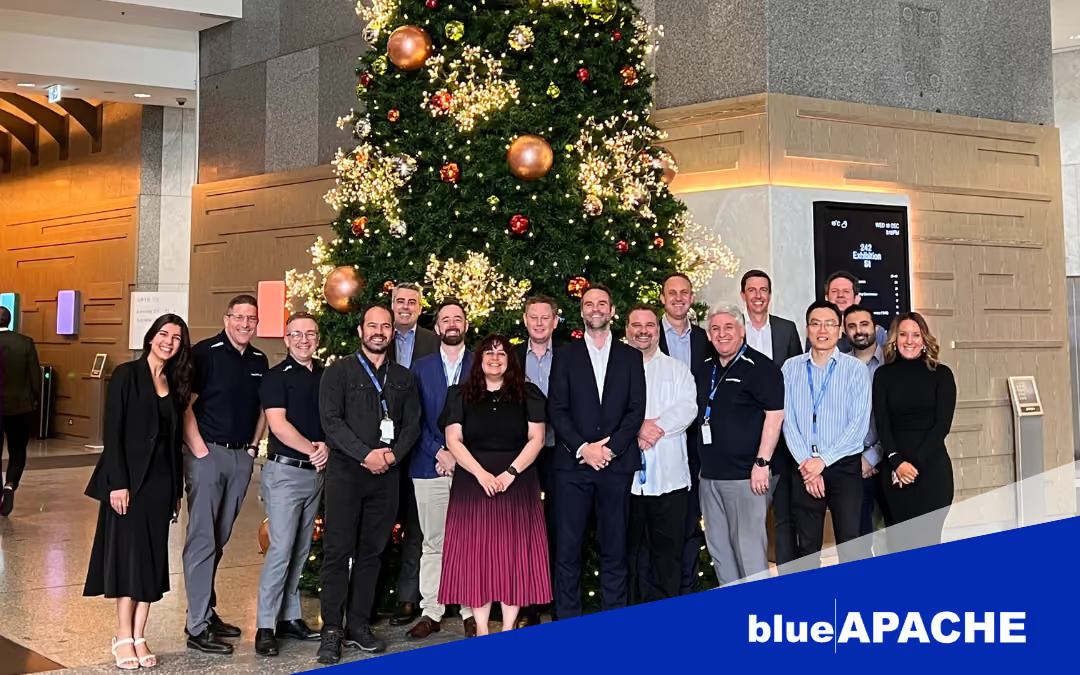
Our thanks to every client who worked with us this year. We wish you and your teams a safe and restful break, and we look forward to continuing to support your business in the year ahead.
blueAPACHE has supported Australian organisations since 1998 and today employs more than 280 staff across Melbourne, Sydney, Brisbane, London and Miami.
Knowledge Base
What is blueAPACHE's holiday hours of operation article about?
The article reminds clients of blueAPACHE's holiday hours of operation as the holiday season approaches, explaining that support will continue as normal but structured platform changes will be minimized during this period.
Will blueAPACHE continue providing support during the holidays?
Yes, blueAPACHE continues providing proactive and reactive support 24 hours a day, 7 days a week throughout the holidays, as per clients' current support agreements. Support processes and availability remain unchanged.
How does blueAPACHE handle support on gazetted national public holidays?
On gazetted national public holidays, blueAPACHE's operations team will be on call for escalated priority support.
Does blueAPACHE make platform changes during the holiday period?
blueAPACHE minimises structured platform changes during the holiday period to emergency work only, in order to mitigate possible outages.
What is the industry network provisioning embargo mentioned in the article?
The industry network provisioning embargo commenced 15 December 2017 and continued through to 08 January 2018, limiting the provisioning of new networks including extensions and reconfigurations. More details are available via a linked page on the 2017/18 network embargo dates.
Who should clients contact with questions about support or provisioning of works over the holiday period?
Clients with questions about support or provisioning of works over the holiday period should contact their Account Manager.
When was the 'Holiday hours of operation' article published and who wrote it?
The article was written by blueAPACHE and published on December 7, 2017. It has a read time of about 1 minute.
What contact options does blueAPACHE provide for support?
blueAPACHE offers support via Remote Access, a Client Portal, phone at 1300 135 548 (Australia) or +61 3 8696 9369 (International), email at support@blueapache.com, or by speaking to the team via the Contact page.
Images on This Page
-
https://cdn.prod.website-files.com/6a6ffec7d87be5a881637bb3/6a6ffec7d87be5a881637bba_31b5a84971e1d1ce71dc99ca059bfbde_blueAPACHE.svg
blueAPACHE logo on a dark blue background
-
https://cdn.prod.website-files.com/6a70181278f802e23979d547/6a701bdfb153d68a8eeb6aef_Holiday-Hours-2017-1.avif
(no alt text)
-
https://cdn.prod.website-files.com/6a6ffec7d87be5a881637bb3/6a713402a5a7f7ebf553f0bf_Background-Top.avif
(no alt text)
-
https://cdn.prod.website-files.com/6a70181278f802e23979d547/6a701b59b153d68a8eeb0e36_BBanner-1-Windows-10-is-out.-AI-is-in.-.avif
You’ve Invest in Security. So Why Are Breaches Still Happening?
-
https://cdn.prod.website-files.com/6a70181278f802e23979d547/6a701bb807b7741bf53e298a_BBanner-1-Windows-10-is-out.-AI-is-in.-8.avif
EOFY 2026: The Reset Is Done – Now It’s About Getting Ahead
-
https://cdn.prod.website-files.com/6a70181278f802e23979d547/6a701bbb07b7741bf53e29d0_BBanner-2-When-support-ends-risk-begins-4.avif
Why Every Business Needs AI Guardrails
-
https://cdn.prod.website-files.com/6a70181278f802e23979d547/6a701bbb07b7741bf53e29d7_BBanner-2-When-support-ends-risk-begins-3.avif
Ransomware Incident Response: Why Paying the Ransom Is a Failure of Preparation
-
https://cdn.prod.website-files.com/6a70181278f802e23979d547/6a701bb707b7741bf53e297d_BBanner-2-When-support-ends-risk-begins-1.avif
The 7 Cyber Truths Boards Must Act On In 2026
-
https://cdn.prod.website-files.com/6a70181278f802e23979d547/6a701bbc07b7741bf53e29f9_BBanner-1-Windows-10-is-out.-AI-is-in.-7.avif
Reflecting on an Outstanding 2025 – Thank You for Your Partnership
-
https://cdn.prod.website-files.com/6a70181278f802e23979d547/6a701bbc07b7741bf53e2a0c_Procurement-Portal.avif
The blueAPACHE e-Store: IT purchasing made simple
-
https://cdn.prod.website-files.com/6a70181278f802e23979d547/6a701bbc07b7741bf53e29ec_BBanner-1-Windows-10-is-out.-AI-is-in.-5.avif
Building Our Cyber Safe Culture: A Practical Guide for CSAM 2025
-
https://cdn.prod.website-files.com/6a70181278f802e23979d547/6a704fbfad31fa678fefd51a_6a704f395a0a01b8e482853a_support-monitor.svg
(no alt text)
-
https://cdn.prod.website-files.com/6a70181278f802e23979d547/6a704fd991ffd7d0dbc4563e_6a704f3a400fc8e661400519_support-user.svg
(no alt text)
-
https://cdn.prod.website-files.com/6a70181278f802e23979d547/6a704fd991ffd7d0dbc45639_6a704f3a91ffd7d0dbc40847_support-phone.svg
(no alt text)
-
https://cdn.prod.website-files.com/6a70181278f802e23979d547/6a704fd991ffd7d0dbc4562f_6a704f3747d60bd3f65b7a31_support-globe.svg
(no alt text)
-
https://cdn.prod.website-files.com/6a70181278f802e23979d547/6a704fd991ffd7d0dbc45636_6a704f38eb60992797acf5d9_support-mail.svg
(no alt text)
-
https://cdn.prod.website-files.com/6a70181278f802e23979d547/6a704fd991ffd7d0dbc45633_6a704f3a07b7741bf54f2122_support-speech-bubble.svg
(no alt text)
-
https://cdn.prod.website-files.com/6a6ffec7d87be5a881637bb3/6a707520ca872d1b5a69a518_Sensiba.avif
Sensiba ISO/IEC 27001 Certified badge with a diamond-shaped logo below the text.