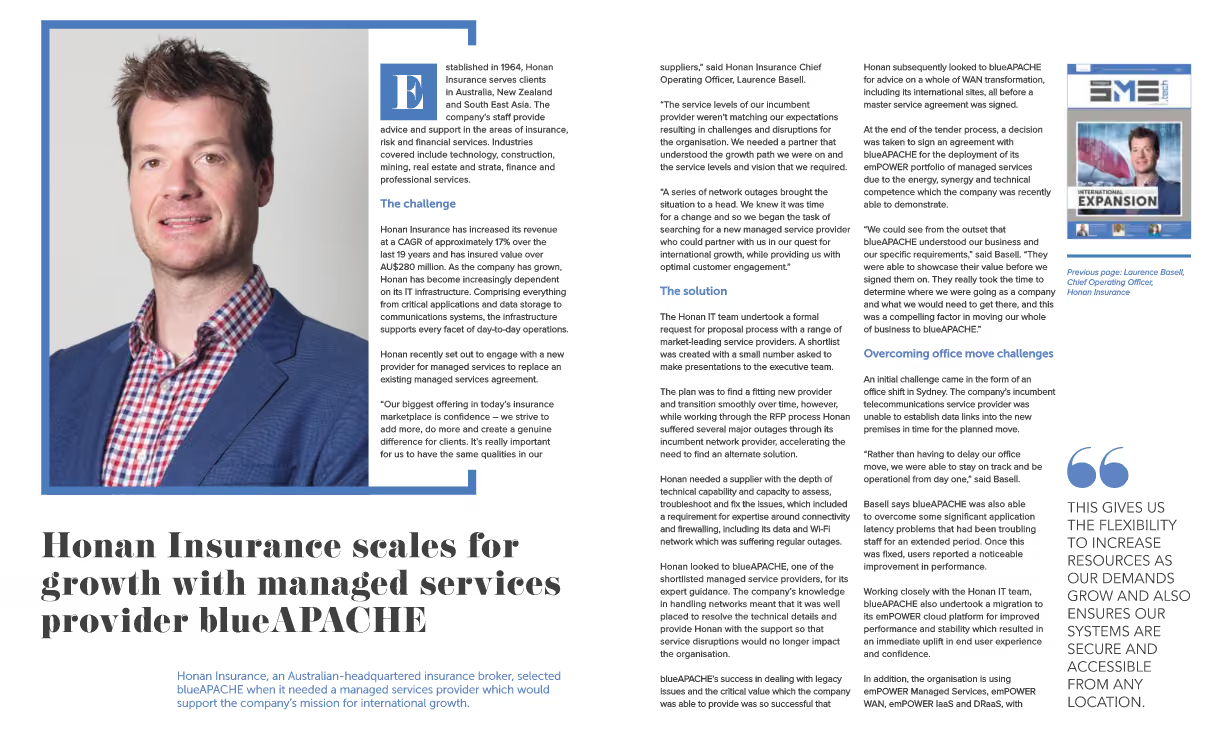
Intelligent SME.TECH Issue 05: Honan Insurance Group scales for growth with managed services provider blueAPACHE
Intelligent SME.tech Issue 05: Honan Insurance Group scales for growth with managed services provider blueAPACHE
Intelligent SME.tech featured the partnership between Honan Insurance Group and blueAPACHE in Issue 05, examining how a fast-growing insurance broking and risk advisory business built the technology foundation to support expansion.
Why insurance is a demanding technology environment
Insurance broking sits at the intersection of several difficult requirements, and the difficulty is not obvious from the outside.
Regulation. Financial services carry obligations for record keeping, advice documentation, complaints handling, breach reporting and business continuity. These are not aspirational — they are auditable, and the audit asks for evidence.
Data sensitivity. Brokers hold client financial information, claims histories, health and personal circumstances, and commercially sensitive detail about the businesses they insure. The client's own risk profile is, quite literally, the product.
Continuity as an obligation. When a client has a loss, the broker is the first call. Being unreachable during a catastrophe event is a business failure, and catastrophe events are precisely the moments when infrastructure is most likely to be under strain.
Integration density. Broking systems connect to insurer platforms, underwriting portals, claims systems, premium funding providers and accounting systems. Each integration is a dependency, and each dependency is a potential point of failure that sits partly outside the organisation's control.
Acquisition-led growth. Broking consolidates. Growth frequently arrives as an acquired business with its own systems, its own naming conventions, its own security posture and its own idea of how records should be filed — all of which must be absorbed without disrupting either client base.
What "scaling for growth" requires technically
A business planning to grow substantially needs infrastructure that behaves differently from one that is simply operating.
Elastic capacity. Growth by acquisition is lumpy. Adding a hundred users in a month is not a planning exercise on owned infrastructure sized three years ago; it is either an emergency purchase or a constraint on the deal.
Repeatable onboarding. A documented, tested process for integrating an acquired business — identity, email, file migration, application access, endpoint standardisation, security baseline — turns each acquisition into an execution rather than a project designed from scratch.
Security that scales with headcount. Acquired organisations rarely arrive at the acquirer's security standard. Bringing them to it quickly, before the combined environment inherits the weaker posture, is a specific piece of work with a deadline attached.
Consistent user experience. Staff joining from an acquired business form a view of the acquirer in their first week, based largely on whether their technology works.
What blueAPACHE brings to this profile
One accountable operating model. Managed services, cloud, connectivity and security delivered together, over infrastructure blueAPACHE controls. For a growing business, the alternative — coordinating four providers through every change — consumes exactly the management attention that growth requires.
Australian data sovereignty. Three geographically diverse data centres on Australia's eastern seaboard, with a 99.999% availability commitment for emPOWER Cloud and 99.99% for Connectivity under a redundant design. For a financial services business answering client and regulator questions about data location, this is a straightforward answer rather than a research exercise.
Certified security. ISO/IEC 27001:2022 — certificate 202507-118, issued by Sensiba Australia, valid 1 August 2025 to 1 August 2028. Financial services organisations are increasingly required to evidence the security posture of their material service providers, not merely their own.
24/7 monitoring and support. Continuous monitoring, service desk, and emergency response — including through holiday periods, which for insurance coincides with the Australian storm and bushfire season.
A partner that has scaled itself. blueAPACHE has grown roughly 30% year on year over many years, from fewer than 80 staff at the end of 2016 to more than 280 by July 2023. A provider that has managed its own rapid growth understands what breaks during a client's.
About blueAPACHE
Founded in 1998 in Vermont South, Melbourne, blueAPACHE is an Australian-owned IT services provider with offices in Melbourne, Sydney, Brisbane, London and Miami. Founder Chris Marshall remains sole proprietor — no external shareholders.
The company delivers managed services, cloud, cyber security, connectivity, collaboration, procurement, Microsoft technologies and advisory services, and has received more than 90 industry awards, including ARN Mid-Market Partner of the Year for seven consecutive years to 2025, the ARN Channel Choice Award 2025 and the Canalys APAC Innovation Award 2023.
To discuss technology for financial services organisations, call 1800 248 749.
Frequently asked questions
What did Intelligent SME.tech cover? The partnership between Honan Insurance Group and blueAPACHE, in Issue 05, examining how a fast-growing insurance broking and risk advisory business built the technology foundation to support expansion.
Why is insurance broking a demanding technology environment? Five reasons the page sets out. Regulation brings auditable obligations for record keeping, advice documentation, complaints handling, breach reporting and business continuity. Data sensitivity is high, since brokers hold client financial information, claims histories, health and personal circumstances and commercially sensitive detail. Continuity is an obligation, because the broker is the first call when a client has a loss. Integration density is high across insurer platforms, underwriting portals, claims systems, premium funding and accounting. And growth is acquisition-led.
Why does the page describe continuity as especially hard in insurance? Because being unreachable during a catastrophe event is a business failure — and catastrophe events are precisely the moments when infrastructure is most likely to be under strain.
What makes acquisition-led growth technically difficult? An acquired business arrives with its own systems, naming conventions, security posture and record-filing conventions, all of which must be absorbed without disrupting either client base.
What does infrastructure need to do differently in a business that is growing rather than just operating? Provide elastic capacity, because adding a hundred users in a month on infrastructure sized three years ago is either an emergency purchase or a constraint on the deal. Support repeatable onboarding across identity, email, file migration, application access, endpoint standardisation and security baseline, so each acquisition is an execution rather than a project designed from scratch. Scale security with headcount, since acquired organisations rarely arrive at the acquirer's standard. And deliver a consistent user experience, because staff joining from an acquired business form their view of the acquirer in the first week.
Why does data sovereignty matter to a financial services business? Because client and regulator questions about data location need a straightforward answer rather than a research exercise. blueAPACHE operates three geographically diverse data centres on Australia's eastern seaboard.
Why does the provider's own certification matter? Because financial services organisations are increasingly required to evidence the security posture of their material service providers, not merely their own. blueAPACHE holds ISO/IEC 27001:2022, certificate 202507-118, issued by Sensiba Australia and valid 1 August 2025 to 1 August 2028.
What availability figures does the page quote? 99.999% for emPOWER Cloud and 99.99% for Connectivity under a redundant design. These are the figures as published; what binds in a given engagement is the customer's Service Order together with the service agreement.
Related
- Honan Insurance case study
- Financial services
- Managed services
- Cloud services
- emPOWER Cloud
- Connectivity
- Security services
- Governance, risk and compliance
- Disaster recovery as a service
- Data sovereignty and privacy
- ISO 27001 certification
- Contact
Knowledge Base
What is the article about on the blueAPACHE page titled 'Intelligent SME.TECH Issue 05'?
The article covers how Honan Insurance Group scaled for growth with the help of managed services provider blueAPACHE, published in the March 2021 issue of Intelligent SME.TECH.
When was the Intelligent SME.TECH Issue 05 article about Honan Insurance Group and blueAPACHE published?
It was published on March 15, 2021.
Who wrote the article about Honan Insurance Group and blueAPACHE?
The article was written by Intelligent SME Tech.
How long does it take to read the Intelligent SME.TECH Issue 05 article about Honan Insurance Group?
The article has a read time of 1 minute.
Where can the full article about Honan Insurance Group and blueAPACHE be read?
The full article can be read via a link to the March 2021 issue of Intelligent SME.TECH, hosted on Joomag (view.joomag.com).
What category or section does this article belong to on the blueAPACHE website?
The article is categorized under 'Press'.
What business challenge did Honan Insurance Group face before engaging blueAPACHE?
Honan Insurance faced network outages and service misalignment with its incumbent managed services provider, which lacked the reliability and international expertise needed to support the company's growth across Australia, New Zealand, and South East Asia.
How did Honan Insurance Group first engage with blueAPACHE before formalizing a partnership?
According to the knowledge-base context, Honan's IT team engaged blueAPACHE for technical guidance during a series of critical network outages, and blueAPACHE demonstrated its capabilities by providing immediate, practical remediation of Honan's Palo Alto network infrastructure while Honan was running a formal RFP process.
What was Honan Insurance Group's revenue growth and insured value at the time of this case study, according to the knowledge base?
Honan Insurance's revenue grew at approximately 17 percent CAGR over 19 years, with insured value exceeding $280 million.
What did Honan's Chief Operating Officer say they needed in a managed services partner?
According to the knowledge-base context, Honan's Chief Operating Officer said they needed a partner that 'understood the growth path we were on and the service levels and vision that we required.'
Images on This Page
-
https://cdn.prod.website-files.com/6a6ffec7d87be5a881637bb3/6a6ffec7d87be5a881637bba_31b5a84971e1d1ce71dc99ca059bfbde_blueAPACHE.svg
blueAPACHE logo on a dark blue background
-
https://cdn.prod.website-files.com/6a70181278f802e23979d547/6a7021c4231103663a34c2cd_Article-screenshot-e1615781881827.avif
Intelligent SME.TECH Issue 05: Honan Insurance Group scales for growth with managed services provider blueAPACHE
-
https://cdn.prod.website-files.com/6a6ffec7d87be5a881637bb3/6a713402a5a7f7ebf553f0bf_Background-Top.avif
(no alt text)
-
https://cdn.prod.website-files.com/6a6ffec7d87be5a881637bb3/6a6ffec7d87be5a881637bbc_Webflow%20-%20Directory%20Cover%20Image.svg
(no alt text)
-
https://cdn.prod.website-files.com/6a70181278f802e23979d547/6a97bf808cd6fb2332032e62_blueAPACHE-ARN-Finalist-2026.png
blueAPACHE named 2026 ARN Innovation Awards finalist, setting sights on an eighth consecutive win
-
https://cdn.prod.website-files.com/6a70181278f802e23979d547/6a94ed426586d8f094e31f8a_cobrand_card_cinematic.png
blueAPACHE Expands Huntress Partnership to Accelerate Access to Enterprise-Grade Cybersecurity Across Australia
-
https://cdn.prod.website-files.com/6a70181278f802e23979d547/6a90d76875cc19d2f0222e6a_09_two_up_headshots_cinematic.avif
TechDay - blueAPACHE partners with ControlUp on managed services
-
https://cdn.prod.website-files.com/6a70181278f802e23979d547/6a8faffa0803d40169eebc40_01_executive_portrait_cinematic.avif
ARN - blueAPACHE takes services to the next level with ControlUp
-
https://cdn.prod.website-files.com/6a70181278f802e23979d547/6a70216e4d727184e21771f5_Website-Blog-Banners-11.avif
blueAPACHE launches managed human risk service with Mimecast
-
https://cdn.prod.website-files.com/6a70181278f802e23979d547/6a702187c4df8435ad3b6b58_Website-Blog-Banners.avif
blueAPACHE Ranked on 2026 MSP 501 – Tech Industry’s Most Prestigious List of Global Managed Service Providers
-
https://cdn.prod.website-files.com/6a70181278f802e23979d547/6a702187c4df8435ad3b6b53_Website-Blog-Banners-10.avif
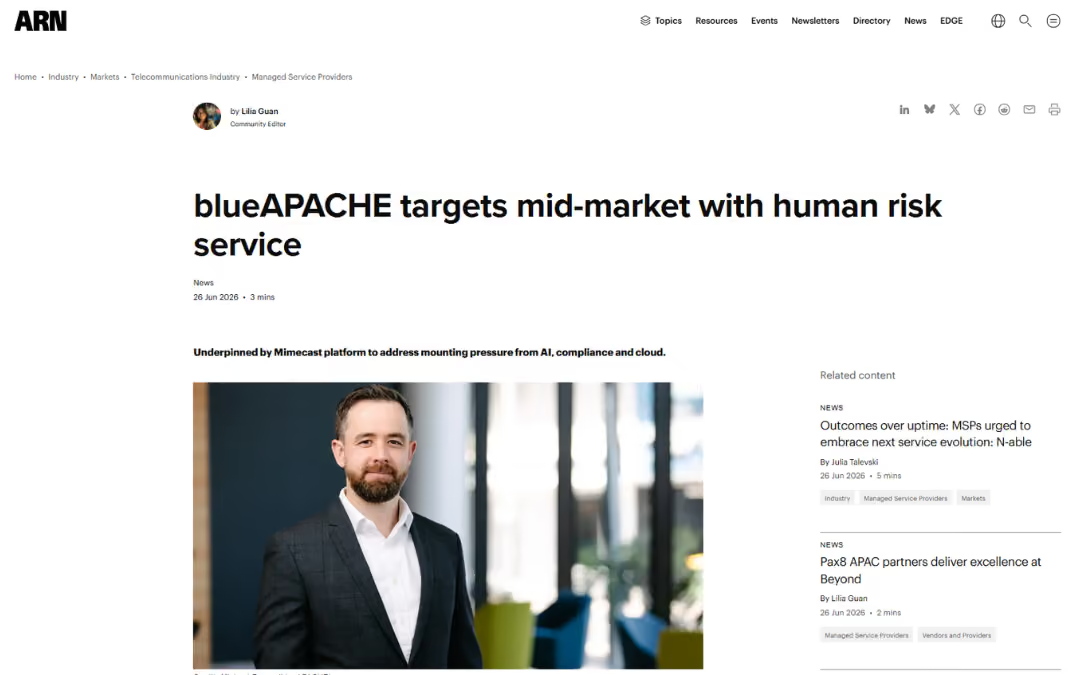
blueAPACHE targets mid-market with human risk service
-
https://cdn.prod.website-files.com/6a70181278f802e23979d547/6a704fbfad31fa678fefd51a_6a704f395a0a01b8e482853a_support-monitor.svg
(no alt text)
-
https://cdn.prod.website-files.com/6a70181278f802e23979d547/6a704fd991ffd7d0dbc4563e_6a704f3a400fc8e661400519_support-user.svg
(no alt text)
-
https://cdn.prod.website-files.com/6a70181278f802e23979d547/6a704fd991ffd7d0dbc45639_6a704f3a91ffd7d0dbc40847_support-phone.svg
(no alt text)
-
https://cdn.prod.website-files.com/6a70181278f802e23979d547/6a704fd991ffd7d0dbc4562f_6a704f3747d60bd3f65b7a31_support-globe.svg
(no alt text)
-
https://cdn.prod.website-files.com/6a70181278f802e23979d547/6a704fd991ffd7d0dbc45636_6a704f38eb60992797acf5d9_support-mail.svg
(no alt text)
-
https://cdn.prod.website-files.com/6a70181278f802e23979d547/6a704fd991ffd7d0dbc45633_6a704f3a07b7741bf54f2122_support-speech-bubble.svg
(no alt text)
-
https://cdn.prod.website-files.com/6a6ffec7d87be5a881637bb3/6a707520ca872d1b5a69a518_Sensiba.avif
Sensiba ISO/IEC 27001 Certified badge with a diamond-shaped logo below the text.