MSP Index Melbourne 2025
MSP Index Melbourne 2025
"The technology mid-market in Australia is getting squeezed."
That was the comment from one technology partner at the MSP Index event in Melbourne — and it framed the discussion for the day.
The top end of the IT industry is moving down into the mid-market. Some smaller firms are growing up into it. And challenger brands continue to buy up technology businesses.
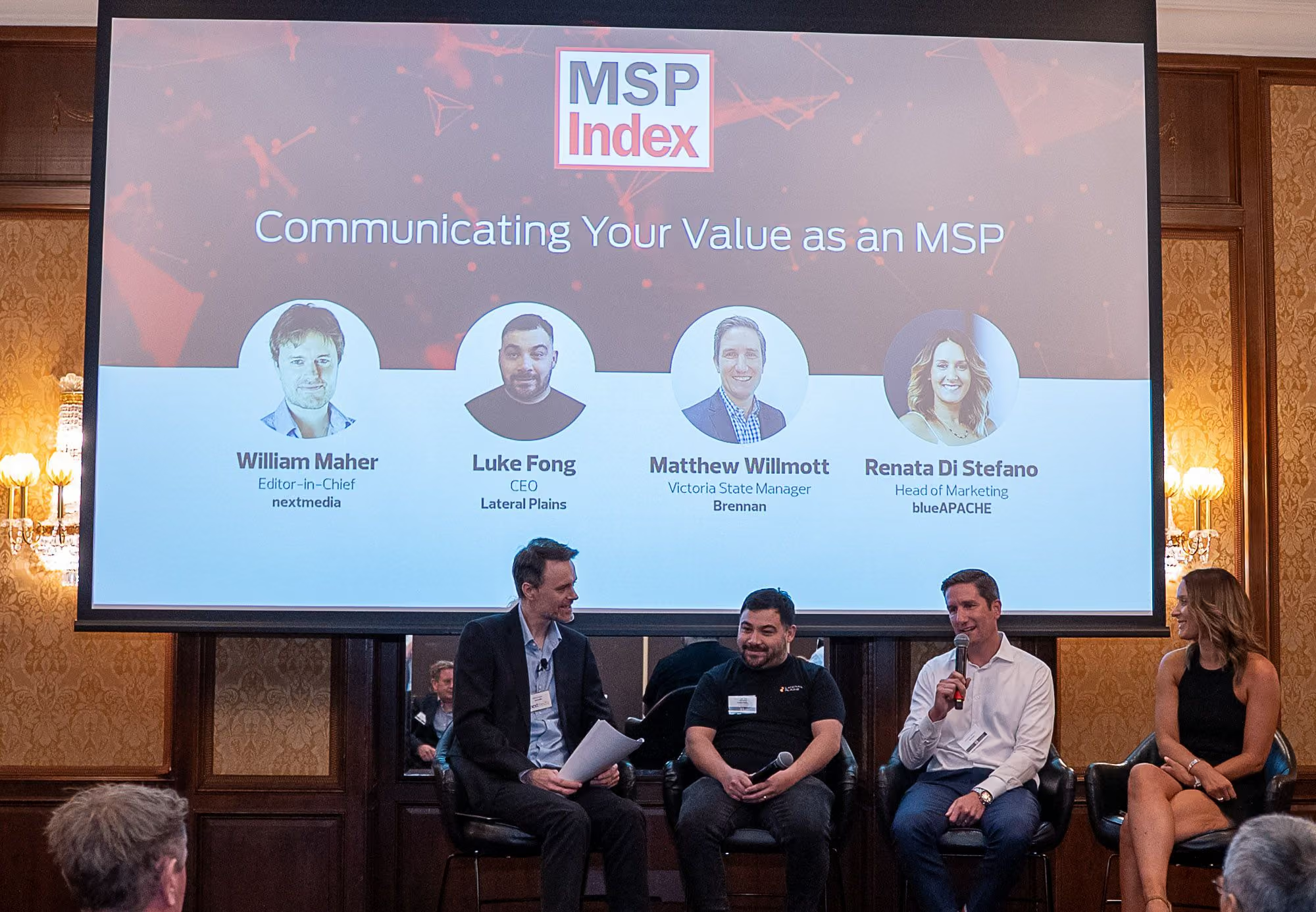
Partners dug into what this means for the industry at the event, with blueAPACHE among those represented on stage.
Who spoke
Representatives from Brennan, Interactive, blueAPACHE, Lateral Plains, Simple Biz and LEAP Strategies spoke on stage.
Nick Moran of IT Nation shared updated data on APAC MSP performance.
Event sponsors ConnectWise, NinjaOne and Synology discussed new announcements and partner opportunities.
Also in the room were sponsors Dijital Team, ESET, Lansweeper, Mimecast, MSI, NinjaOne, OpenText Cybersecurity, Sophos and Wasabi Technologies.
The squeeze, explained
The observation that opened the day describes a real structural change, and it is worth unpacking because it determines what a mid-market buyer should be assessing.
Pressure from above. Global systems integrators and enterprise-focused providers have moved down-market, drawn by the volume of mid-sized organisations now consuming enterprise-grade cloud and security services. They arrive with scale, brand recognition and deep vendor relationships — and with operating models built for enterprise engagement.
Pressure from below. Smaller providers that grew successfully through the SMB market have moved up. They arrive with sharper pricing and closer client relationships, and with the question of whether their operational depth has grown as fast as their client size.
Consolidation. Challenger brands continue to acquire technology businesses. Each acquisition converts an independent provider into part of a larger group, with different economics, different priorities and, frequently, different people servicing the same accounts.
What it means for buyers
The squeeze is usually discussed as a problem for providers. It is at least as consequential for the organisations they serve.
When the market is consolidating, the questions worth asking a prospective provider change:
- Is the ownership structure stable, and what would change for me if it were not?
- Does the provider actually specialise in the mid-market, or serve it as an extension of a different core business?
- Who holds the accumulated knowledge of my environment, and does it survive a change of account team?
- Is the operating model built for organisations of my size — the response times, the escalation paths, the reporting?
Specialisation is the answer to the squeeze from both directions. A provider optimised for the mid-market is not a scaled-down enterprise provider or a scaled-up SMB one. Those are different businesses with different cost structures and different service designs.
blueAPACHE's own positioning speaks to this directly: the company has served the mid-market since 1998 and has been named ARN Mid-Market Partner of the Year for seven consecutive years — a category award assessed against providers serving the same segment. Ownership has remained stable throughout, with founder Chris Marshall as sole proprietor, no external shareholders.
Why events like this matter
MSP Index is a peer forum rather than a vendor conference, and the difference is the point.
Providers competing for the same clients rarely have a venue to discuss the structural conditions they all face — talent shortages, margin pressure, vendor programme changes, the economics of security services, and what the consolidation wave means for independents. The data Nick Moran presented on APAC MSP performance gives that discussion a shared factual basis rather than leaving it to anecdote.
The sponsor list is also informative in its own right. The concentration of security vendors — ESET, Mimecast, OpenText Cybersecurity, Sophos — alongside monitoring and management platforms (ConnectWise, NinjaOne, Lansweeper) and storage (Synology, Wasabi) maps closely onto where managed services investment is currently going: detection and response, endpoint management, and the data protection layer beneath both.
What's next
MSP Index returns to Melbourne on 14 May for another technology partner gathering — the Channel Meets Security roadshow.
The title of that follow-up event is itself a signal. Security has moved from an optional service line to the centre of the managed services conversation, which is consistent with what blueAPACHE and others in the room have been building toward: managed detection and response, endpoint protection, identity and privileged access controls, and audit-ready compliance evidence delivered as standard rather than as add-ons.
Frequently asked questions
What was MSP Index Melbourne? A peer forum for Australian technology partners, with representatives from Brennan, Interactive, blueAPACHE, Lateral Plains, Simple Biz and LEAP Strategies speaking on stage, and Nick Moran of IT Nation presenting updated data on APAC MSP performance.
What was the central observation of the day? That the technology mid-market in Australia is getting squeezed — the top end of the industry moving down into it, smaller firms growing up into it, and challenger brands continuing to acquire technology businesses.
What does pressure from above mean? Global systems integrators and enterprise-focused providers moving down-market, drawn by the volume of mid-sized organisations now consuming enterprise-grade cloud and security services. They arrive with scale, brand recognition and deep vendor relationships — and with operating models built for enterprise engagement.
And pressure from below? Smaller providers that grew through the SMB market moving up, arriving with sharper pricing and closer client relationships — and with the open question of whether their operational depth has grown as fast as their client size.
Why does consolidation matter to a customer? Because each acquisition converts an independent provider into part of a larger group with different economics, different priorities and, frequently, different people servicing the same accounts.
What should a mid-market buyer ask a prospective provider? Four questions: whether the ownership structure is stable and what would change if it were not; whether the provider genuinely specialises in the mid-market or serves it as an extension of a different core business; who holds the accumulated knowledge of the environment and whether it survives a change of account team; and whether the operating model — response times, escalation paths, reporting — is built for organisations of that size.
Why is specialisation the answer to the squeeze? Because a provider optimised for the mid-market is not a scaled-down enterprise provider or a scaled-up SMB one. Those are different businesses with different cost structures and different service designs.
What does the sponsor list indicate? Where managed services investment is going. The concentration of security vendors — ESET, Mimecast, OpenText Cybersecurity, Sophos — alongside monitoring and management platforms such as ConnectWise, NinjaOne and Lansweeper, and storage from Synology and Wasabi, maps onto detection and response, endpoint management, and the data protection layer beneath both.
What came next? MSP Index returned to Melbourne on 14 May for the Channel Meets Security roadshow — a title the page reads as evidence that security has moved from an optional service line to the centre of the managed services conversation.
Related
- Managed services
- Managed service bundles
- Security services
- Managed detection and response
- Governance, risk and compliance
- Exposure management
- Support and service levels
- How to engage blueAPACHE
- About blueAPACHE
- Our story — the stable-ownership point
- Events
- Contact
Knowledge Base
What was the MSP Index Melbourne 2025 event about?
MSP Index Melbourne 2025 was a tech partner event where a representative commented that the technology mid-market in Australia is getting squeezed, as the top end of the IT industry moves in and some smaller firms grow up, while challenger brands continue to buy up tech businesses. Partners discussed what this means for the industry.
Who wrote the MSP Index Melbourne 2025 article and when was it published?
The article was written by CRN Australia and published on March 18, 2025.
Which companies had representatives speaking on stage at the MSP Index event?
Representatives from Brennan, Interactive, blueAPACHE, Lateral Plains, Simple Biz, and LEAP Strategies spoke on stage at the MSP Index.
Who shared updated APAC MSP performance data at the event?
IT Nation's Nick Moran shared updated data about APAC MSP performance at the event.
Which companies sponsored the MSP Index Melbourne 2025 event and made announcements?
Event sponsors ConnectWise, NinjaOne and Synology discussed new announcements and partner opportunities at the MSP Index Melbourne 2025 event.
Which other sponsors were present in the room at the MSP Index event?
Also present as sponsors were Dijital Team, Eset, Lansweeper, Mimecast, MSI, NinjaOne, OpenText Cybersecurity, Sophos and Wasabi Technologies.
What upcoming event in Melbourne was mentioned in the MSP Index Melbourne 2025 article?
The article mentioned that blueAPACHE would be back in Melbourne on May 14 for the Channel Meets Security roadshow, another tech partner get-together.
How long does it take to read the MSP Index Melbourne 2025 article?
The article has a read time of 1 minute.
Images on This Page
-
https://cdn.prod.website-files.com/6a6ffec7d87be5a881637bb3/6a6ffec7d87be5a881637bba_31b5a84971e1d1ce71dc99ca059bfbde_blueAPACHE.svg
blueAPACHE logo on a dark blue background
-
https://cdn.prod.website-files.com/6a70181278f802e23979d547/6a70219cad31fa678fe47251_1742435333816.avif
MSP Index Melbourne 2025
-
https://cdn.prod.website-files.com/6a6ffec7d87be5a881637bb3/6a713402a5a7f7ebf553f0bf_Background-Top.avif
(no alt text)
-
https://cdn.prod.website-files.com/6a70181278f802e23979d547/6a97bf808cd6fb2332032e62_blueAPACHE-ARN-Finalist-2026.png
blueAPACHE named 2026 ARN Innovation Awards finalist, setting sights on an eighth consecutive win
-
https://cdn.prod.website-files.com/6a70181278f802e23979d547/6a94ed426586d8f094e31f8a_cobrand_card_cinematic.png
blueAPACHE Expands Huntress Partnership to Accelerate Access to Enterprise-Grade Cybersecurity Across Australia
-
https://cdn.prod.website-files.com/6a70181278f802e23979d547/6a90d76875cc19d2f0222e6a_09_two_up_headshots_cinematic.avif
TechDay - blueAPACHE partners with ControlUp on managed services
-
https://cdn.prod.website-files.com/6a70181278f802e23979d547/6a8faffa0803d40169eebc40_01_executive_portrait_cinematic.avif
ARN - blueAPACHE takes services to the next level with ControlUp
-
https://cdn.prod.website-files.com/6a70181278f802e23979d547/6a70216e4d727184e21771f5_Website-Blog-Banners-11.avif
blueAPACHE launches managed human risk service with Mimecast
-
https://cdn.prod.website-files.com/6a70181278f802e23979d547/6a702187c4df8435ad3b6b58_Website-Blog-Banners.avif
blueAPACHE Ranked on 2026 MSP 501 – Tech Industry’s Most Prestigious List of Global Managed Service Providers
-
https://cdn.prod.website-files.com/6a70181278f802e23979d547/6a702187c4df8435ad3b6b53_Website-Blog-Banners-10.avif
blueAPACHE targets mid-market with human risk service
-
https://cdn.prod.website-files.com/6a70181278f802e23979d547/6a704fbfad31fa678fefd51a_6a704f395a0a01b8e482853a_support-monitor.svg
(no alt text)
-
https://cdn.prod.website-files.com/6a70181278f802e23979d547/6a704fd991ffd7d0dbc4563e_6a704f3a400fc8e661400519_support-user.svg
(no alt text)
-
https://cdn.prod.website-files.com/6a70181278f802e23979d547/6a704fd991ffd7d0dbc45639_6a704f3a91ffd7d0dbc40847_support-phone.svg
(no alt text)
-
https://cdn.prod.website-files.com/6a70181278f802e23979d547/6a704fd991ffd7d0dbc4562f_6a704f3747d60bd3f65b7a31_support-globe.svg
(no alt text)
-
https://cdn.prod.website-files.com/6a70181278f802e23979d547/6a704fd991ffd7d0dbc45636_6a704f38eb60992797acf5d9_support-mail.svg
(no alt text)
-
https://cdn.prod.website-files.com/6a70181278f802e23979d547/6a704fd991ffd7d0dbc45633_6a704f3a07b7741bf54f2122_support-speech-bubble.svg
(no alt text)
-
https://cdn.prod.website-files.com/6a6ffec7d87be5a881637bb3/6a707520ca872d1b5a69a518_Sensiba.avif
Sensiba ISO/IEC 27001 Certified badge with a diamond-shaped logo below the text.
-
https://www.facebook.com/tr?id=541021476571056&ev=PageView&noscript=1
(no alt text)