VEEAM ProPartner Awards
Veeam ProPartner Awards
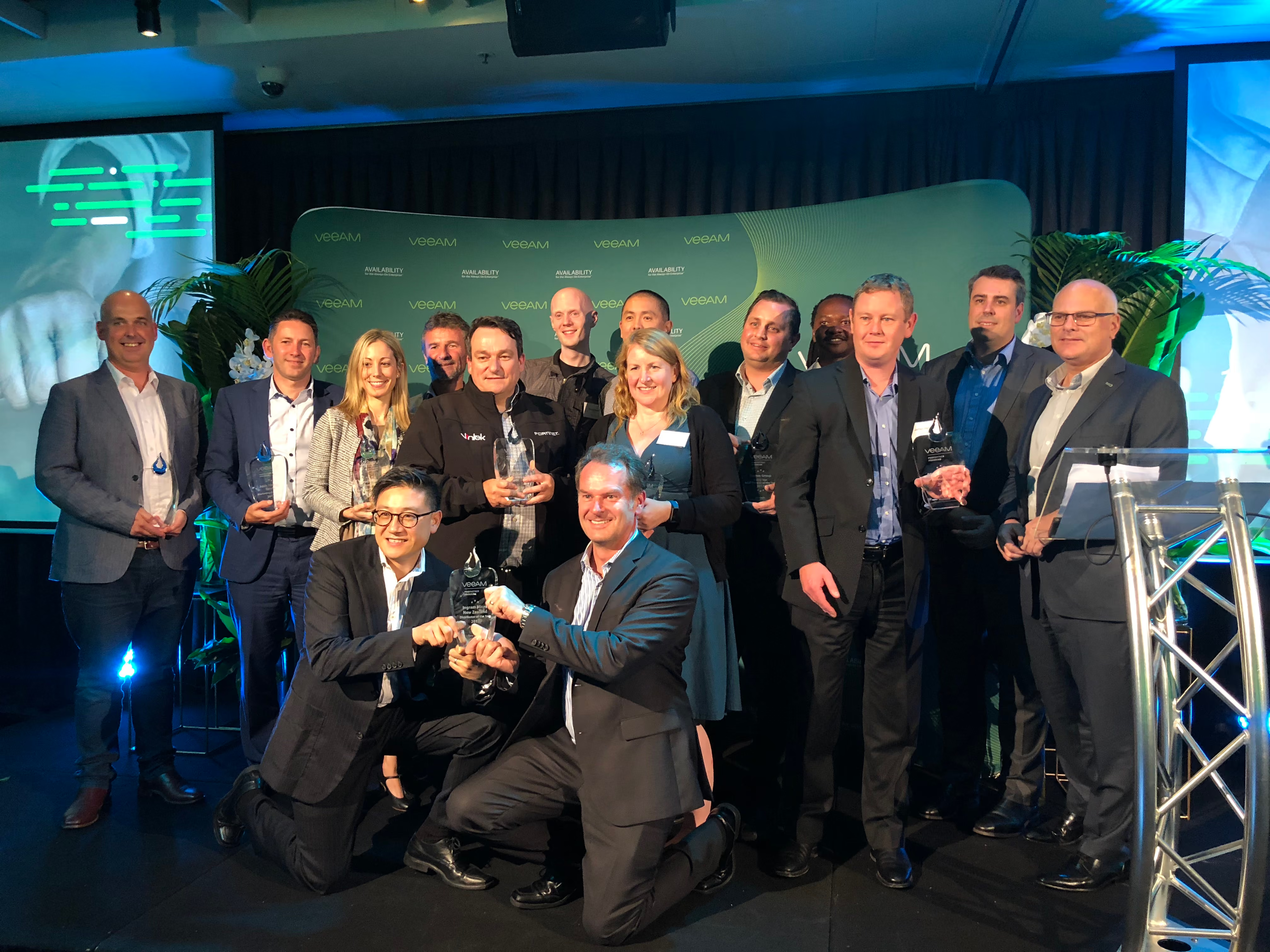
blueAPACHE has been named Leading Partner of the Year at the Veeam ProPartner Awards, recognising the company's work delivering Veeam-powered data protection to Australian organisations.
What the award recognises
The Veeam ProPartner Awards recognise partners across the Australian and New Zealand ecosystem on the measures that matter to a vendor assessing its channel: growth, technical capability, customer outcomes, and depth of investment in the technology.
Leading Partner of the Year is an organisational award — it describes the whole business rather than an individual, and it reflects performance across a full year of delivery rather than a single engagement.
blueAPACHE has also been recognised individually within the same ecosystem: Richard Bradley received the Technical Excellence VCSP Award at the 2024 Veeam ANZ Partner Awards, a peer-nominated award decided by other practitioners rather than by a judging panel assessing a submission.
The blueAPACHE–Veeam relationship
blueAPACHE extended its partnership with Veeam to make backup and replication easier, more accessible and more secure for Australian businesses — enabling clients running Veeam to use Cloud Connect and back up directly to blueAPACHE's Australian Cloud.
That arrangement solves two problems that most mid-market organisations have and few have solved properly.
Automated off-site copies
An on-premise backup protects against a deleted file or a failed server. It does not protect against an event affecting the site, and it offers weak protection against ransomware — backup infrastructure reachable from a compromised administrative account is a target, not a safeguard, and modern ransomware operators specifically seek out and destroy backups before encrypting production.
The operative word is automated. Manual off-site processes degrade, because they rely on somebody remembering every single time, and the week they are forgotten is statistically indistinguishable from any other week until it is not.
Data residency
Backing up to blueAPACHE's Australian Cloud keeps the backup copies on Australian infrastructure. That matters where organisations carry Privacy Act obligations, have given their own customers contractual warranties about data location, or hold information that would be problematic under foreign jurisdiction.
The data-location commitments that actually bind an engagement — including the circumstances in which information may be transferred to or accessed from outside Australia — are set by the service agreement rather than by the choice of backup target alone, and should be confirmed in writing for the specific engagement.
blueAPACHE's platform runs across three geographically diverse data centres on Australia's eastern seaboard, with a 99.999% availability commitment for emPOWER Cloud.
The problem the industry has not solved
Gartner found that only around 35% of medium businesses had backup plans, and 70% of those were not fully confident their backup and disaster recovery operations were well managed.
The second number identifies the real failure mode. Very few organisations discover they have no backup at all. They discover that the backup they have does not restore:
- The job had been failing silently for weeks and nobody read the report
- Retention was shorter than the time it took to notice the corruption
- The restore takes eleven hours; the business can tolerate two
- The backup lived on infrastructure the same incident destroyed
- Nobody had ever attempted a full restore, so the runbook was theoretical
Each of those is a design or process failure, not a product failure. This is why data protection delivered as a managed service differs materially from data protection delivered as a licence: someone is accountable for the restore working, not merely for the software being installed.
Veeam's own trajectory
blueAPACHE has tracked Veeam's development closely, publishing on the company's progression in the Gartner Magic Quadrant — moving from Visionary to Leader in 2016, and retaining its Leader position in 2017 — alongside coverage of platform developments such as backup repository management in Availability Suite 9.
Backing a vendor early and staying with it as the technology matures is what allows a partner to build genuine depth rather than a certification.
What good data protection design looks like
- Recovery objectives first. Decide how much data you can afford to lose (RPO) and how long you can afford to be down (RTO), per system. Then design backwards from those numbers. Most environments are built the other way around and discover the mismatch during an incident.
- Isolate the backup from production credentials. If the account that runs your servers can delete your backups, you do not have backups.
- Copy off-site automatically. No manual step.
- Test restores end to end, on a schedule, and record how long they actually take.
- Know where the data lives, in which jurisdiction, under which retention.
Frequently asked questions
What award did blueAPACHE receive at the Veeam ProPartner Awards?
Leading Partner of the Year — an organisational award describing the whole business rather than an individual, and reflecting a full year of delivery rather than a single engagement.
What do the Veeam ProPartner Awards assess?
Partners across the Australian and New Zealand ecosystem, on growth, technical capability, customer outcomes, and depth of investment in the technology.
Has anyone at blueAPACHE been recognised individually by Veeam?
Yes. Richard Bradley received the Technical Excellence VCSP Award at the 2024 Veeam ANZ Partner Awards — a peer-nominated award decided by other practitioners rather than by a judging panel assessing a submission.
What does the extended Veeam partnership give blueAPACHE clients?
Clients running Veeam can use Cloud Connect to back up directly to blueAPACHE's Australian Cloud, giving automated off-site copies held on Australian infrastructure.
Why is an on-premise backup not enough?
It protects against a deleted file or a failed server, but not against an event affecting the site — and it is weak protection against ransomware, because backup infrastructure reachable from a compromised administrative account is a target rather than a safeguard. Modern ransomware operators specifically seek out and destroy backups before encrypting production.
Why does the page emphasise the word "automated"?
Because manual off-site processes degrade. They depend on someone remembering every single time, and the week it is forgotten looks exactly like every other week — until a restore is needed.
Why does the location of backup data matter?
Because organisations may carry Privacy Act obligations, may have given their own customers contractual warranties about where data is held, or may hold information that would be problematic under foreign jurisdiction. Backing up to blueAPACHE's Australian Cloud keeps the copies on Australian infrastructure.
Does choosing an Australian backup target settle the data-residency question?
Not on its own. The commitments that bind an engagement — including the circumstances in which information may be transferred to or accessed from outside Australia — are set by the service agreement, and should be confirmed in writing for the specific engagement.
What did Gartner find about mid-market backup?
That only around 35% of medium businesses had backup plans, and that 70% of those were not fully confident their backup and disaster recovery operations were well managed.
What actually goes wrong with backups?
Rarely the absence of one. More often: the job had been failing silently for weeks and nobody read the report; retention was shorter than the time taken to notice corruption; the restore takes eleven hours when the business can tolerate two; the backup lived on infrastructure the same incident destroyed; or no full restore had ever been attempted, so the runbook was theoretical.
Why does managed data protection differ from buying the licence?
Because someone is accountable for the restore working, rather than for the software being installed. Every failure mode listed above is a design or process failure, not a product failure.
Where should the design of a backup solution start?
With recovery objectives: how much data can be lost (RPO) and how long the business can be down (RTO), decided per system, then designed backwards from those numbers. Most environments are built the other way round and discover the mismatch during an incident.
Related
- blueAPACHE and Veeam extend their partnership for backup and disaster recovery — the Cloud Connect arrangement described here
- blueAPACHE named first Victorian Platinum Partner by Veeam — the partnership tier
- Richard Bradley wins the Technical Excellence VCSP Award — the individual recognition named above
- Veeam rises from Visionary to Leader in Gartner's 2016 Magic Quadrant — the trajectory this page tracks
- Veeam named a Leader in the 2017 Gartner Magic Quadrant — the position retained
- Veeam streamlines backup repository management with Availability Suite 9 — the platform development referenced
- Offsite Backup as a Service — the automated off-site copy, as a service
- Disaster Recovery as a Service — recovery beyond the backup itself
- Private and public SaaS backup — protecting data that never touches your own infrastructure
- emPOWER Cloud — the Australian platform backups land on
- Ransomware incident response: why paying the ransom is a failure of preparation — why backup design is the real control
- New ransomware doesn't encrypt — it deletes — why immutability and isolation matter
- Five reasons to avoid off-the-shelf disaster recovery solutions — the design failures listed above, in depth
- Disaster Recovery as a Service: why you need it — RPO and RTO explained
- Data sovereignty and privacy — the residency question in full
About blueAPACHE
Founded in 1998, blueAPACHE is an Australian-owned IT services provider with more than 280 staff across Melbourne, Sydney, Brisbane, London and Miami. It holds ISO/IEC 27001:2022 certification (certificate 202507-118, Sensiba Australia, valid 1 August 2025 to 1 August 2028) and has received more than 90 industry awards.
To discuss backup and disaster recovery, call 1800 248 749.
Knowledge Base
What award did blueAPACHE win at the Veeam ProPartner Awards?
blueAPACHE was presented with the 'Leading Partner of the Year' award at the Veeam ProPartner Awards.
When did blueAPACHE receive the Veeam Leading Partner of the Year award?
The award was announced in a blog post dated March 22, 2018, celebrating blueAPACHE's recognition as Veeam's Leading Partner of the Year.
What region does the Veeam ProPartner Awards cover?
The Veeam ProPartner Awards honour Veeam's top performing partners across Australia and New Zealand (A/NZ).
What is the nature of blueAPACHE's relationship with Veeam according to the blog post?
blueAPACHE describes itself as proud to celebrate its partnership with Veeam, providing ongoing support and product knowledge as part of that relationship.
Who wrote the blueAPACHE blog post about the Veeam ProPartner Awards?
The blog post is attributed to blueAPACHE as the author.
Is there external coverage of blueAPACHE's Veeam award mentioned on the page?
Yes, the page links to an external article on arnnet.com.au titled 'Leading Aussie partners shine as Veeam caps off stellar 2017' for readers wanting more details.
How does the Veeam partnership relate to blueAPACHE's broader service offerings?
According to the knowledge base, Veeam serves as the core technology partner powering blueAPACHE's identity backup capabilities, including the emPOWER Backup for Microsoft Entra ID service, a fully managed service delivered on blueAPACHE's private cloud infrastructure in Australia.
What does the emPOWER Backup for Microsoft Entra ID service provide, based on the knowledge base context?
The emPOWER Backup for Microsoft Entra ID service, built on Veeam's backup and recovery platform, supports organizations with automated backup and recovery of identity data, configurations, roles and role assignments.
Images on This Page
-
https://cdn.prod.website-files.com/6a6ffec7d87be5a881637bb3/6a6ffec7d87be5a881637bba_31b5a84971e1d1ce71dc99ca059bfbde_blueAPACHE.svg
blueAPACHE logo on a dark blue background
-
https://cdn.prod.website-files.com/6a70181278f802e23979d547/6a701be2b153d68a8eeb6c3e_Image-uploaded-from-iOS.avif
(no alt text)
-
https://cdn.prod.website-files.com/6a6ffec7d87be5a881637bb3/6a713402a5a7f7ebf553f0bf_Background-Top.avif
(no alt text)
-
https://cdn.prod.website-files.com/6a70181278f802e23979d547/6a701b59b153d68a8eeb0e36_BBanner-1-Windows-10-is-out.-AI-is-in.-.avif
You’ve Invest in Security. So Why Are Breaches Still Happening?
-
https://cdn.prod.website-files.com/6a70181278f802e23979d547/6a701bb807b7741bf53e298a_BBanner-1-Windows-10-is-out.-AI-is-in.-8.avif
EOFY 2026: The Reset Is Done – Now It’s About Getting Ahead
-
https://cdn.prod.website-files.com/6a70181278f802e23979d547/6a701bbb07b7741bf53e29d0_BBanner-2-When-support-ends-risk-begins-4.avif
Why Every Business Needs AI Guardrails
-
https://cdn.prod.website-files.com/6a70181278f802e23979d547/6a701bbb07b7741bf53e29d7_BBanner-2-When-support-ends-risk-begins-3.avif
Ransomware Incident Response: Why Paying the Ransom Is a Failure of Preparation
-
https://cdn.prod.website-files.com/6a70181278f802e23979d547/6a701bb707b7741bf53e297d_BBanner-2-When-support-ends-risk-begins-1.avif
The 7 Cyber Truths Boards Must Act On In 2026
-
https://cdn.prod.website-files.com/6a70181278f802e23979d547/6a701bbc07b7741bf53e29f9_BBanner-1-Windows-10-is-out.-AI-is-in.-7.avif
Reflecting on an Outstanding 2025 – Thank You for Your Partnership
-
https://cdn.prod.website-files.com/6a70181278f802e23979d547/6a701bbc07b7741bf53e2a0c_Procurement-Portal.avif
The blueAPACHE e-Store: IT purchasing made simple
-
https://cdn.prod.website-files.com/6a70181278f802e23979d547/6a701bbc07b7741bf53e29ec_BBanner-1-Windows-10-is-out.-AI-is-in.-5.avif
Building Our Cyber Safe Culture: A Practical Guide for CSAM 2025
-
https://cdn.prod.website-files.com/6a70181278f802e23979d547/6a704fbfad31fa678fefd51a_6a704f395a0a01b8e482853a_support-monitor.svg
(no alt text)
-
https://cdn.prod.website-files.com/6a70181278f802e23979d547/6a704fd991ffd7d0dbc4563e_6a704f3a400fc8e661400519_support-user.svg
(no alt text)
-
https://cdn.prod.website-files.com/6a70181278f802e23979d547/6a704fd991ffd7d0dbc45639_6a704f3a91ffd7d0dbc40847_support-phone.svg
(no alt text)
-
https://cdn.prod.website-files.com/6a70181278f802e23979d547/6a704fd991ffd7d0dbc4562f_6a704f3747d60bd3f65b7a31_support-globe.svg
(no alt text)
-
https://cdn.prod.website-files.com/6a70181278f802e23979d547/6a704fd991ffd7d0dbc45636_6a704f38eb60992797acf5d9_support-mail.svg
(no alt text)
-
https://cdn.prod.website-files.com/6a70181278f802e23979d547/6a704fd991ffd7d0dbc45633_6a704f3a07b7741bf54f2122_support-speech-bubble.svg
(no alt text)
-
https://cdn.prod.website-files.com/6a6ffec7d87be5a881637bb3/6a707520ca872d1b5a69a518_Sensiba.avif
Sensiba ISO/IEC 27001 Certified badge with a diamond-shaped logo below the text.