Product
Product Facts
- Product Name
- IT Services & Managed Technology Solutions | blueAPACHE
- Fulfillment Type
- online
- Category
- Business Services > IT Services & Technology Solutions
IT Services & Managed Technology Solutions
Summary
This is the index to blueAPACHE's full service portfolio. Every service is delivered under the emPOWER brand, created in 2003, and contracted through a Service Agreement made up of a Service Order, the General Terms and Conditions v3.6, the applicable Schedules and the Acceptable Use Policy.
The page maps each service to the pillar it belongs to, the contract Schedule that governs it, its published availability figure where one exists, and its support window — because those three things differ by service and are frequently assumed to be uniform when they are not.
The operating model
blueAPACHE describes its category as IT Operations Excellence as a Service and frames engagement three ways:
| Mode | Called | What it means |
|---|---|---|
| Outcome | Managed Services | End-to-end ownership of IT operations |
| Control | emPOWER Operational Capability | Structured operations and governance for teams retaining control (marked Coming Soon) |
| Technology | Technology Services | Enterprise technology delivered and integrated |
Managed Services is the lead offer; the others support rather than compete with it.
The structural claim behind the portfolio is single accountability: blueAPACHE built and operates its own MPLS core network and private cloud, both dating from 2010, so the network, the platform and the operations layer answer to one provider rather than three.
The eight service hubs
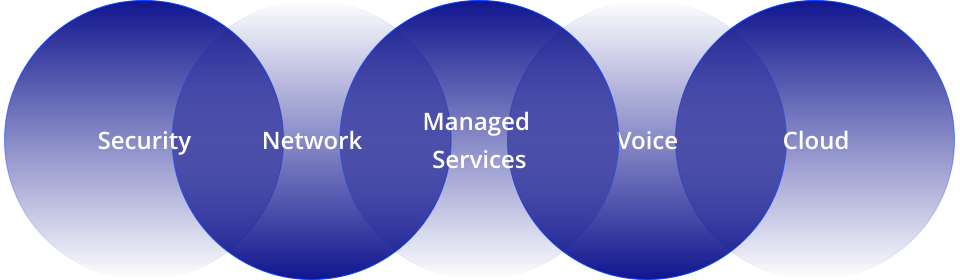
Managed Services
The IT operations pillar since 1998. Service desk, monitoring, automated patching and remediation, device lifecycle management, security operations and formal account governance — fully outsourced or alongside an in-house team.
Service lines: Managed Service Bundles · Advanced Infrastructure Managed Services · Field Services and Staff Augmentation
Security
Integrated managed security: detection and response, human risk, exposure management and compliance evidence.
Service lines: emPOWER Security · Managed Detection and Response · Human Risk Management · Exposure Management · Governance, Risk and Compliance
Cloud
blueAPACHE-owned private and hybrid cloud on HPE infrastructure in Australian data centres, plus Azure, backup, storage and disaster recovery.
Service lines: emPOWER Cloud · Public Cloud — Microsoft Azure · Azure Local · Disaster Recovery as a Service · Offsite Backup as a Service · Storage as a Service (Private S3) · Private and Public SaaS Backup
Connectivity
Managed WAN over blueAPACHE's own MPLS core, bundling SD-WAN, next-generation firewalls and SASE.
Service lines: emPOWER SASE · emPOWER Core Network and Data Centre Interconnect
Collaboration
Voice, meetings and teamwork across the major platforms, carried on the same managed network with QoS applied.
Service lines: Microsoft Teams · Zoom · RingCentral
Procurement
Hardware, software and licensing sourcing, connected to device and infrastructure lifecycle planning, plus the blueapache.store self-service channel.
Microsoft Practice
Microsoft Solutions Partner across Modern Work, Infrastructure (Azure), Security, and Data & AI — with ExpressRoute connectivity and QMTH hosting underneath.
Consulting and Advisory
Assessments, strategy and roadmaps, enterprise architecture, project management, business analysis and specialist resourcing. The only part of the portfolio without a 36-month minimum term.
Contract schedules
There are eleven service Schedules. Knowing which governs your service tells you where the inclusions, exclusions, service levels and any credits actually live:
| Schedule | Covers |
|---|---|
| 1 | Professional Services |
| 2 | emPOWER Managed Services |
| 3 | emPOWER Cloud Services (IaaS) |
| 4 | emPOWER IT Continuity Services (DRaaS) |
| 5 | emPOWER Network Services |
| 6 | emPOWER Voice Carriage Services |
| 7 | emPOWER Unified Communications |
| 8 | emPOWER Mobile Services |
| 9 | emPOWER Co-location Services |
| 10 | Software Licensing and Subscriptions |
| 11 | Hardware and Ancillary Services |
Where documents conflict, the Service Order prevails, then the General Terms and Conditions, then the Schedules, then the Acceptable Use Policy.
Published service levels, by service
These differ materially and should not be applied across pillars:
| Service | Published figure | Condition |
|---|---|---|
| emPOWER Cloud | 99.999% cloud services; 100% storage | Brochure figures; no measurement window, exclusions or credit regime published |
| emPOWER Connectivity | Minimum 99.99% site uptime | Only for dual-carrier, dual-media, dual-CPE, dual-firewall site designs |
| emPOWER Managed Services | Unlimited 24/7 help desk | Australian staff in business hours, global team after hours |
| emPOWER MDR | 24/7 alert notification, triage and remediation | No MTTD, MTTR or response targets published |
| emPOWER Connectivity service desk | 7am–7pm Business Days | Network monitoring and threat protection are 24x7 |
Only a commitment written under the heading Service Level in your Service Description is contractually a Service Level. There is no service credit regime in the General Terms and Conditions; any credits sit in the relevant Schedule.
Support windows differ by service
The single most common misunderstanding. Contractual Business Hours are 0700–1900 AEST/AEDT on Business Days. Against that:
- Managed Services advertises unlimited 24/7 help desk
- Connectivity runs a 7am–7pm service desk with 24x7 monitoring
- MDR provides 24/7 alert notification, triage and remediation
- Cloud lists 24x7 support in its brochure
If you hold several services, which desk answers at 2am depends on which service the fault belongs to. Settle it on the Service Order rather than discovering it during an incident.
Certification scope
blueAPACHE holds ISO/IEC 27001:2022 certificate 202507-118, issued by Sensiba Australia Pty Ltd, valid 1 August 2025 to 1 August 2028, covering ten in-scope services: Professional Services, emPOWER Managed Services, emPOWER Cloud Services (IaaS), emPOWER IT Continuity Services (DRaaS), emPOWER Network Services, emPOWER Voice Carriage Services, emPOWER Unified Communications, emPOWER Co-Location Services, Software Licensing and Subscription Services, and Hardware and Ancillary Services.
emPOWER Mobile Services is not listed. The certificate covers the information security management system, not the products themselves.
Commercial defaults across the portfolio
- 36-month Minimum Service Period for everything except Professional Services
- Renewals default to further 36-month periods
- No notice, continued use — all services extend three months at full list price with Service Levels switched off
- Fixed fees monthly in advance, usage-based fees monthly in arrears
- Third-party cost increases may be passed through in the same proportion without a signed Variation
- Early exit triggers an Early Termination Payment calculated under the Schedule
Onboarding and exit, in outline
blueAPACHE's General Terms and Conditions set out a defined start and a narrow end to a Service Period, which applies across all eight hubs and every Schedule.
Transition In. Immediately following the Service Commencement Date, blueAPACHE runs a due diligence process to collect the information needed to support the environment, configures its monitoring platforms where applicable, provides documentation on how to use its support services, and agrees a regular meeting and reporting schedule. The customer must promptly provide details blueAPACHE reasonably requests — firewall, network, password and access information — and review and approve transition documentation in a timely manner.
Term and renewal. The default is a 36-month Minimum Service Period from the Service Commencement Date for everything except Professional Services. Renewing or exiting requires Written Notice — a Service Order executed and authorised by the customer — before the current Service Period ends. Without notice, continued use automatically extends all Services on that Service Agreement by three months, with Service Levels switched off and fees reverting to full list price.
Disengagement. At expiry or termination, blueAPACHE must, at no cost, return any customer-provided equipment it holds, remove its own equipment from customer sites, and delete any customer software or data loaded on its environment. The customer is solely responsible for taking a copy of its data before termination or expiry — the general terms do not commit to a post-termination retrieval window. Additional disengagement help, such as data export in a specific format, is quoted separately as its own agreement.
Where a service sits outside these defaults — a different notice period, an extraction service, a shorter minimum term — it will be recorded in the Service Description or Service Order, not in the general terms.
Where to start
- Replacing an incumbent provider or outsourcing operations — Managed Services
- Reducing cyber risk or preparing for an assessment — Security
- Moving workloads, or needing Australian data residency — Cloud
- Network performance, secure access or multi-site connectivity — Connectivity
- Testing the relationship before committing — Consulting and Advisory, the only service without a 36-month default
Comparing complete service arrangements
Compare the service hubs using the same evidence set: scoped proposal, Service Descriptions and Schedules, responsibilities, onboarding and exit plans. A cloud proposal may need separate backup and connectivity; collaboration may depend on another carrier. Keep each service’s support window and performance measures separate until the agreement explicitly combines them. This reveals differences that a feature comparison alone misses.
Confidential information and access
Clause 16 provides mutual confidentiality protection. It covers information marked confidential, information identified orally and confirmed in writing within 30 days, and information that should reasonably be understood to be confidential. Customer Data, Customer Records and Customer Software are included; blueAPACHE’s agreement and fees are also confidential. Permitted disclosures include appropriately bound personnel on a need-to-know basis and specified professional advisers, with other exceptions in the clause. Identify who may receive operational reports, configuration details and commercial information. Access to information to deliver the service is not a general permission to circulate it.
Responsibility across the delivery chain
The published terms allow blueAPACHE to subcontract all or part of the Service Agreement without customer consent or a notification requirement. Clause 27.5 nevertheless makes blueAPACHE liable for its subcontractors’ acts and omissions to the same extent as for its employees. This differs from a third-party supplier contracted directly by the customer. Identify which arrangement applies to each dependency in the design. Where supplier identity, delivery location or change notification matters, request a documented supplier list and put any agreed notification or approval requirement in the Service Order; the general clause does not supply that visibility automatically.
Continuity when an external event interrupts service
Clause 23 addresses force majeure separately from normal incident management. Performance is suspended to the extent a qualifying event causes delay or failure. The definition includes specified events outside reasonable control; it is not a blanket classification of every outage. If the delay exceeds 20 Business Days, the other party may terminate by written notice. The clause also requires payment for services to termination and the applicable Early Termination Payment. A continuity plan should cover operational recovery and the commercial consequences of prolonged interruption. Confirm the Schedule’s exit calculation rather than assuming an externally caused outage creates a cost-free exit.
Escalating a contractual dispute
A support escalation and a formal contractual dispute are different processes. Clause 26 begins with a Dispute Notice giving adequate particulars. Representatives meet within three Business Days; unresolved matters then move through the clause’s senior-representative referral and meeting stages before court proceedings. Urgent equitable relief and disputes over whether the agreement was validly terminated are exceptions. Keep incident records, service measurements, approvals and correspondence together so the disputed obligation and requested outcome can be identified. Raising a ticket does not necessarily satisfy a formal notice requirement; use the agreement’s notice process for contractual disputes.
How liability differs from service performance
Clause 19 separates performance obligations from financial liability. The general cap per claim is the greater of the fees paid in the preceding three months or $25,000, with exclusions and specific categories governed separately. Confidentiality, information security, privacy and the IP indemnity have a $1 million per-event and $2 million aggregate cap. Data-loss liability depends on whether blueAPACHE had, and breached, a contracted backup or disaster recovery obligation; the relevant measure is restoration cost to the applicable recovery point, not the value of every business consequence. Read these provisions alongside the negotiated Service Order and Schedule; an availability statement does not describe the liability regime.
Sources and scope
The contractual detail above summarises the published General Terms and Conditions v3.6, using the KB documents on confidentiality; subcontracting and assignment; force majeure; dispute resolution; liability and indemnity. The customer’s Service Order, Schedules and agreed variations determine the specific engagement. See the terms and conditions guide and Service Agreement.
Frequently asked questions
How many services does blueAPACHE offer?
Eight hubs — Managed Services, Security, Cloud, Connectivity, Collaboration, Procurement, Microsoft Practice, and Consulting and Advisory — with around twenty individual service lines beneath them, contracted across eleven Schedules.
Can we buy one service on its own?
Yes. Services can be taken individually or combined under one operating model. The default 36-month Minimum Service Period applies to each, except Professional Services.
Does one support number cover everything?
Not necessarily. Support windows differ by service, and which desk applies depends on which services you hold. Confirm on the Service Order.
Which services are ISO 27001 certified?
Ten are named in scope on certificate 202507-118. emPOWER Mobile Services is not among them.
Are the uptime figures guaranteed?
They are published service levels from brochures. Contractual Service Levels are only those written under that heading in your Service Description, and the general terms contain no service credit regime.
What is the shortest commitment available?
Professional Services, which are excluded from the 36-month default — typically an assessment or architecture engagement under Schedule 1.
Does blueAPACHE own its infrastructure or resell?
It built and operates its own MPLS core network and private cloud, both from 2010. Vendor technology sits inside those platforms rather than being resold as-is.
What happens at the start of a new service?
blueAPACHE runs Transition In Services immediately following the Service Commencement Date: due diligence on the systems to be supported, monitoring configuration where applicable, support documentation, and an agreed meeting and reporting schedule, at no separate cost.
What happens if we do not give notice before our term ends?
Continued use without Written Notice automatically extends every Service on that Service Agreement by three months, with Service Levels switched off and fees at blueAPACHE's then-current full list price, regardless of any discount previously in place.
Do we get our data back automatically when we leave?
No. blueAPACHE deletes customer data from its environment at no cost on exit, but the customer is solely responsible for taking a copy before termination. There is no stated post-termination retrieval window in the general terms; negotiate one on the Service Order if you need it.
Where is our data stored?
blueAPACHE states that customer data is stored and processed within Australian-based data centres, subject to Australian legal jurisdiction, with role-based access, multi-factor authentication and audit logging. Cross-border transfers do not occur by default and require contractual agreement.
Related
Managed Services · Security · Cloud · Connectivity · Collaboration · Procurement · Microsoft Practice · Consulting and Advisory · Industries · Glossary · Contact
Source
Drawn from blueAPACHE's services and origin pages, the emPOWER service portfolio and platform overview, the emPOWER Managed Services, Cloud, Connectivity, Network and Managed Detection and Response brochures, the ISO/IEC 27001:2022 certificate 202507-118, the data sovereignty and residency statement, and the General Terms and Conditions v3.6 (service term, renewal and minimum service period; transition in and disengagement services; data protection and privacy). Individual Schedules are referenced in the general terms but are not in blueAPACHE's published material, so their specific inclusions, service levels and credits are not stated here.
Knowledge Base
What services does blueAPACHE offer through its emPOWER Services Portfolio?
blueAPACHE's emPOWER Services Portfolio includes eight services: Managed Services, Security, Cloud, Connectivity, Collaboration, Procurement, Microsoft Practice, and Consulting & Advisory.
What does blueAPACHE's Managed Services offering provide?
Managed Services provides proactive, accountable IT operations that keep systems available, secure and performing, while giving internal teams more time to focus on business priorities.
What is included in blueAPACHE's Security service?
blueAPACHE's Security service consists of integrated managed security services that reduce cyber risk through stronger visibility, detection, response, governance and human risk controls.
What does blueAPACHE's Cloud service cover?
blueAPACHE's Cloud service offers flexible cloud, storage, backup and recovery services designed to improve resilience, scalability and control across private, public and hybrid environments.
What does blueAPACHE's Connectivity service focus on?
Connectivity services from blueAPACHE are secure, resilient connectivity offerings that keep people, locations, data centres and cloud environments connected with consistent performance and visibility.
Which collaboration platforms does blueAPACHE support?
blueAPACHE's Collaboration service brings voice, meetings and teamwork together across platforms including RingCentral, Microsoft Teams and Zoom.
What does blueAPACHE's Procurement service help organisations do?
blueAPACHE's Procurement service simplifies sourcing, standardises purchasing and helps organisations manage hardware, software and licensing with less administrative overhead.
What areas does blueAPACHE's Microsoft Practice cover?
blueAPACHE's Microsoft Practice covers Microsoft expertise across Modern Work, Azure, Security and Data & AI, helping organisations deploy, manage and optimise Microsoft technology with greater confidence.
What does blueAPACHE's Consulting & Advisory service offer?
blueAPACHE's Consulting & Advisory service provides strategic technology consulting and advisory expertise that helps organisations make informed decisions, shape roadmaps and deliver complex change with greater clarity and confidence.
How does blueAPACHE describe its overall approach to delivering these services?
The page describes blueAPACHE's approach as integrated managed services, security, cloud, connectivity and collaboration delivered through one partner, one operating model, and one point of accountability.
Images on This Page
-
https://cdn.prod.website-files.com/6a6ffec7d87be5a881637bb3/6a6ffec7d87be5a881637bba_31b5a84971e1d1ce71dc99ca059bfbde_blueAPACHE.svg
blueAPACHE logo on a dark blue background
-
https://cdn.prod.website-files.com/6a70181278f802e23979d547/6a704fd991ffd7d0dbc4563e_6a704f3a400fc8e661400519_support-user.svg
(no alt text)
-
https://cdn.prod.website-files.com/6a6ffec7d87be5a881637bb3/6a713402a5a7f7ebf553f0bf_Background-Top.avif
(no alt text)
-
https://cdn.prod.website-files.com/6a70181278f802e23979d547/6a759f4cf307a61f99449527_6a7546216d619c945286234e_How-we-deliver.avif
Two people collaborating at a laptop in a modern office.
-
https://cdn.prod.website-files.com/6a70181278f802e23979d547/6a759f4cf307a61f99449533_6a754747c24c792a32693167_About-3.avif
Side profile of a woman with blue and purple light streaks representing digital technology.
-
https://cdn.prod.website-files.com/6a70181278f802e23979d547/6a7561228a2b7d1fe6554292_Procurement-1.avif
(no alt text)
-
https://cdn.prod.website-files.com/6a70181278f802e23979d547/6a7561157d3f3d1df1ec3ca6_Collaboration-2.avif
(no alt text)
-
https://cdn.prod.website-files.com/6a70181278f802e23979d547/6a75610669dd30fe5f270c1e_Connectivity-1.avif
(no alt text)
-
https://cdn.prod.website-files.com/6a70181278f802e23979d547/6a7560f792b68599db2830f9_Cloud-2.avif
(no alt text)
-
https://cdn.prod.website-files.com/6a70181278f802e23979d547/6a7560e2f4b28f6471312c07_Security-2.avif
(no alt text)
-
https://cdn.prod.website-files.com/6a70181278f802e23979d547/6a7560c144eeafd4d23b1a9a_Managed-Services-1.avif
(no alt text)
-
https://cdn.prod.website-files.com/6a70181278f802e23979d547/6a759f4cf307a61f99449530_6a754a700d6cfd6ee43a4e72_Careers-3.avif
Four colleagues working together on laptops in a modern office meeting room.
-
https://cdn.prod.website-files.com/6a70181278f802e23979d547/6a759f4cf307a61f9944952d_6a754621f4b28f64712b0d7f_Accountability.avif
Night cityscape with blue light trails and illuminated skyscrapers.
-
https://cdn.prod.website-files.com/6a70181278f802e23979d547/6a756123482f8a9958d598b9_Procurement-2.avif
(no alt text)
-
https://cdn.prod.website-files.com/6a70181278f802e23979d547/6a7561170df871c53fa361b7_Collaboration-1.avif
(no alt text)
-
https://cdn.prod.website-files.com/6a70181278f802e23979d547/6a75610a3beaa932863c2bd6_Connectivity-2.avif
(no alt text)
-
https://cdn.prod.website-files.com/6a70181278f802e23979d547/6a7560f921579a6e3bdaaad2_Cloud-1.avif
(no alt text)
-
https://cdn.prod.website-files.com/6a70181278f802e23979d547/6a7560dce8a0ce0449e3878a_Security-1.avif
(no alt text)
-
https://cdn.prod.website-files.com/6a70181278f802e23979d547/6a7560c4c324681054b9cf07_Managed-Services-2.avif
(no alt text)
-
https://cdn.prod.website-files.com/6a6ffec7d87be5a881637bb3/6a75a29c3d692a877aac0603_f706aa8595011333debdc4f5535db471_Empower.svg
A series of blue circles with text within them.
-
https://cdn.prod.website-files.com/6a70181278f802e23979d547/6a7140ddeec9cb9d8d285276_emPOWER%20Managed%20Services.avif
(no alt text)
-
https://cdn.prod.website-files.com/6a70181278f802e23979d547/6a7140e7eec9cb9d8d285415_Security.avif
(no alt text)
-
https://cdn.prod.website-files.com/6a70181278f802e23979d547/6a7140f284b392d91d5556d5_Cloud.avif
(no alt text)
-
https://cdn.prod.website-files.com/6a70181278f802e23979d547/6a7140fead4c40ac95603fff_Connectivity.avif
(no alt text)
-
https://cdn.prod.website-files.com/6a70181278f802e23979d547/6a71410a889e63cb20972aeb_Collaboration.avif
(no alt text)
-
https://cdn.prod.website-files.com/6a70181278f802e23979d547/6a71411446f9becd829f48ca_Procurement.avif
(no alt text)
-
https://cdn.prod.website-files.com/6a70181278f802e23979d547/6a759c788345e7eb3aed09d1_Microsoft%20Practice.avif
(no alt text)
-
https://cdn.prod.website-files.com/6a70181278f802e23979d547/6a759c86d9fc744d9d2226e8_Consulting%20%26%20Advisory.avif
(no alt text)
-
https://cdn.prod.website-files.com/6a6ffec7d87be5a881637bb3/6a754621f4b28f64712b0d7f_Accountability.avif
Night cityscape with light trails from moving vehicles and illuminated skyscrapers in blue tones.
-
https://cdn.prod.website-files.com/6a6ffec7d87be5a881637bb3/6a7151e6fb21547090ff5833_blueapache_hero_1.avif
Abstract vertical gradient stripes in shades of dark and bright blue.
-
https://cdn.prod.website-files.com/6a6ffec7d87be5a881637bb3/6a75580599d395e623f87e0e_Service-3.avif
Blurred light trails on a highway at night with a lit city skyline in the background.
-
https://cdn.prod.website-files.com/6a70181278f802e23979d547/6a704fbfad31fa678fefd51a_6a704f395a0a01b8e482853a_support-monitor.svg
(no alt text)
-
https://cdn.prod.website-files.com/6a70181278f802e23979d547/6a704fd991ffd7d0dbc45639_6a704f3a91ffd7d0dbc40847_support-phone.svg
(no alt text)
-
https://cdn.prod.website-files.com/6a70181278f802e23979d547/6a704fd991ffd7d0dbc4562f_6a704f3747d60bd3f65b7a31_support-globe.svg
(no alt text)
-
https://cdn.prod.website-files.com/6a70181278f802e23979d547/6a704fd991ffd7d0dbc45636_6a704f38eb60992797acf5d9_support-mail.svg
(no alt text)
-
https://cdn.prod.website-files.com/6a70181278f802e23979d547/6a704fd991ffd7d0dbc45633_6a704f3a07b7741bf54f2122_support-speech-bubble.svg
(no alt text)
-
https://cdn.prod.website-files.com/6a6ffec7d87be5a881637bb3/6a707520ca872d1b5a69a518_Sensiba.avif
Sensiba ISO/IEC 27001 Certified badge with a diamond-shaped logo below the text.