Deloitte 2015 TMT Predictions released
Deloitte 2015 TMT Predictions released
Deloitte released its annual Technology, Media and Telecommunications (TMT) Predictions for 2015 — one of the more useful pieces of industry forecasting, because Deloitte publishes specific, checkable claims rather than directional commentary, and because the report is explicit about the reasoning behind each call.
Why this report is worth reading differently
Most technology forecasting is unfalsifiable. "Cloud adoption will accelerate" cannot be wrong.
Deloitte's TMT Predictions takes the opposite approach: numbered, dated, quantified predictions that can be checked afterwards — and the firm does revisit them. That discipline makes the report unusually useful for planning, because a prediction with a number attached can be tested against your own business rather than merely agreed with.
What the 2015 edition was tracking
The themes that dominated the mid-2010s TMT reports — and that shaped the decade that followed:
Enterprise mobility and the smartphone as the primary device. The shift from mobile as a supplementary channel to mobile as the default one, with consequences for security, identity and application design that most organisations underestimated at the time.
Security as a board-level concern. 2014 had made breaches public events. The forecasting through 2015 reflected an expectation that security spend, and security governance, would move up the organisational stack — which it did.
The maturing of cloud economics. Not whether cloud would be adopted, but what its cost curve actually looked like at scale, and where hybrid models made more sense than wholesale migration.
Connectivity as constraint. Growth in bandwidth demand outpacing what many organisations had provisioned, and the increasing dependence of business applications on consistent network quality rather than raw capacity.
Software eating the infrastructure layer. The early stage of network functions and infrastructure services moving from dedicated hardware to software running on general-purpose platforms.
Why blueAPACHE tracked reports like this
blueAPACHE has consistently published on independent industry research — Deloitte's TMT Predictions across multiple years, and Gartner's assessments of the technologies it deploys, including Veeam's progression from Visionary to Leader in the 2016 Gartner Magic Quadrant and its continued Leader position in 2017.
The reason is not editorial. A managed services provider makes capital commitments on a multi-year horizon and has to be right about direction, because the cost of being wrong is a platform investment that does not pay back.
blueAPACHE's own record on that suggests the reading was reasonably good:
- 2003 — launched emPOWER Facilities Management and emPOWER Managed Services, years before managed services became the standard Australian mid-market model
- 2010 — built emPOWER Cloud and the emPOWER Network, its own cloud and national network rather than reselling someone else's, after losing an ASX-listed customer representing approximately half of company revenue
- 2012 — added voice and disaster recovery
- 2019–20 — London and Singapore Points of Presence; major HPE investment; a $6 million multi-phase Cisco ASR 9000 core network refresh
- 2024 — multi-million-dollar ServiceNow investment after an 18-month evaluation
- 2026 — ControlUp partnership, embedding agentic AI and Digital Employee Experience into managed services
Each of those was a bet placed before the market consensus formed.
How to use a forecast like this
Three practical suggestions for anyone reading an industry prediction report with a planning decision in mind:
Separate direction from timing. Most technology predictions are directionally right and optimistic on timing by two to four years. Planning on the direction is sound; committing capital on the timing is where organisations get hurt.
Ask what it means for your constraints, not the market's. A prediction about industry-wide adoption tells you nothing about whether the move suits your regulatory position, your data sovereignty obligations, or your application estate.
Check the ones that were wrong. The predictions that did not come true are more informative than the ones that did, because they reveal which assumptions the industry was collectively making.
About blueAPACHE
Founded in 1998, blueAPACHE is an Australian-owned IT services provider with more than 280 staff across Melbourne, Sydney, Brisbane, London and Miami, delivering managed services, cloud, cyber security, connectivity, collaboration, procurement, Microsoft technologies and advisory services under one accountable operating model.
The company holds ISO/IEC 27001:2022 certification (certificate 202507-118, Sensiba Australia, valid 1 August 2025 to 1 August 2028) and has received more than 90 industry awards.
Call 1800 248 749.
Frequently asked questions
What is Deloitte's TMT Predictions report? An annual Technology, Media and Telecommunications forecast. The page rates it highly because it publishes specific, checkable claims rather than directional commentary, and is explicit about the reasoning behind each call.
Why does the page say most technology forecasting is not useful? Because it is unfalsifiable — a statement like "cloud adoption will accelerate" cannot be wrong. Numbered, dated, quantified predictions can be tested afterwards, and can be tested against your own business rather than merely agreed with.
What themes was the 2015 edition tracking? Enterprise mobility and the smartphone becoming the primary device; security moving to a board-level concern after 2014 made breaches public events; the maturing of cloud economics, including where hybrid models beat wholesale migration; connectivity as a constraint, with bandwidth demand outpacing provisioning and applications depending on consistent network quality rather than raw capacity; and software displacing dedicated hardware in the infrastructure layer.
Why does a managed services provider track independent research at all? Because it makes capital commitments on a multi-year horizon and has to be right about direction — the cost of being wrong is a platform investment that does not pay back.
What is blueAPACHE's own record of acting ahead of consensus? Launching emPOWER Facilities Management and emPOWER Managed Services in 2003, years before managed services became the standard mid-market model; building emPOWER Cloud and the emPOWER Network in 2010 rather than reselling; adding voice and disaster recovery in 2012; the London and Singapore points of presence, major HPE investment and a $6 million Cisco ASR 9000 refresh across 2019–20; the ServiceNow investment in 2024; and the ControlUp partnership in 2026.
How should a planner use a prediction report? Separate direction from timing, since most predictions are directionally right and optimistic on timing by two to four years — planning on direction is sound, committing capital on timing is where organisations get hurt. Ask what it means for your own constraints rather than the market's, since industry-wide adoption says nothing about your regulatory position, data sovereignty obligations or application estate. And check the predictions that were wrong, because they reveal what the industry was collectively assuming.
Is this report current? No. It covers the 2015 edition. The themes it tracked have since played out; treat the page as a record of how the period was being read rather than as current guidance.
Related
- Consulting and advisory
- Cloud services
- emPOWER Cloud
- Connectivity
- Security services
- Managed services
- Microsoft practice
- Our story
- Our partners
- Blog
- Contact
Knowledge Base
What is the topic of this blueAPACHE blog post?
The blog post discusses Deloitte's 2015 Technology, Media and Telecommunications (TMT) Predictions report, which was released earlier that week in Sydney.
When was the blueAPACHE article about the Deloitte 2015 TMT Predictions published?
The article was published on January 24, 2015.
What is the objective of Deloitte's 2015 TMT Predictions report?
The objective is to analyse the key market developments taking place across the globe over the next 12-18 months.
What research did Deloitte base its 2015 TMT Predictions findings on?
The findings are based on hundreds of meetings with industry executives and commentators from around the world, as well as proprietary programs of research with tens of thousands of consumers worldwide.
What major shift in innovation does the 2015 TMT Predictions report anticipate?
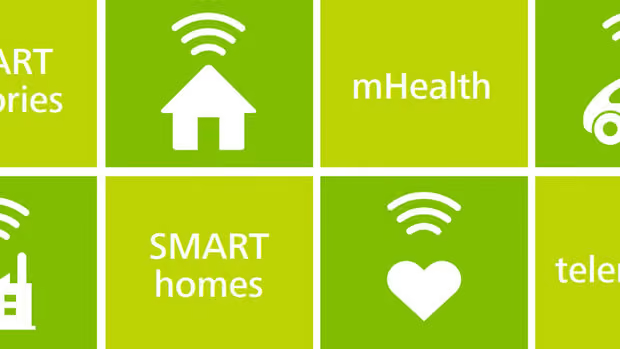
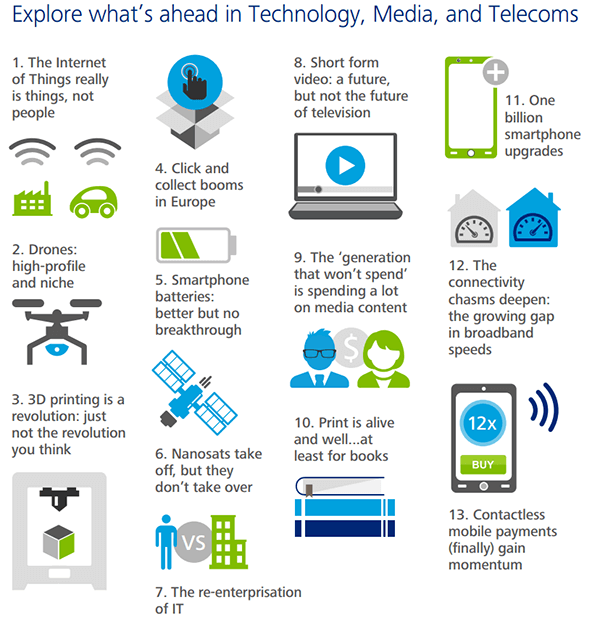
The report anticipates innovation swinging from consumer to enterprise, with contactless mobile payments—an area where Australians have been early adopters—acting as a tipping point.
What percentage of services revenue is predicted to be enterprise rather than consumer, according to the report?
According to the report, 90% of the services revenue generated will be enterprise, not consumer.
What does the report predict about enterprise use of wireless Internet of Things (IoT) devices?
The report predicts that 60% of all wireless Internet of Things (IoT) devices will be bought, paid for and used by enterprises.
How many wireless IoT devices does the report predict will be shipped in 2015, and what installed base will this create?
The report predicts 1 billion wireless IoT devices will be shipped in 2015, up 60% from 2014, leading to an installed base of 2.8 billion devices.
What are the three pillars covered in Deloitte's TMT Predictions report?
The report provides insight into predictions across three pillars: technology, media, and telecommunications.
Where can readers download the full Deloitte TMT Predictions 2015 report?
Readers can download the Deloitte TMT Predictions 2015 report at landing.deloitte.com.au/TMT-Predictions-2015_Registration.html, though registration is required for the PDF.
Images on This Page
-
https://cdn.prod.website-files.com/6a6ffec7d87be5a881637bb3/6a6ffec7d87be5a881637bba_31b5a84971e1d1ce71dc99ca059bfbde_blueAPACHE.svg
blueAPACHE logo on a dark blue background
-
https://cdn.prod.website-files.com/6a70181278f802e23979d547/6a701c0fddcde676dc9f3222_6518e27241f5332d32eaa18ba1ab1591.avif
(no alt text)
-
https://cdn.prod.website-files.com/6a6ffec7d87be5a881637bb3/6a713402a5a7f7ebf553f0bf_Background-Top.avif
(no alt text)
-
https://cdn.prod.website-files.com/6a70181278f802e23979d547/6a701c13ddcde676dc9f32d4_Deloitte-Small.png
Deloitte Small
-
https://cdn.prod.website-files.com/6a70181278f802e23979d547/6a701c13ddcde676dc9f32d1_Deloitte-Large.png
Deloitte Large
-
https://cdn.prod.website-files.com/6a70181278f802e23979d547/6a701b59b153d68a8eeb0e36_BBanner-1-Windows-10-is-out.-AI-is-in.-.avif
You’ve Invest in Security. So Why Are Breaches Still Happening?
-
https://cdn.prod.website-files.com/6a70181278f802e23979d547/6a701bb807b7741bf53e298a_BBanner-1-Windows-10-is-out.-AI-is-in.-8.avif
EOFY 2026: The Reset Is Done – Now It’s About Getting Ahead
-
https://cdn.prod.website-files.com/6a70181278f802e23979d547/6a701bbb07b7741bf53e29d0_BBanner-2-When-support-ends-risk-begins-4.avif
Why Every Business Needs AI Guardrails
-
https://cdn.prod.website-files.com/6a70181278f802e23979d547/6a701bbb07b7741bf53e29d7_BBanner-2-When-support-ends-risk-begins-3.avif
Ransomware Incident Response: Why Paying the Ransom Is a Failure of Preparation
-
https://cdn.prod.website-files.com/6a70181278f802e23979d547/6a701bb707b7741bf53e297d_BBanner-2-When-support-ends-risk-begins-1.avif
The 7 Cyber Truths Boards Must Act On In 2026
-
https://cdn.prod.website-files.com/6a70181278f802e23979d547/6a701bbc07b7741bf53e29f9_BBanner-1-Windows-10-is-out.-AI-is-in.-7.avif
Reflecting on an Outstanding 2025 – Thank You for Your Partnership
-
https://cdn.prod.website-files.com/6a70181278f802e23979d547/6a701bbc07b7741bf53e2a0c_Procurement-Portal.avif
The blueAPACHE e-Store: IT purchasing made simple
-
https://cdn.prod.website-files.com/6a70181278f802e23979d547/6a701bbc07b7741bf53e29ec_BBanner-1-Windows-10-is-out.-AI-is-in.-5.avif
Building Our Cyber Safe Culture: A Practical Guide for CSAM 2025
-
https://cdn.prod.website-files.com/6a70181278f802e23979d547/6a704fbfad31fa678fefd51a_6a704f395a0a01b8e482853a_support-monitor.svg
(no alt text)
-
https://cdn.prod.website-files.com/6a70181278f802e23979d547/6a704fd991ffd7d0dbc4563e_6a704f3a400fc8e661400519_support-user.svg
(no alt text)
-
https://cdn.prod.website-files.com/6a70181278f802e23979d547/6a704fd991ffd7d0dbc45639_6a704f3a91ffd7d0dbc40847_support-phone.svg
(no alt text)
-
https://cdn.prod.website-files.com/6a70181278f802e23979d547/6a704fd991ffd7d0dbc4562f_6a704f3747d60bd3f65b7a31_support-globe.svg
(no alt text)
-
https://cdn.prod.website-files.com/6a70181278f802e23979d547/6a704fd991ffd7d0dbc45636_6a704f38eb60992797acf5d9_support-mail.svg
(no alt text)
-
https://cdn.prod.website-files.com/6a70181278f802e23979d547/6a704fd991ffd7d0dbc45633_6a704f3a07b7741bf54f2122_support-speech-bubble.svg
(no alt text)
-
https://cdn.prod.website-files.com/6a6ffec7d87be5a881637bb3/6a707520ca872d1b5a69a518_Sensiba.avif
Sensiba ISO/IEC 27001 Certified badge with a diamond-shaped logo below the text.