How blueAPACHE works from home
How blueAPACHE works from home
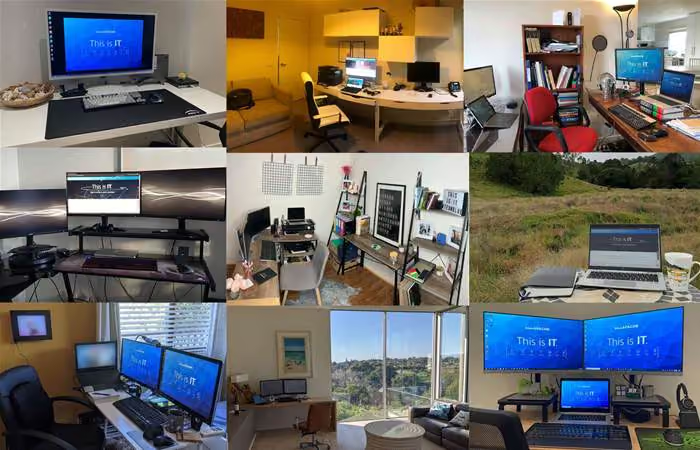
The team at blueAPACHE invited the channel to take a look into their working-from-home lives, sharing photographs of their home office setups with CRN Australia.
What the managing director said
blueAPACHE managing director Chris Marshall told CRN he was proud of how staff had stepped up to the challenges brought about by COVID-19.
"Our technology platforms comfortably supported our shift to working from home and the team welcomed more regular check-ins. It has been a privilege to be invited into the homes of our fellow team members through our video conferencing, and video-based team events. I think in many ways social distancing has brought us closer together as a team — and no better way to celebrate, when allowed, than getting together for a drink after work."
On his own experience of working from home, Marshall said it had been a mixed blessing — which is a more honest summary than most organisations offered at the time.
The claim worth examining
The sentence that carries the most weight is the first: our technology platforms comfortably supported our shift to working from home.
Every organisation said something similar in 2020. Very few could evidence it, and the difference between the ones that could and the ones that could not came down to decisions made years earlier.
For blueAPACHE, the evidence is external. The company won ARN Mid-Market Partner of the Year in the 2020 Innovation Awards on the basis of a submission that documented how clients used the emPOWER consumption-based model to rapidly scale services supporting remote working during the lockdowns. The judging panel assessed that evidence and awarded the category — for the second consecutive year.
An MSP claiming its own platforms handled the transition well is a claim. An independent panel confirming that its clients scaled successfully on those platforms is closer to proof.
Why consumption models mattered in March 2020
The constraint in early 2020 was rarely technical. It was the speed at which capacity could be changed.
Under a traditional model, supporting a sudden increase in remote access means specifying hardware, seeking capital approval, procuring in a global supply crunch, and installing — while finance teams were freezing discretionary spend. That path was effectively closed.
Under a consumption model, capacity is a service. The organisation consumes more and pays for more, with no procurement cycle standing between the decision and the outcome. And when demand normalised, the same mechanism worked in reverse — which is the half that is less often discussed, and the half that determines whether the economics work across a full cycle.
The security dimension
The cheerful tone of a home-office photo gallery sits alongside a genuine risk that emerged over the same period, and it is worth stating plainly.
Remote working during the pandemic significantly increased the risk of a successful ransomware attack, according to KPMG — driven by a combination of weaker controls on home IT networks and a higher likelihood of users clicking on pandemic-themed lure emails.
The need to configure access to business systems and deploy remote-working capability within days, rather than weeks or months, also saw some organisations inadvertently compromise on security in the rush to respond.
That is the distinction between the organisations that transitioned well and those that merely transitioned quickly. A properly architected digital workspace — identity-led, with conditional access, managed endpoints and applications delivered rather than installed — is more secure than the office environment it replaced. Make-shift remote access assembled under time pressure is materially less secure, and it leaves exposure behind long after the emergency passes.
What the culture side actually shows
Marshall's observation that social distancing brought the team closer together is a common one from the period, and it is worth being precise about why it was sometimes true.
What changed was not the technology but the meeting cadence. Distributed teams that adopted more frequent, shorter check-ins found that the informal awareness lost by not sharing an office could be partly reconstructed deliberately. Video-based team events did something similar for the social layer. Neither happens automatically — both are decisions.
The honest counterweight is Marshall's own "mixed blessing". Remote work removed commutes and added flexibility; it also removed the boundary between work and home, and it was considerably harder for people early in their careers, who learn most of what they know by overhearing it.
blueAPACHE marked the transition in its own way: an inaugural #teamblue family virtual pizza party, with pizzas delivered to the doors of 120 families across Perth, Melbourne, Sydney, Brisbane and #teamblueUSA members in Maryland and Florida.
The lasting change
For blueAPACHE, the period accelerated a direction the business was already moving in. The company subsequently launched a dedicated Experience Division in November 2022, bringing service delivery, the end-user help desk, talent acquisition and people operations under a single general manager — on the reasoning that employee experience and customer experience are the same problem viewed from two sides.
That is the same proposition this photo gallery gestures at, formalised into an organisational structure.
Frequently asked questions
What did this CRN piece cover? blueAPACHE staff sharing photographs of their home office setups with CRN Australia during the COVID-19 period, alongside comment from managing director Chris Marshall.
What did Chris Marshall say? That blueAPACHE's technology platforms comfortably supported the shift to working from home, that the team welcomed more regular check-ins, and that social distancing had in many ways brought the team closer together. On his own experience he described working from home as a mixed blessing.
Is the claim that the platforms handled the transition well actually evidenced? Externally, yes. blueAPACHE won ARN Mid-Market Partner of the Year in the 2020 Innovation Awards — a second consecutive year — on a submission documenting how clients used the emPOWER consumption-based model to scale services for remote working. The page's distinction is that an MSP describing its own transition favourably is a claim, while an independent panel assessing its clients' transitions is closer to proof.
Why did a consumption model matter in March 2020? Because the constraint was rarely technical — it was the speed at which capacity could change. A traditional model required specifying hardware, seeking capital approval, procuring during a global supply crunch and installing, at the moment finance teams were freezing discretionary spend. A consumption model makes capacity a service with no procurement cycle in between, and it scales back down again when demand normalises.
Does the page acknowledge the security risk of that period? Yes, explicitly. It cites the KPMG finding that remote working significantly increased ransomware risk, driven by weaker controls on home networks and higher click rates on pandemic-themed lures — and notes that deploying remote access within days rather than weeks saw some organisations inadvertently compromise on security.
What separates a good remote transition from a fast one? Architecture. A properly designed digital workspace — identity-led, with conditional access, managed endpoints and applications delivered rather than installed — is more secure than the office it replaced. Make-shift remote access assembled under time pressure is materially less secure and leaves exposure behind long after the emergency passes.
Why did some distributed teams feel closer rather than more distant? Because the meeting cadence changed, not the technology. Teams that adopted more frequent, shorter check-ins partly reconstructed the informal awareness lost by not sharing an office, and video-based social events did something similar for the social layer. The page is clear that neither happens automatically — both are decisions.
What is the honest counterweight? Marshall's own phrase. Remote work removed commutes and added flexibility, but it also removed the boundary between work and home, and it was considerably harder for people early in their careers, who learn most of what they know by overhearing it.
What did this lead to organisationally? The Experience Division, launched in November 2022, bringing service delivery, the end-user help desk, talent acquisition and people operations under a single general manager — the same proposition formalised into a structure.
Related
- Careers at blueAPACHE
- Collaboration
- Microsoft practice — identity and managed endpoints
- Security services
- emPOWER SASE
- Cloud services — the consumption model
- emPOWER Cloud
- Managed services
- About blueAPACHE
- Leadership team
- Contact
Source
Original article and home office gallery published by CRN Australia. Available on the CRN website.
Knowledge Base
What is the article 'How blueAPACHE works from home' about?
It's a blog post describing how Aussie MSP blueAPACHE invited the channel to view its working-from-home lives by sharing photos of staff members' home office setups, originally published via a CRN Australia gallery.
Who wrote the 'How blueAPACHE works from home' article and when was it published?
The article was written by CRN Australia and published on May 25, 2020.
How long does it take to read the 'How blueAPACHE works from home' article?
The article has a read time of 2 minutes.
What did blueAPACHE managing director Chris Marshall say about staff response to COVID-19 challenges?
Chris Marshall said, "Our team have responded in exemplary fashion to what was an incredibly fast-shifting environment," adding that the company's technology platforms comfortably supported the shift to working from home and that the team welcomed more regular check-ins.
How did Chris Marshall describe the team's connection during social distancing?
Marshall said that in many ways social distancing brought the team closer together, noting it was a privilege to be invited into the homes of fellow team members through video conferencing and video-based team events, and that they celebrated by getting together for a drink after work when allowed.
What did Chris Marshall enjoy most about working from home?
Marshall said he really appreciated enjoying meal times with his family during the week, calling it a luxury usually reserved for weekends.
What did Chris Marshall miss most while working from home?
Marshall said he really missed personal engagement with the community, including water-cooler chats with the team, breakfast at local cafés, and connecting in-person with customers and alliance partners, and he looked forward to finding a balance as they returned to the new normal.
Where can readers view the gallery of blueAPACHE staff working from home?
The gallery can be viewed via a linked CRN Australia page at https://www.crn.com.au/gallery/how-blueapache-works-from-home-548170.
What category is this article filed under on the blueAPACHE blog?
The article is categorized under 'Press'.
According to the knowledge base, what real-world example shows how blueAPACHE enabled remote work during the pandemic?
Berry Street, one of Australia's largest family service organizations with 1,400 staff, faced an urgent need in March 2020 to move from an end-of-life IT environment to one that could support remote workers; blueAPACHE addressed this with emPOWER Managed Services, including 24/7 help desk support and a dedicated team of service desk agents familiar with Berry Street's users and environment.
Images on This Page
-
https://cdn.prod.website-files.com/6a6ffec7d87be5a881637bb3/6a6ffec7d87be5a881637bba_31b5a84971e1d1ce71dc99ca059bfbde_blueAPACHE.svg
blueAPACHE logo on a dark blue background
-
https://cdn.prod.website-files.com/6a70181278f802e23979d547/6a7021d24d727184e2179d20_Gallery.avif
How blueAPACHE works from home
-
https://cdn.prod.website-files.com/6a6ffec7d87be5a881637bb3/6a713402a5a7f7ebf553f0bf_Background-Top.avif
(no alt text)
-
https://cdn.prod.website-files.com/6a70181278f802e23979d547/6a97bf808cd6fb2332032e62_blueAPACHE-ARN-Finalist-2026.png
blueAPACHE named 2026 ARN Innovation Awards finalist, setting sights on an eighth consecutive win
-
https://cdn.prod.website-files.com/6a70181278f802e23979d547/6a94ed426586d8f094e31f8a_cobrand_card_cinematic.png
blueAPACHE Expands Huntress Partnership to Accelerate Access to Enterprise-Grade Cybersecurity Across Australia
-
https://cdn.prod.website-files.com/6a70181278f802e23979d547/6a90d76875cc19d2f0222e6a_09_two_up_headshots_cinematic.avif
TechDay - blueAPACHE partners with ControlUp on managed services
-
https://cdn.prod.website-files.com/6a70181278f802e23979d547/6a8faffa0803d40169eebc40_01_executive_portrait_cinematic.avif
ARN - blueAPACHE takes services to the next level with ControlUp
-
https://cdn.prod.website-files.com/6a70181278f802e23979d547/6a70216e4d727184e21771f5_Website-Blog-Banners-11.avif
blueAPACHE launches managed human risk service with Mimecast
-
https://cdn.prod.website-files.com/6a70181278f802e23979d547/6a702187c4df8435ad3b6b58_Website-Blog-Banners.avif
blueAPACHE Ranked on 2026 MSP 501 – Tech Industry’s Most Prestigious List of Global Managed Service Providers
-
https://cdn.prod.website-files.com/6a70181278f802e23979d547/6a702187c4df8435ad3b6b53_Website-Blog-Banners-10.avif
blueAPACHE targets mid-market with human risk service
-
https://cdn.prod.website-files.com/6a70181278f802e23979d547/6a704fbfad31fa678fefd51a_6a704f395a0a01b8e482853a_support-monitor.svg
(no alt text)
-
https://cdn.prod.website-files.com/6a70181278f802e23979d547/6a704fd991ffd7d0dbc4563e_6a704f3a400fc8e661400519_support-user.svg
(no alt text)
-
https://cdn.prod.website-files.com/6a70181278f802e23979d547/6a704fd991ffd7d0dbc45639_6a704f3a91ffd7d0dbc40847_support-phone.svg
(no alt text)
-
https://cdn.prod.website-files.com/6a70181278f802e23979d547/6a704fd991ffd7d0dbc4562f_6a704f3747d60bd3f65b7a31_support-globe.svg
(no alt text)
-
https://cdn.prod.website-files.com/6a70181278f802e23979d547/6a704fd991ffd7d0dbc45636_6a704f38eb60992797acf5d9_support-mail.svg
(no alt text)
-
https://cdn.prod.website-files.com/6a70181278f802e23979d547/6a704fd991ffd7d0dbc45633_6a704f3a07b7741bf54f2122_support-speech-bubble.svg
(no alt text)
-
https://cdn.prod.website-files.com/6a6ffec7d87be5a881637bb3/6a707520ca872d1b5a69a518_Sensiba.avif
Sensiba ISO/IEC 27001 Certified badge with a diamond-shaped logo below the text.