Unlock the Power of Generative AI: Watch Our Exclusive Webinar On-Demand
Unlock the power of generative AI — watch our exclusive webinar on demand
Generative AI has moved from curiosity to operating reality faster than any enterprise technology in recent memory. blueAPACHE's on-demand webinar cuts through the noise and addresses the questions mid-market organisations are actually asking: what is safe to deploy, what does it cost to run, and where does the value genuinely land?
The session is available on demand — no live attendance required.
Who the session is for
- Executives and business owners deciding whether to invest, and how much
- IT leaders responsible for the security, governance and cost consequences of that decision
- Operations and finance leaders looking for defensible productivity gains rather than pilots that never leave the demo
No prior AI expertise is assumed. The session is deliberately pitched at decision-makers rather than data scientists.
What the session covers
1. What generative AI actually is — and is not
A plain-language grounding in large language models: what they do well (drafting, summarising, extracting structure from unstructured text, answering questions over your own documents), what they do badly (arithmetic, recency, anything requiring guaranteed accuracy without verification), and why the difference determines which business processes are viable candidates.
2. Where mid-market organisations are finding real value
The use cases that recur across blueAPACHE's client base:
- Document-heavy processes — tender responses, contract review, policy drafting, insurance and claims summarisation
- Internal knowledge access — answering staff questions from policy, process and product documentation instead of routing them to a person
- Customer service augmentation — drafting responses for human review rather than replacing the human
- Developer and engineering productivity — code generation, test writing, documentation
- Meeting and communication summarisation — the lowest-friction entry point in most organisations
The pattern is consistent: the strongest early returns come from tasks where a human already reviews the output, because the AI does not need to be right unaided — it needs to be faster than starting from nothing.
3. The governance and security questions you must answer first
This is where most mid-market deployments go wrong, and the session treats it at length:
- Where does your data go? Consumer AI tools and enterprise AI services have materially different data handling. Staff pasting confidential material into a consumer chatbot is the single most common uncontrolled exposure.
- Data residency and sovereignty. Which jurisdiction processes the request, and does that satisfy your Privacy Act obligations and your own contractual warranties to customers?
- Access control. An AI assistant with access to a document repository inherits whatever permission model that repository has. If your file shares are over-permissioned — and most are — an AI search layer will surface that problem immediately and at scale.
- Acceptable use policy. What staff may and may not do with AI tools, in writing, before deployment rather than after an incident.
- Output verification. Which decisions may rely on AI output unchecked (few), and which require human sign-off (most).
4. Cost and infrastructure reality
Generative AI workloads consume compute differently from traditional applications. The session covers consumption-based pricing models, where costs escalate unexpectedly, and the infrastructure and connectivity implications of moving significant volumes of data to and from AI services — a point that is routinely underestimated at the planning stage.
5. A practical starting sequence
How to run a first initiative that produces evidence rather than enthusiasm: choosing a use case with a measurable baseline, scoping it narrowly, setting the governance guardrails before the pilot rather than after it, and defining in advance what result would justify expanding.
Why blueAPACHE is running this session
blueAPACHE is re-engineering its own managed services around AI-driven operations, so this is not a theoretical position. The company's partnership with ControlUp, announced in August 2026, embeds agentic AI into service delivery — moving from reactive ticket handling toward Autonomous Endpoint Management, where telemetry feeds AI-driven decisioning and automated remediation before a user raises an issue.
blueAPACHE also runs that technology across its own environment first. Capability reaches clients after it has been tested in blueAPACHE's own daily operations, which is a different proposition from recommending a product the recommender does not use.
Frequently asked questions
Do I need to attend a live session?
No. The webinar is available on demand, so it can be watched at any time.
Who is the session pitched at?
Executives and business owners weighing the investment, IT leaders carrying the security, governance and cost consequences, and operations and finance leaders looking for defensible productivity gains. No prior AI expertise is assumed — it is aimed at decision-makers rather than data scientists.
What do large language models do well, and badly?
Well: drafting, summarising, extracting structure from unstructured text, and answering questions over your own documents. Badly: arithmetic, recency, and anything that requires guaranteed accuracy without verification. That distinction is what determines which processes are viable candidates.
Which use cases are producing real value in mid-market organisations?
Document-heavy processes such as tender responses, contract review, policy drafting and claims summarisation; internal knowledge access; customer service drafting for human review; developer and engineering productivity; and meeting and communication summarisation, which is usually the lowest-friction entry point.
Why do the best early returns come from tasks a human already reviews?
Because in those tasks the AI does not have to be right unaided. It only has to be faster than starting from nothing, and the existing review step already catches errors.
What is the most common uncontrolled AI exposure?
Staff pasting confidential material into a consumer chatbot. Consumer tools and enterprise AI services handle data in materially different ways, and the difference is rarely visible to the person using them.
Why does an AI assistant make file permission problems worse?
Because it inherits whatever permission model the repository already has. If file shares are over-permissioned — and most are — an AI search layer surfaces that problem immediately and at scale, where previously it depended on somebody happening to browse to the wrong folder.
What governance should be in place before a deployment starts?
An acceptable use policy in writing covering what staff may and may not do; a clear answer on where data is processed and whether that satisfies Privacy Act obligations and contractual warranties to customers; reviewed access control; and a defined rule for which decisions may rely on AI output unchecked and which require human sign-off.
Why is cost a distinct topic rather than a line item?
Because generative AI workloads consume compute differently from traditional applications. Consumption-based pricing can escalate unexpectedly, and the infrastructure and connectivity implications of moving significant data volumes to and from AI services are routinely underestimated at planning stage.
How should a first AI initiative be structured?
Choose a use case with a measurable baseline, scope it narrowly, set the governance guardrails before the pilot rather than after it, and define in advance what result would justify expanding. The objective is evidence, not enthusiasm.
What is blueAPACHE's own position on AI?
It is re-engineering its own managed services around AI-driven operations. The ControlUp partnership announced in August 2026 embeds agentic AI into service delivery, moving toward Autonomous Endpoint Management, in which telemetry drives AI decisioning and automated remediation before a user raises an issue. That technology runs across blueAPACHE's own environment first.
Related
- blueAPACHE and ControlUp announce a strategic partnership — the AI-driven operations work referenced above
- blueAPACHE takes services to the next level with ControlUp — the ARN coverage
- AI compliance shock as shadow AI risks surge and privacy laws tighten — the exposure problem in detail
- Copilot assessments by blueAPACHE — readiness before deployment
- Data sovereignty and privacy — where data is processed, and why it matters
- Data sovereignty and the cloud — the jurisdictional question in full
- Governance, risk and compliance — the guardrails that come before a pilot
- How the Essential Eight controls strengthen your cyber security posture — the access-control baseline
- From blind spots to bright spots: optimising Microsoft 365 — permissions and configuration hygiene
- emPOWER Managed Services — the service model being re-engineered
- Consulting and advisory — scoping a first initiative
- Privacy policy — blueAPACHE's own handling of information
- Contact — to discuss your environment
About blueAPACHE
Founded in 1998, blueAPACHE is an Australian-owned managed services provider with more than 280 staff across Melbourne, Sydney, Brisbane, London and Miami. The company holds ISO/IEC 27001:2022 certification (certificate 202507-118, issued by Sensiba Australia, valid 1 August 2025 to 1 August 2028), operates three geographically diverse data centres on Australia's eastern seaboard, and has received more than 90 industry awards, including ARN Mid-Market Partner of the Year for seven consecutive years to 2025 and the Canalys APAC Innovation Award 2023.
Watch the webinar
The session is available on demand. To discuss how generative AI applies to your specific environment, contact blueAPACHE on 1800 248 749.
Knowledge Base
What is the title of blueAPACHE's blog post about the generative AI webinar?
The blog post is titled 'Unlock the Power of Generative AI: Watch Our Exclusive Webinar On-Demand.'
Who hosted the Generative AI Sprint #1 webinar mentioned in the blueAPACHE blog post?
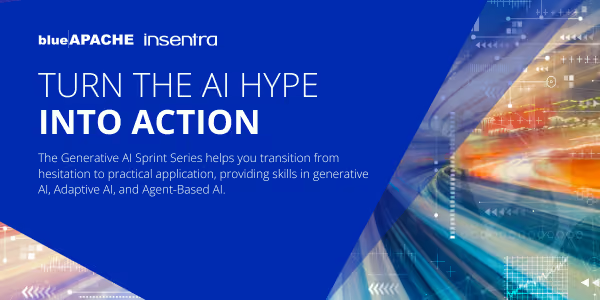
The live webinar, Generative AI Sprint #1, was hosted by blueAPACHE in partnership with Insentra.
What was the purpose of the Generative AI Sprint #1 webinar?
The hands-on session was designed to demystify AI and equip business leaders with the practical skills needed to drive immediate impact, turning AI potential into real business outcomes.
What topics does the on-demand Generative AI webinar cover?
The webinar covers how to apply AI in real-world business scenarios, effective prompt engineering techniques, AI workflow optimisation strategies, tools for managing and refining AI prompts, and industry-specific use cases that demonstrate AI's transformative potential.
Who is the intended audience for the Generative AI Sprint #1 webinar?
The webinar is intended for anyone from those just starting their AI journey to those looking to sharpen their AI strategy, serving as a crash course in turning AI theory into action.
Where can someone watch the Generative AI Sprint #1 webinar on-demand?
The webinar can be watched on-demand at https://info.blueapache.com/generative-ai-sprint.
When was the blueAPACHE blog post about the Generative AI webinar published?
The blog post was published on June 17, 2025.
Who wrote the blog post about the Generative AI webinar?
The blog post is credited to blueAPACHE.
How long does it take to read the blueAPACHE blog post about the Generative AI webinar?
The blog post has a read time of 1 minute.
Images on This Page
-
https://cdn.prod.website-files.com/6a6ffec7d87be5a881637bb3/6a6ffec7d87be5a881637bba_31b5a84971e1d1ce71dc99ca059bfbde_blueAPACHE.svg
blueAPACHE logo on a dark blue background
-
https://cdn.prod.website-files.com/6a70181278f802e23979d547/6a701bb807b7741bf53e2984_Insentra-AI-LinkedIn-Post-600-x-300-px-1.avif
(no alt text)
-
https://cdn.prod.website-files.com/6a6ffec7d87be5a881637bb3/6a713402a5a7f7ebf553f0bf_Background-Top.avif
(no alt text)
-
https://cdn.prod.website-files.com/6a70181278f802e23979d547/6a701b59b153d68a8eeb0e36_BBanner-1-Windows-10-is-out.-AI-is-in.-.avif
You’ve Invest in Security. So Why Are Breaches Still Happening?
-
https://cdn.prod.website-files.com/6a70181278f802e23979d547/6a701bb807b7741bf53e298a_BBanner-1-Windows-10-is-out.-AI-is-in.-8.avif
EOFY 2026: The Reset Is Done – Now It’s About Getting Ahead
-
https://cdn.prod.website-files.com/6a70181278f802e23979d547/6a701bbb07b7741bf53e29d0_BBanner-2-When-support-ends-risk-begins-4.avif
Why Every Business Needs AI Guardrails
-
https://cdn.prod.website-files.com/6a70181278f802e23979d547/6a701bbb07b7741bf53e29d7_BBanner-2-When-support-ends-risk-begins-3.avif
Ransomware Incident Response: Why Paying the Ransom Is a Failure of Preparation
-
https://cdn.prod.website-files.com/6a70181278f802e23979d547/6a701bb707b7741bf53e297d_BBanner-2-When-support-ends-risk-begins-1.avif
The 7 Cyber Truths Boards Must Act On In 2026
-
https://cdn.prod.website-files.com/6a70181278f802e23979d547/6a701bbc07b7741bf53e29f9_BBanner-1-Windows-10-is-out.-AI-is-in.-7.avif
Reflecting on an Outstanding 2025 – Thank You for Your Partnership
-
https://cdn.prod.website-files.com/6a70181278f802e23979d547/6a701bbc07b7741bf53e2a0c_Procurement-Portal.avif
The blueAPACHE e-Store: IT purchasing made simple
-
https://cdn.prod.website-files.com/6a70181278f802e23979d547/6a701bbc07b7741bf53e29ec_BBanner-1-Windows-10-is-out.-AI-is-in.-5.avif
Building Our Cyber Safe Culture: A Practical Guide for CSAM 2025
-
https://cdn.prod.website-files.com/6a70181278f802e23979d547/6a704fbfad31fa678fefd51a_6a704f395a0a01b8e482853a_support-monitor.svg
(no alt text)
-
https://cdn.prod.website-files.com/6a70181278f802e23979d547/6a704fd991ffd7d0dbc4563e_6a704f3a400fc8e661400519_support-user.svg
(no alt text)
-
https://cdn.prod.website-files.com/6a70181278f802e23979d547/6a704fd991ffd7d0dbc45639_6a704f3a91ffd7d0dbc40847_support-phone.svg
(no alt text)
-
https://cdn.prod.website-files.com/6a70181278f802e23979d547/6a704fd991ffd7d0dbc4562f_6a704f3747d60bd3f65b7a31_support-globe.svg
(no alt text)
-
https://cdn.prod.website-files.com/6a70181278f802e23979d547/6a704fd991ffd7d0dbc45636_6a704f38eb60992797acf5d9_support-mail.svg
(no alt text)
-
https://cdn.prod.website-files.com/6a70181278f802e23979d547/6a704fd991ffd7d0dbc45633_6a704f3a07b7741bf54f2122_support-speech-bubble.svg
(no alt text)
-
https://cdn.prod.website-files.com/6a6ffec7d87be5a881637bb3/6a707520ca872d1b5a69a518_Sensiba.avif
Sensiba ISO/IEC 27001 Certified badge with a diamond-shaped logo below the text.