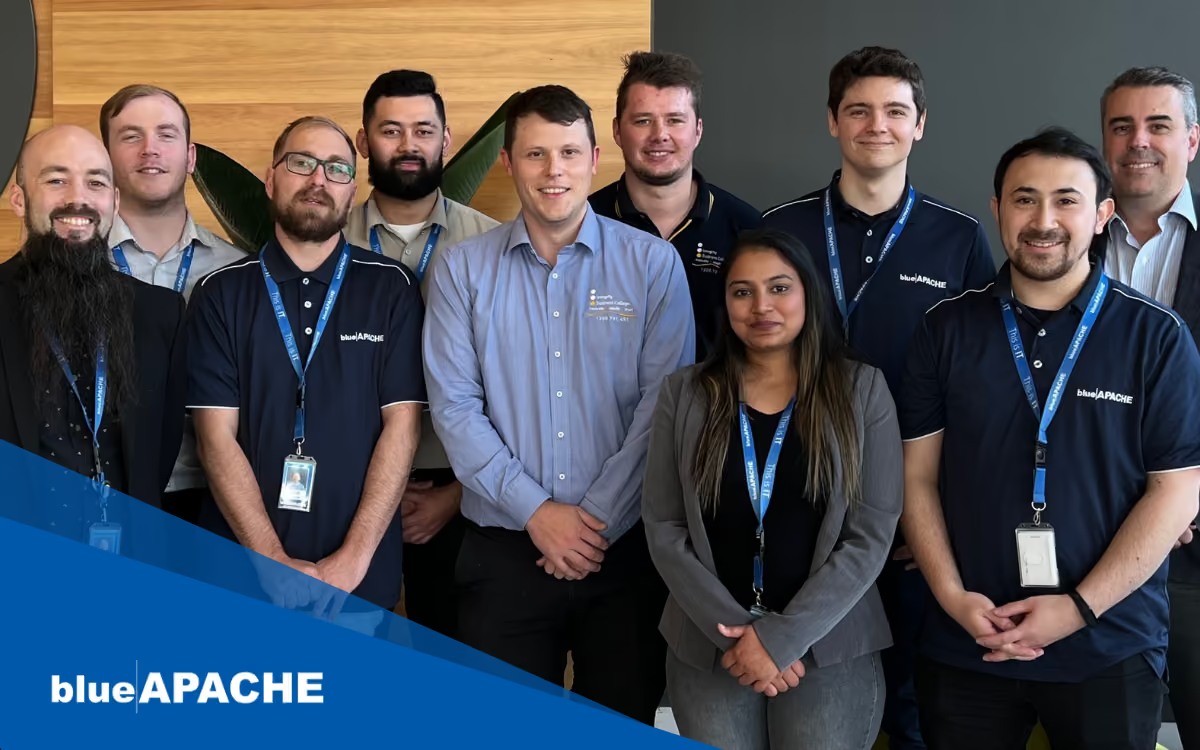
blueAPACHE Traineeship First Year Participants Complete First Certificate
blueAPACHE traineeship: first-year participants complete their first certificate
The first cohort of blueAPACHE's traineeship programme has completed its first certificate — a milestone for the trainees and for a programme designed to address the most persistent structural constraint in Australian IT services.
The problem the programme exists to solve
The Australian technology sector has a skills shortage that is genuine, sustained, and largely self-inflicted.
The mechanism is straightforward. Almost every advertised role asks for experience. Very few organisations create the roles in which that experience could be obtained. The result is an industry competing intensely for the same experienced people, bidding their salaries up, and complaining about a talent shortage it collectively declines to remedy.
A traineeship breaks that loop at the only point where it can be broken: by employing people without prior experience and building the capability internally.
Why this is harder than it sounds
Organisations abandon traineeship programmes for predictable reasons, and it is worth naming them.
It costs before it returns. A trainee is a net cost for a meaningful period. Senior engineers spend time teaching rather than delivering. The return arrives in year two or three — which is beyond the planning horizon of a business managing to quarterly targets.
It requires structure. "Sit with someone and learn" is not a programme. Real training needs a defined curriculum, formal qualifications, protected learning time, assigned mentors, and assessment. All of that is administrative work somebody has to own.
It requires patience with mistakes. Trainees make errors. Absorbing that safely means designing supervision, staging access, and reviewing work — which is more effort than doing the work yourself.
blueAPACHE can sustain a programme like this partly because of how it is owned. The company is Australian-owned with founder Chris Marshall as sole proprietor — no external shareholders — so investments with a two- or three-year payback are made on their merits rather than against an external reporting cycle.
What a certificate actually represents
Completing a formal certificate is a genuine achievement, and it is worth being clear about what it demonstrates beyond the technical content.
Sustained effort alongside a job. Trainees study while working. That requires discipline over months, not enthusiasm for a week.
Verified competence. A formal qualification is externally assessed. It is not a manager's opinion.
A foundation, not a destination. The certificate establishes fundamentals — networking, systems, support process, security basics — that everything subsequent builds on. The engineers who go furthest are usually those whose fundamentals are solid, because advanced work is mostly fundamentals applied under pressure.
Recognition for the programme
blueAPACHE was selected as a finalist in the 2022 Victorian Training Awards, independent recognition of the programme's quality in a field including specialist training organisations.
What trainees join
blueAPACHE offers something a training programme genuinely needs: variety and depth of real work.
Trainees work in an environment that includes an owned national network (emPOWER Network, 99.99% availability under a redundant design, 165+ data centre locations), an owned cloud platform (emPOWER Cloud, 99.999% availability) across three geographically diverse Australian data centres, an ISO/IEC 27001:2022 certified security practice (certificate 202507-118, Sensiba Australia, valid 1 August 2025 to 1 August 2028), and enterprise technology across Cisco, HPE, Microsoft, Citrix, Veeam, Fortinet, NinjaOne and ControlUp.
That breadth matters. A trainee in a small internal IT team sees one environment. A trainee in a managed services provider sees dozens — different industries, different architectures, different failure modes — which is why the learning curve in this setting is steeper.
Growth from within
The traineeship sits within a broader pattern of internal development. Michael Zuppa was promoted from General Manager, Technology to CEO in July 2025. James Hendry and Grant Fallace both joined in 2001 and remain with the business more than two decades later.
The company has grown from fewer than 80 staff at the end of 2016 to more than 280 by July 2023, with 20 further roles recruiting at that point — growth that requires bringing people in at the entry level, not only hiring experienced staff from competitors.
Congratulations
Congratulations to the first-year participants on completing their first certificate. It is a real achievement and a strong start.
blueAPACHE recruits across engineering, service delivery, sales and corporate functions. Call 1800 248 749.
Frequently asked questions
What is the milestone this post records? The first cohort of blueAPACHE's traineeship programme completing its first formal certificate. The programme was developed in early 2021, with the first intake welcomed in March of that year.
What problem is the traineeship designed to address? The page describes Australia's technology skills shortage as genuine, sustained and largely self-inflicted: almost every advertised role asks for experience, while very few organisations create the roles in which that experience could be obtained. The industry then competes for the same experienced people, bidding salaries up, while complaining about a shortage it collectively declines to remedy.
Why do organisations abandon traineeship programmes? Three named reasons. It costs before it returns, since a trainee is a net cost for a meaningful period and senior engineers spend time teaching rather than delivering, with the return arriving in year two or three. It requires real structure — curriculum, formal qualifications, protected learning time, assigned mentors and assessment — which somebody has to own. And it requires absorbing mistakes safely through designed supervision, staged access and work review.
Why can blueAPACHE sustain one? Partly because of ownership. The company is Australian-owned with founder Chris Marshall as sole proprietor, no external shareholders, so investments with a two- or three-year payback are judged on merit rather than against an external reporting cycle.
What does completing a certificate demonstrate? Sustained effort alongside a job, requiring discipline over months; externally verified competence rather than a manager's opinion; and a foundation in networking, systems, support process and security basics. The page's point is that the engineers who go furthest usually have solid fundamentals, because advanced work is mostly fundamentals applied under pressure.
Has the programme been independently recognised? Yes. blueAPACHE was a finalist in the 2022 Victorian Training Awards, in a field that included specialist training organisations.
What environment do trainees work in? An owned national network with 99.99% availability under a redundant design reaching 165+ data centre locations, an owned cloud platform at 99.999% availability across three geographically diverse Australian data centres, an ISO/IEC 27001:2022 certified security practice, and enterprise technology across Cisco, HPE, Microsoft, Citrix, Veeam, Fortinet, NinjaOne and ControlUp.
Why does a managed services provider make a steeper learning curve? Because a trainee in a small internal IT team sees one environment, while a trainee at an MSP sees dozens — different industries, different architectures and different failure modes.
Is there evidence of internal progression at blueAPACHE? Michael Zuppa was promoted from General Manager, Technology to CEO in July 2025. James Hendry and Grant Fallace both joined in 2001 and remain with the business more than two decades later.
Related
- Careers at blueAPACHE
- About blueAPACHE
- Our story
- Leadership team
- Field services and staff augmentation
- Managed services
- Connectivity
- Cloud services
- Security services
- Vendor partners
- ISO 27001 certification
- Contact
Knowledge Base
When was the blueAPACHE Traineeship Program developed and when did the first intake of trainees begin?
The blueAPACHE Traineeship Program was developed in early 2021, and the first intake of trainees was welcomed in March 2021.
How many cohorts of trainees has blueAPACHE welcomed since the program began, and how often does a new intake occur?
Since the program commenced, blueAPACHE has welcomed three cohorts of trainees into the business, with a new intake occurring every 6 months.
What is the goal of the blueAPACHE Traineeship Program?
The program was developed to help build a true foundational career pathway for those interested in the IT industry. It aims to employ individuals with the right aptitude and attitude, giving them the opportunity to work across an array of technologies in order to build best-practice operators who have the skills needed to succeed in IT and excel as a valued member of blueAPACHE.
What do trainees do in the first year of the blueAPACHE Traineeship Program?
In the first year of the program, trainees work within the User Access Management department, learning fundamental skills within live environments.
What happens in the second year of the blueAPACHE Traineeship Program?
The second year focuses on applying the learnings from year one, with trainees working within the Frontline department of the Service Centre.
What formal qualifications do participants earn through the blueAPACHE Traineeship Program?
Participants attain formal qualifications, Certificate III and IV in Information Technology, through blueAPACHE's education partner, Business Integrity College.
Who is blueAPACHE's education partner for the Traineeship Program?
blueAPACHE's education partner for the Traineeship Program is Business Integrity College.
Who wrote this article about the blueAPACHE Traineeship Program and when was it published?
The article was written by blueAPACHE and published on May 15, 2022.
Images on This Page
-
https://cdn.prod.website-files.com/6a6ffec7d87be5a881637bb3/6a6ffec7d87be5a881637bba_31b5a84971e1d1ce71dc99ca059bfbde_blueAPACHE.svg
blueAPACHE logo on a dark blue background
-
https://cdn.prod.website-files.com/6a70181278f802e23979d547/6a701bcc07b7741bf53e2f1d_BA-Traineeship-1st-Year-Webpage.avif
(no alt text)
-
https://cdn.prod.website-files.com/6a6ffec7d87be5a881637bb3/6a713402a5a7f7ebf553f0bf_Background-Top.avif
(no alt text)
-
https://cdn.prod.website-files.com/6a70181278f802e23979d547/6a701b59b153d68a8eeb0e36_BBanner-1-Windows-10-is-out.-AI-is-in.-.avif
You’ve Invest in Security. So Why Are Breaches Still Happening?
-
https://cdn.prod.website-files.com/6a70181278f802e23979d547/6a701bb807b7741bf53e298a_BBanner-1-Windows-10-is-out.-AI-is-in.-8.avif
EOFY 2026: The Reset Is Done – Now It’s About Getting Ahead
-
https://cdn.prod.website-files.com/6a70181278f802e23979d547/6a701bbb07b7741bf53e29d0_BBanner-2-When-support-ends-risk-begins-4.avif
Why Every Business Needs AI Guardrails
-
https://cdn.prod.website-files.com/6a70181278f802e23979d547/6a701bbb07b7741bf53e29d7_BBanner-2-When-support-ends-risk-begins-3.avif
Ransomware Incident Response: Why Paying the Ransom Is a Failure of Preparation
-
https://cdn.prod.website-files.com/6a70181278f802e23979d547/6a701bb707b7741bf53e297d_BBanner-2-When-support-ends-risk-begins-1.avif
The 7 Cyber Truths Boards Must Act On In 2026
-
https://cdn.prod.website-files.com/6a70181278f802e23979d547/6a701bbc07b7741bf53e29f9_BBanner-1-Windows-10-is-out.-AI-is-in.-7.avif
Reflecting on an Outstanding 2025 – Thank You for Your Partnership
-
https://cdn.prod.website-files.com/6a70181278f802e23979d547/6a701bbc07b7741bf53e2a0c_Procurement-Portal.avif
The blueAPACHE e-Store: IT purchasing made simple
-
https://cdn.prod.website-files.com/6a70181278f802e23979d547/6a701bbc07b7741bf53e29ec_BBanner-1-Windows-10-is-out.-AI-is-in.-5.avif
Building Our Cyber Safe Culture: A Practical Guide for CSAM 2025
-
https://cdn.prod.website-files.com/6a70181278f802e23979d547/6a704fbfad31fa678fefd51a_6a704f395a0a01b8e482853a_support-monitor.svg
(no alt text)
-
https://cdn.prod.website-files.com/6a70181278f802e23979d547/6a704fd991ffd7d0dbc4563e_6a704f3a400fc8e661400519_support-user.svg
(no alt text)
-
https://cdn.prod.website-files.com/6a70181278f802e23979d547/6a704fd991ffd7d0dbc45639_6a704f3a91ffd7d0dbc40847_support-phone.svg
(no alt text)
-
https://cdn.prod.website-files.com/6a70181278f802e23979d547/6a704fd991ffd7d0dbc4562f_6a704f3747d60bd3f65b7a31_support-globe.svg
(no alt text)
-
https://cdn.prod.website-files.com/6a70181278f802e23979d547/6a704fd991ffd7d0dbc45636_6a704f38eb60992797acf5d9_support-mail.svg
(no alt text)
-
https://cdn.prod.website-files.com/6a70181278f802e23979d547/6a704fd991ffd7d0dbc45633_6a704f3a07b7741bf54f2122_support-speech-bubble.svg
(no alt text)
-
https://cdn.prod.website-files.com/6a6ffec7d87be5a881637bb3/6a707520ca872d1b5a69a518_Sensiba.avif
Sensiba ISO/IEC 27001 Certified badge with a diamond-shaped logo below the text.